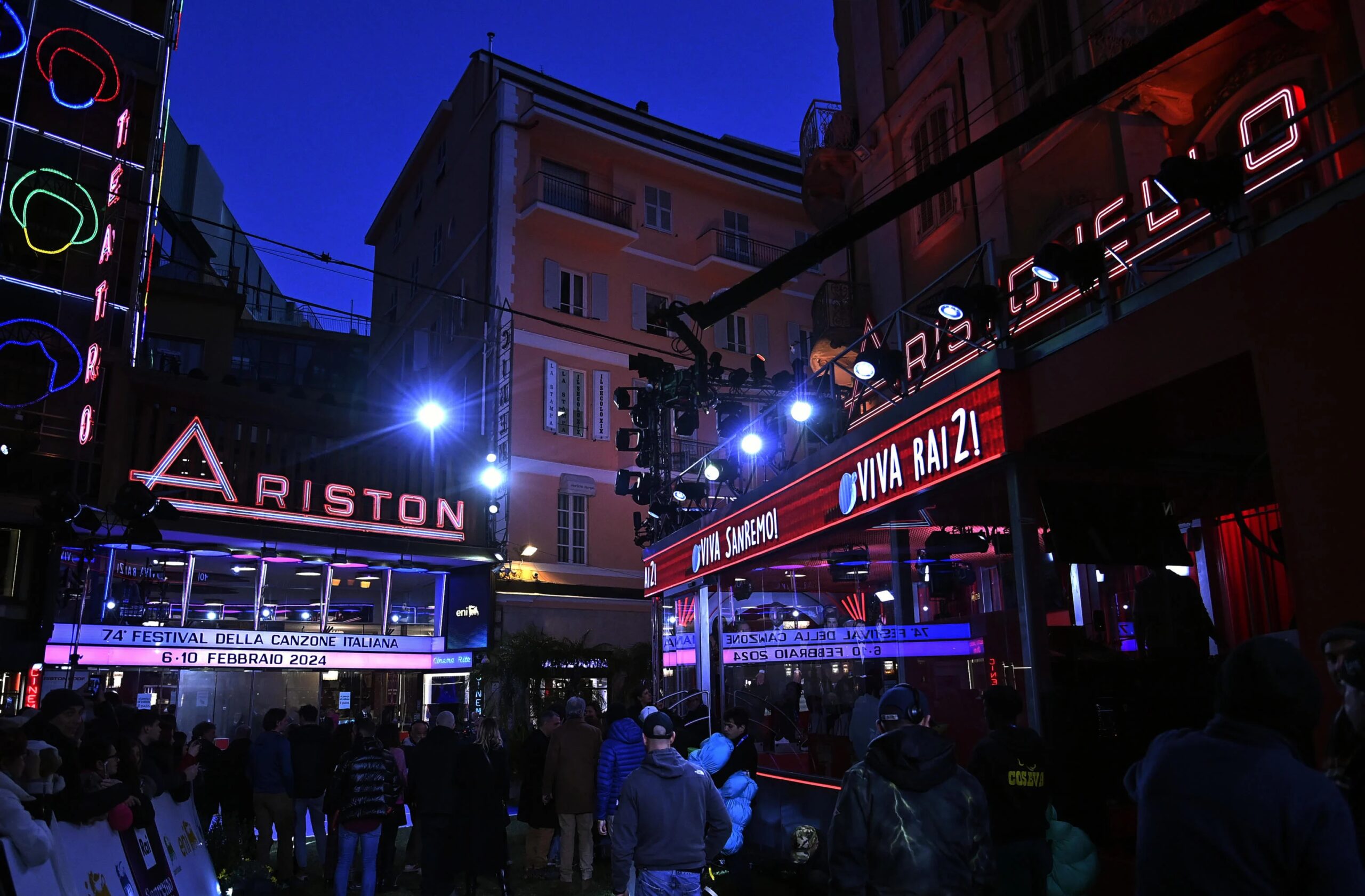
Sanremo always seems identical to itself. The Ariston stage, the orchestra that tunes the instruments, the five evenings that mark a national rite and finally a winner who enters – at least for a few days – into the collective memory of the country. Yet, beneath this reassuring surface, the Italian Song Festival has undergone a radical, almost silent transformation over the last thirty years, which has rewritten its rules without altering its appearance.
The numbers for 2025 demonstrate this clearly: an average share of 66.38% and a final followed by over 13 million spectators, with a 73.1% share. Numbers which, rather than recounting a television success, certify a cultural legacy. Because Sanremo did not remain standing due to inertia, but because it was able to shed its skin every time the music and media system changed its structure.
From CD to streaming: the end of linear success
In the nineties the path to success was linear, almost predictable. An artist performed on stage, the radio fixed the refrain in the listeners’ heads with constant passages, CDs filled the shelves of shops and the homes of Italians. Possession was an integral part of the musical experience: buying a record meant declaring belonging, choosing a duration, repeating listening until it settled.
Then the record market experienced a profound crisis, with a collapse that from the peak of the early 2000s led the sector to reach historic lows in 2012. It seemed like the beginning of an irreversible downward spiral. Instead the recovery came through a structural change: streaming. In 2023 the sector recorded record takings, with growth of more than 260% over a decade, and in 2024 streaming represented 67% of overall revenues, exceeding 166 million euros in the first half of 2025 alone.
This step has not only changed the market, but the very meaning of success. If once upon a time consecration came after television exposure, today the opposite often happens: a song circulates, grows, becomes viral, and only then finds official consecration on the Ariston stage. It is no longer the peak that determines victory, but the ability to remain in the flow.
From live to feed: the multiplication of screens
The enjoyment of the Festival has also changed shape. Free-to-air television remains central, but it is no longer the only space of experience. Live coverage coexists with fragmented consumption, spread across multiple screens, reassembled in clips, memes, reactions, comments in real time. In 2025 RaiPlay recorded 13.5 million views and 12 million hours overall, with hundreds of thousands of devices connected every evening.
You no longer just look at the Festival: you walk through it.
Advertising collection, which in 2025 reached 65.2 million euros with an increase of 8.5%, confirms this economic centrality. Sanremo is not just entertainment: it is a platform.
The winner is no longer enough: the balance between audiences
Even the dynamics of victory turned into a complex balance between different audiences. Today the weight is distributed between the press, radio and televoting, each with an almost equivalent share. It is a formula that reduces the idea of the “announced” winner and rewards those who manage to dialogue with different systems.
The case of Geolier in 2024 – 60% in the televoting but no final winner – explains this new architecture of consensus better than any theory: dominating one dimension is no longer enough, we must inhabit all the others.
Fantasanremo and the gamification of the ritual
In this context comes a phenomenon that has redefined the relationship between the public and entertainment: Fantasanremo. It is no longer just a side game, but a form of gamification that multiplies micro-actions, encourages attention to detail, transforms every gesture into a potential score.
In 2025 it exceeded 5 million registered teams, with over 750 thousand leagues and almost 4 million registrations. The Festival thus becomes a continuous participatory experience, an open system in which the spectator not only attends, but intervenes.
The algorithm as a new radio
The third great revolution concerns discovery. If for decades radio and television selected what deserved listening, today the algorithm suggests and the feed decides. A hit is no longer just an effective melody, but a sum of signals: saves, replays, inclusions in playlists, reuse of audio in videos, trends, editing.
In 2025, around 70 thousand posts were published with the hashtag #Sanremo2025, cumulative views exceeded 399 million with an increase of 40%, and song saves exceeded one billion. The song has become moving matter.
Sanremo as a cultural and economic infrastructure
Yet, amidst this digital transformation, one physical constant remains: the city of Sanremo. In 2025 the economic impact exceeded 245 million euros and in 2026 almost 35 thousand tourists are expected with an average stay of five nights.
For a week, the city transforms into a nerve center that concentrates high season, international visibility and cultural production. The Festival continues to function because it has never stood still. It has gone through the transition from possession to circulation, from linear television to fragmented consumption, from radio to the algorithm, from single victory to plurality of audiences.
It always seems like the same Festival. In reality it is an ecosystem that changes together with us.