There is a phrase that emerges almost by chance during the press presentation of Rooster, but which ends up perfectly defining the soul of the series. “At its core, it’s a show about loneliness,” says showrunner Matt Tarses. It’s not a studied statement, but one of those moments that reveal more than you really want to say.
And it is perhaps precisely there that the heart of Rooster lies, the new HBO series led by Steve Carell and signed by Bill Lawrence and Matt Tarses: a comedy that laughs a lot, but which beneath the surface tells something more fragile and universal — the uncertainty of adults who are still trying to understand who they are, while the world around them changes rapidly.
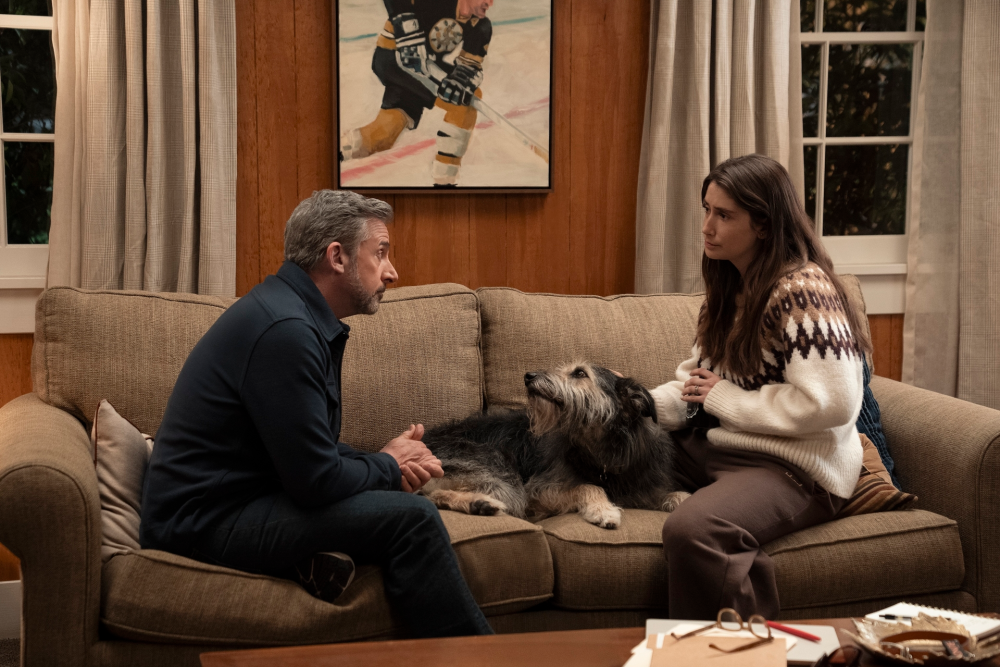
The series follows Greg Russo, writer of a popular saga of adventure novels whose protagonist – Rooster – embodies everything he would like to be: courageous, instinctive, almost mythological. When Greg accepts a job as a professor on a university campus in Massachusetts, his life slowly begins to fall apart and come back together through a series of unpredictable relationships: the one with his daughter Katie, played by Charly Clive, the relationship with his colleagues and students on campus, and the meeting with Dylan, played by Danielle Deadwyler, a presence destined to change the balance of his daily life.
Alongside Carell, the cast also brings together Phil Dunster, Lauren Tsai and John C. McGinley, along with a series of recurring performers who progressively expand the narrative world of the series. The project was born from the collaboration between Bill Lawrence – creator of series such as Scrubs and Ted Lasso – and Matt Tarses, and is constructed as an ensemble comedy capable of alternating moments of very physical irony with more melancholic and reflective passages.
Rooster debuts on HBO on Sunday, March 8 at 10pm in the United States and will be available for streaming on HBO Max immediately after airing. The first season is made up of eight episodes and progressively builds the world of the series through the dynamics between the characters, allowing broader themes that are part of our daily lives to emerge beneath the comic surface.
The idea of a series born from relationships
The origin of the series, the authors said during the press conference, does not arise from a precise narrative idea but rather from a professional and human relationship. Lawrence and Tarses have been working together for years and at one point they found themselves asking the simplest and rarest question in the contemporary television industry: who would we really like to do the next project with?
The answer came almost immediately. Steve Carell.
When the actor even agrees to discuss it, the showrunners ironically say, it immediately becomes clear that whatever will arise from that conversation is worth doing.
«We started with a very simple question: who would we like to do a show with?», explains Bill Lawrence. “And Steve made the huge mistake of even agreeing to talk to us about it.”
However, behind the idea of the series there is also something much more personal. Lawrence, Tarses, and Carell himself are all in a similar stage of life: one in which sons, and particularly daughters, are entering adulthood. It is a subtle but destabilizing transformation, because it forces parents to deal with an unromantic truth: the need to remain present in their children’s lives does not always arise from their need for us, but from our need to remain necessary.
“Sometimes you realize that wanting to be in their life isn’t really for them,” Lawrence says. “It’s for you.”
In that emotional tension – between affection, loss of control and nostalgia – the emotional core of the series takes shape.
Steve Carell is a protagonist full of contradictions
Carell’s character, Greg Russo, is a writer who has built his career around a fictional protagonist called Rooster, an almost mythological figure who represents everything he would like to be.
Carell says that his first reaction, when the project was presented to him, was to avoid a very common narrative trap: transforming Greg into a caricature of the mediocre man who dreams of being someone else.
“I didn’t want him to be some kind of Walter Mitty,” explains the actor. «He is not a pathetic man who dreams of being someone else. He’s a person with a sense of humor, self-aware.”
His Greg is not a loser or a pathetic figure; he is rather a complex man, relatively self-confident, capable of irony and self-awareness, who however constantly lives with the suspicion of not being the best version of himself. It is precisely in this friction between what one is and what one imagines one can become that Carell finds the point of access to the character.
An ensemble that lives on chemistry
A fundamental part of the construction of the series concerns its ensemble character. Lawrence repeatedly insists that Rooster was not conceived as a vehicle for a single star but as an ensemble in which each character has their own narrative path.
It is a choice that also reflects the transformation of television language in recent years. If once a series could afford to take entire seasons to slowly grow the chemistry between the characters, today the viewer decides much more quickly whether to stay or change platform.
“Today, if you don’t immediately build complex characters and credible relationships, the audience simply changes series,” observes Lawrence.
For this reason, the authors explain, the characters must reveal complexities and contradictions from the first episodes.
Comedy, melancholy and the tone of the series
During the press presentation another interesting interpretation also emerges. A journalist observes that Rooster is very funny but at the same time shot through with an undercurrent of melancholy and isolation.
The authors not only accept this interpretation, but consider it central.
Lawrence admits that the true balance of the series consists precisely in the continuous transition between comedy and emotional vulnerability, a delicate balance that can only work with actors capable of crossing very different registers in the space of a single scene.
Danielle Deadwyler describes it with a metaphor that sticks.
“Sadness is like a buzz,” he explains. “It’s not always visible, but it’s always there.”
It’s that underground energy that runs through all the characters. They laugh, they argue, they try to move on with their lives, but beneath the surface there is constantly that more fragile emotional vibration.
University, generations and identity
Part of the series is set on a university campus, and this context becomes an important narrative space. For Danielle Deadwyler, university represents one of the few places where conflict of ideas is not only accepted but encouraged.
«It is a space where discussion and debate are encouraged», says the actress. «It’s an environment that pushes people to grow and question themselves.»
Lauren Tsai, who plays Sunny, brings a younger but surprisingly complex generational perspective to the series. Also during the press conference Panorama had the opportunity to intervene by asking the actress how the series worked to avoid transforming her character into a simple symbolic representation of Gen Z. Tsai explained that the key lies precisely in the specificity of the character and in the plurality of perspectives present in the writing. «It was very interesting to work on a project in which the screenwriters belong to different ages, even close to that of the younger characters», he says. “A lot of the authenticity of how they speak and how they navigate the world comes from there.”
For the actress, Sunny is not thought of as a generational statement but as a specific person, with her emotional rigidities and intellectual defenses. “She’s an outsider,” he explains. “He has this tendency to hyper-intellectualize everything, as if it were a way to hide emotions.” Precisely this combination — a constant tension between analytical clarity and emotional vulnerability — makes the character a very recognizable figure: a bright, slightly clumsy young woman who uses her analysis of the world as a form of protection.
A series made with care
Between backstage stories and improvised jokes, the portrait of a series that is not afraid to oscillate between very different registers gradually emerges. The absurd coexists with the everyday, the comedy with a barely perceptible melancholy.
At the end of the presentation someone asks Steve Carell if during filming he had the feeling that Rooster could become something special.
His answer is surprisingly sincere.
“You never know how a show will go,” he says. “You can have great writing, great actors, but there’s never a guarantee.”
Then he adds something that perhaps explains better than any analysis why the series could work.
On set, he says, it was clear that everyone really cared about the project.
“There was joy in doing it,” Carell says. «And when it happens, it’s already something rare.»
And sometimes, in television as in life, it’s already a surprisingly promising start.