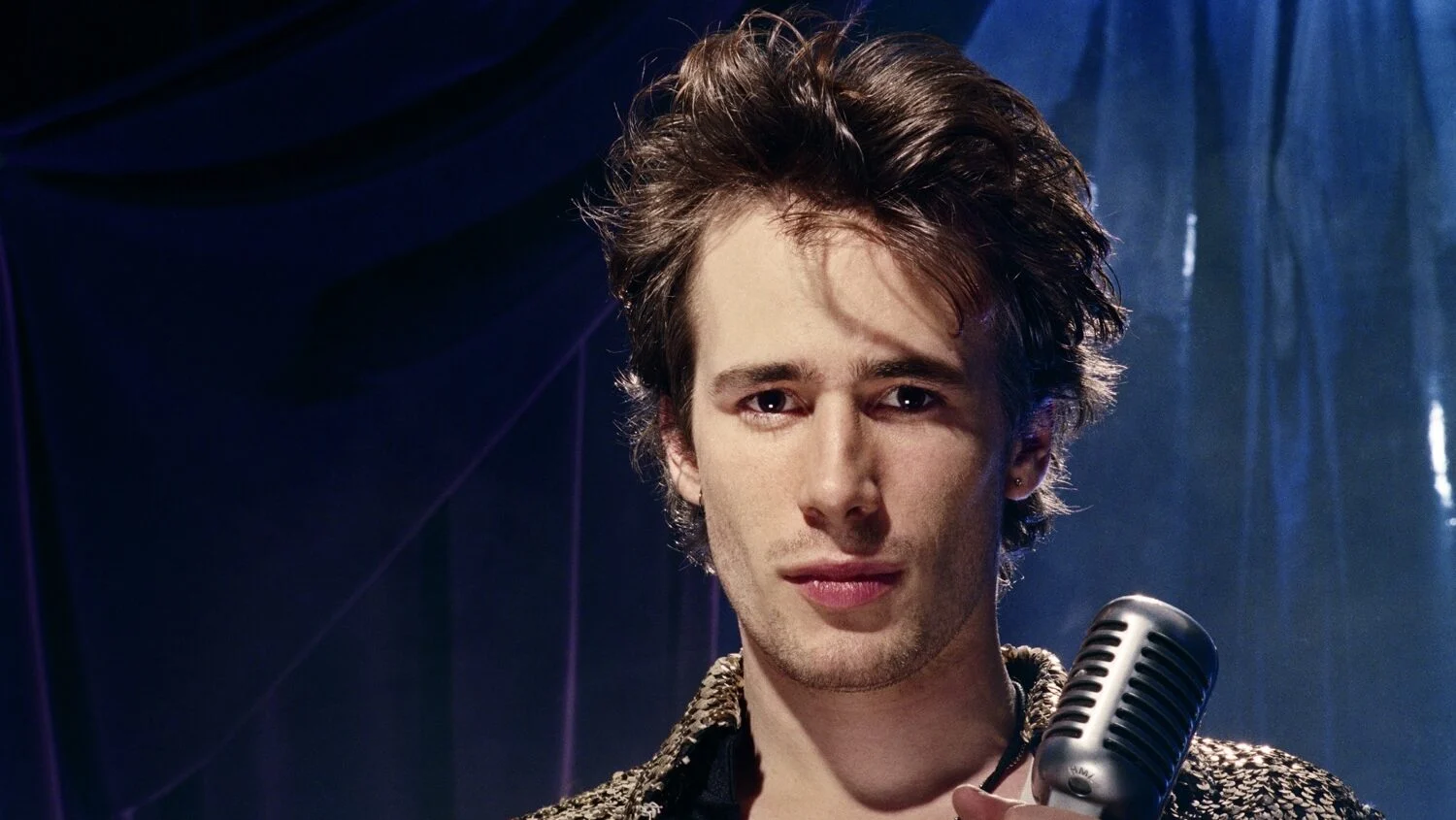
The documentary It’s Never Over rekindles the story of a genius burned too quickly. In theaters from March 16th
Jeff Buckley was a flash appearance in contemporary music: he imposed his voice as an alien and magnetic element, an extension of the soul that seemed to know no technical or emotional limits, and he left. At thirty, too soon, too quickly, leaving an unfillable void. For many reasons. The first is that Buckley did not simply limit himself to interpreting the songs: he inhabited them, crossed them, exposed them on the threshold of the abyss, to the limit of vertigo. For this reason, almost thirty years after his death, his trajectory continues to exert a mystical fascination on musicians and listeners, as if a secret still to be deciphered was kept in those recordings. The Buckley Code.
Before the world noticed him, Jeff was a cult musician in New York’s East Village. His kingdom was a room, an Irish place with an enigmatic name: Sin-é. It is there that he invented his own legend, alone, with the electric guitar used as a magical instrument and a voice capable of silencing even the most talkative and disinterested of customers. Sin-é was not a club for musicians, but a bar of a few square meters, with smoke-filled walls and slightly peeling floor tiles. On the small stage, a tiny nook between the bar and the chairs, Buckley sang as if he were confessing something to everyone present and at the same time telling something personal to each spectator. Each performance was unrepeatable: he could go from Nina Simone to Led Zeppelin, from a folk whisper to a lightning bolt of rock, without ever losing sight of the common thread that linked the songs of his live performances. The recordings of those legendary shows are now available in a deluxe edition (34 tracks) in four vinyl or two CD versions.
Son of the brilliant singer-songwriter Tim Buckley, who died of a heroin overdose at 28, Jeff has lived with the weight of an absence and a cumbersome artistic legacy since he was a child. He chooses not to pine for comparison, on the contrary, he transforms that lack into a continuous creative urgency, into an almost physical need to find a voice that was only his. He succeeded and in 1994 he recorded the masterpiece, Grace, the only album recorded during his lifetime, a work that is in the pantheon of the most beautiful records of all time. Among the bowels of those songs there are electric rock and visionary folk, the sexy veins of soul and a psychedelic spirituality. Buckley does not hold back emotions, on the contrary he seeks them with ferocious determination to make them reach the audience. His voice ranges between tonalities, breaks, becomes a sigh and then explodes, with impressive technical control and an almost jazzy freedom in phrasing. Her interpretation of Hallelujah, Leonard Cohen’s classic, has over time become a standard of beauty to strive for.
Buckley transforms it into a secular prayer, suspended between passion and redemption. It is not a simple and banal cover, but a real rewriting that contributes to consecrating the song in the collective imagination. Thom Yorke of Radiohead and Matthew Bellamy of Muse have always admitted Buckley’s influence on their music, just as Brad Pitt has never hidden his boundless admiration for Grace’s musical language. A non-casual devotion. Buckley’s music has an intrinsic cinematic quality: his songs tell the world inside us like landscapes, they evoke darkness and light, they imagine love stories that fade quickly. It is therefore not surprising that directors and actors consider them an ideal soundtrack to describe passions and fragility.
The documentary It’s Never OverJeff Buckley directed by Amy Berg and co-produced by Brad Pitt (in Italian cinemas 16, 17 and 18 March) retraces its trajectory with delicacy and rigor, weaving together archival materials, intimate recordings, including the last message left on the mother’s answering machine, and testimonies from friends, musicians and ex-girlfriends. What emerges is the portrait of a unique artist who did not have time to complete himself, but who precisely in his incompleteness continues to speak to the present, like a promise that never stops resonating.
On the evening of May 19, 1997, while walking along the Wolf River Harbor, a canal of the Mississippi River, he suddenly decides to jump into the water, fully dressed, singing Whole Lotta Love by Led Zeppelin. He swims for a few meters, then is overwhelmed by the wake and waves caused by a passing tugboat. He disappears into thin air and his body is found five days later. The autopsy completely ruled out alcohol and drugs. No written destiny, no mythology of self-destruction: just a moment of reckless thoughtlessness paid for with one’s life, a cruel accident that interrupts forever the path of a genius who was still becoming himself.