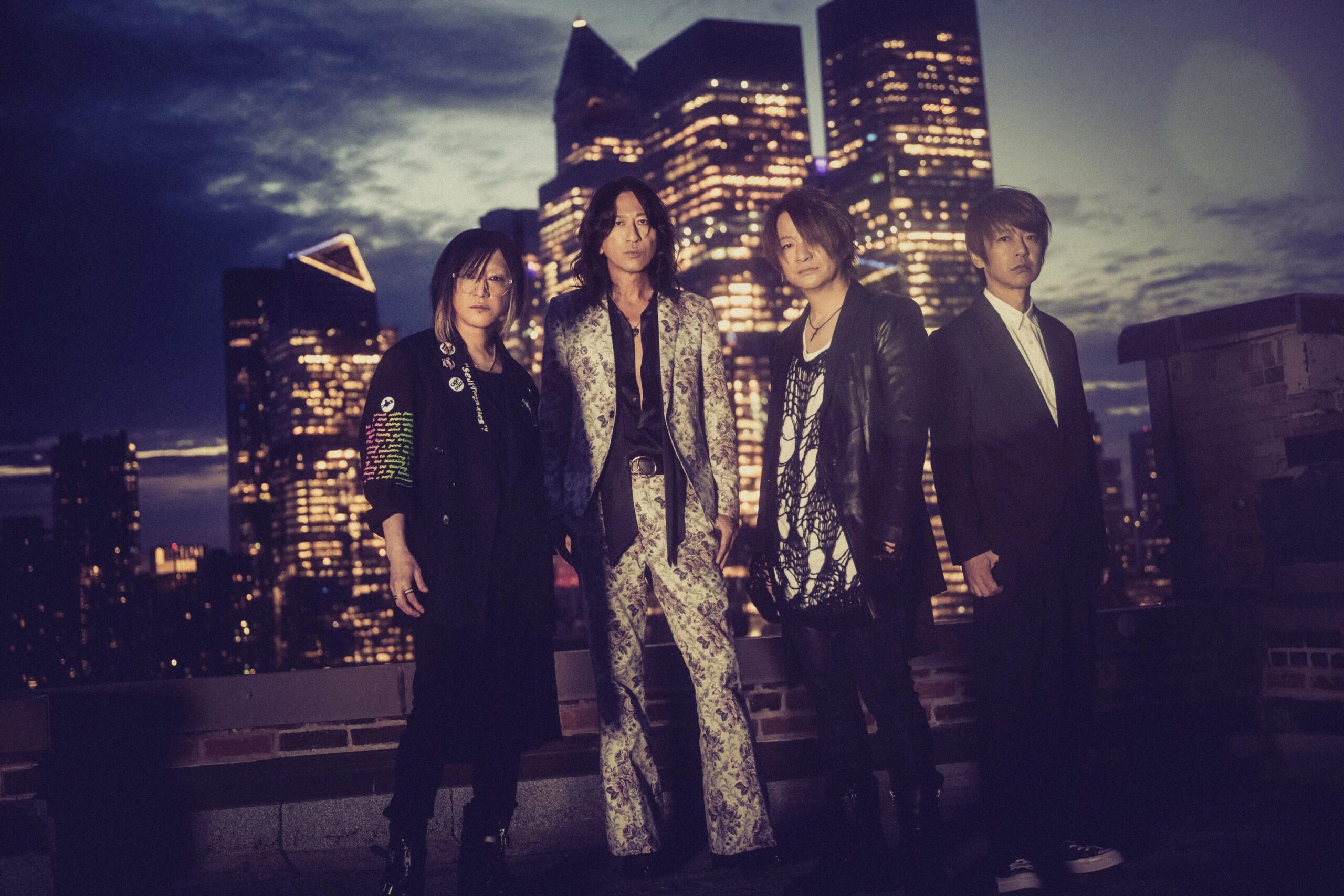
In the story of contemporary Japanese music there are some trajectories that coincide almost perfectly with the transformation of an entire cultural industry. GLAY is one of them.
As they emerged in the early nineties, Japan was experiencing one of the most intense moments in its pop culture. It was the era of the record boom, when the CD became the dominant format and the Japanese music market reached gigantic dimensions. It is also the moment in which Japanese rock finally finds a recognizable identity, distinct from both its Western heritage and its domestic pop tradition.
It is in this context that GLAY established themselves, a band born in Hakodate, on the island of Hokkaido, destined to become one of the pillars of the Japanese rock scene.
In the Nineties, the bands’ journey was still almost ritualistic: small live clubs, tours in live houses, then theatres, arenas and finally the domes, the immense domes that represent the pinnacle of the Japanese music industry. It’s a slow climb, built concert after concert. GLAY follows exactly this trajectory, gradually transforming into one of the country’s biggest musical phenomena.
At the same time, a new cultural language is also born. Expressions such as visual kei and J-rock begin to define a movement that is not only musical, but also aesthetic and identity-building. Bands become visual universes, collective narratives, communities of fans.
Within this revolution, GLAY build a very precise sound signature: emotional melodies, rigorous compositional structure and a rock energy capable of speaking to very different audiences. A formula that will lead them to sell millions of records and permanently enter the history of Japanese music.
Their 1999 concert in front of around two hundred thousand people still remains one of the most monumental live shows ever made by a Japanese band. But what makes their story truly unique is the ability to cross different eras without losing identity.
GLAY experienced the golden age of the physical market, the crisis of traditional discography and finally the revolution of global streaming. Three completely different industrial systems.
Today that trajectory enters a new phase with “Dead Or Alive”, the band’s sixty-third single, released after almost two years of recording silence and just after the thirtieth anniversary of their debut.
The song was written specifically as the opening theme of the anime series Record of Ragnarok III, produced by Warner Bros. Japan and distributed in worldwide streaming on Netflix.
It is a choice that tells very well how the way Japanese music travels around the world has changed. If in the 1990s international diffusion was mainly through records and tours, today one of the main global vectors of Japanese pop culture is anime.
“Dead Or Alive” was born from TAKURO’s desire to return to the essence of GLAY’s rock. The song combines aggressive riffs, JIRO’s powerful bass, HISASHI’s arrangements and TERU’s magnetic voice, building an anthem designed to accompany the narrative intensity of the series.
«We are extremely honored to have been chosen for the opening theme of a work that has gained enormous popularity since the first season», commented TAKURO. «We created “Dead Or Alive” thinking about the grandeur of Record of Ragnarok’s story and the conflicts of its characters, which cannot be judged solely through the concept of justice. The song blends the energy of action with the inherent intensity of rock.”
It is the beginning of the band’s thirty-first year of career. And, as they themselves say, perhaps also the beginning of a new season for Japanese rock.
Panorama interviewed them exclusively.
GLAY emerged in the 1990s as part of a generation that redefined Japanese rock. From your point of view, how did that era transform Japan’s music industry structurally, not just artistically?
TAKURO: The 1990s were truly a revolutionary time. It was the heyday of the CD market and there was a very clear path for artists to grow: from small live music venues to domes. Precisely in those years terms such as what we would today call “visual kei” or “J-rock” began to spread and be recognized by the general public. But I think the most important thing was that we could move forward simply by wanting to play the music we loved. Record labels were also more willing to take risks and support new bands, and I think that spirit laid the foundation for the diverse music scene we see today.
Today, Japanese music is increasingly amplified by anime as a global distribution platform. How aware were you of the international dimension while composing “Dead or Alive” for Record of Ragnarok III?
TAKURO: We were very aware of it. As the opening theme for a series distributed worldwide on Netflix, we knew it couldn’t just be “Japan rock.” We wanted to create a song that people all over the world could listen to while raising their fists and singing along.
We therefore incorporated universal themes into both the sound and the lyrics — the determination to fight and the energy to survive — because from the beginning we imagined a global audience. The response from abroad has been incredibly passionate and makes us feel like the challenge has been worth it.
Anime theme songs often become a gateway to Japanese culture for international audiences. Do you consider this collaboration part of a broader cultural export strategy?
HISASHI: Japanese domestic culture—whether anime, manga, video games, music, or cosplay—has a very distinctive sensibility in general. When these different elements meet and mix, the energy that arises from this sort of creative friction strengthens each individual medium in a positive way.
I’ve seen several friends have great success touring abroad, and I think one reason is that even the most niche anime music — what might be considered very specialized in Japan — finds passionate support abroad. This cross-cultural momentum could be one of the key forces behind this global expansion.
GLAY has remained relevant through the physical sales era, the CD era, and today in streaming. What has been the most difficult transition in adapting to the global digital market?
HISASHI: In the 1990s, I remember the Japanese music fan community being incredibly vibrant and energetic. Then, around the 2000s, with the very rapid expansion of platforms, that energy continued to accelerate. With the spread of subscription services like Spotify we have started to see real phenomena of great resonance.
We have always tried to welcome change with lightness and positivity, instead of considering it something negative. Ultimately, the pleasure of collecting music has simply moved to the cloud, allowing people to discover more talent than ever before. This has also opened the door to collaborations with media and artists that we may never have encountered in the past — and we see this as something full of possibilities.
On a personal level, one of the biggest benefits of the COVID era has been the vast improvement in the accuracy and quality of online recordings.
Compared to the end of the nineties, when dominating the domestic market was the priority, today global positioning is much more central. How will GLAY deal with international visibility in 2026?
TAKURO: In 2026, it’s no longer about “succeeding in Japan and then going abroad.” Since the beginning, artists have been creating music with the world in mind and connecting directly with fans through social media and streaming platforms.
For us, that means leveraging global platforms like anime — just like we did with Dead Or Alive — and increasing live streams with English subtitles, so international audiences can participate in real time. The essence of GLAY hasn’t changed, but we want to remain flexible in how we bring our music to people and continue to grow together with fans around the world.
Record of Ragnarok’s mythological narrative is about conflict, destiny and survival. Have these themes resonated with your journey as a band through decades of music industry changes?
HISASHI: Actually, in a way we are the opposite. Rather than identifying with the conflict, in times of chaos we strengthened the unity within the band. Our creative environment is very warm: we simply focus on the pleasure of making music without thinking too much about it, and we believe that this feeling still reaches listeners, even in the digital and subscription era.
Japan has gone through many difficult times, from major earthquakes to acts of terrorism, and these events have weighed heavily on people’s hearts. As much as we try, music and entertainment are not lifesavers in the literal sense. But we believe that emotional richness is essential, and that’s why we’ve chosen to continue creating music that brings joy even in the darkest and most discouraging moments.
Japanese rock is often described as emotionally expressive but structurally very precise. How would you define GLAY’s identity within this tradition?
TAKURO: I think it’s just that balance between passionate emotion and meticulous construction. We always prioritize melodies and lyrics that move the heart, while the sound is carefully constructed through HISASHI’s guitar arrangements and JIRO’s rhythmic groove.
What makes GLAY unique is that even when the emotion explodes, the music never falls apart: there is a central force that holds everything together. And it is precisely this balance that allows us to express all our power on stage during live concerts.
As veterans of record-breaking concerts, how do you reinterpret the concept of live energy today in an era where global audiences encounter music online first?
HISASHI: Due to COVID, many forms of entertainment have been limited, and we had to cancel our dome tour and spend our days doing online concerts. Looking back, I think that period also had some positive effects. But there is an emotional intensity that can only be experienced in a live concert, where joy, anger, sadness and enthusiasm are shared at the same time.
When things started to get back to normal, the energy around the theatrical release of I was incredible. It really felt like entertainment had come back to life. Even at big festivals, even in extreme heat, crowds gather beyond belief. The true charm of live concerts is precisely that almost “addictive” quality, something that only those who have been captured by the energy of live concerts can truly understand.
Looking to the future, do you think Japanese rock is entering a new phase of global influence? And what role do GLAY intend to have in this evolution?
TAKURO: We are definitely entering a new phase. With anime, video games and platforms like TikTok allowing Japanese content to directly reach young people around the world, there is a real opportunity for J-rock to be rediscovered and appreciated on a global scale.
As GLAY we want to continue to be pioneers, but also a band that is still active and evolving. By showing new generations what it really means to build a long-term musical career, we hope to build the next thirty years together with fans around the world.