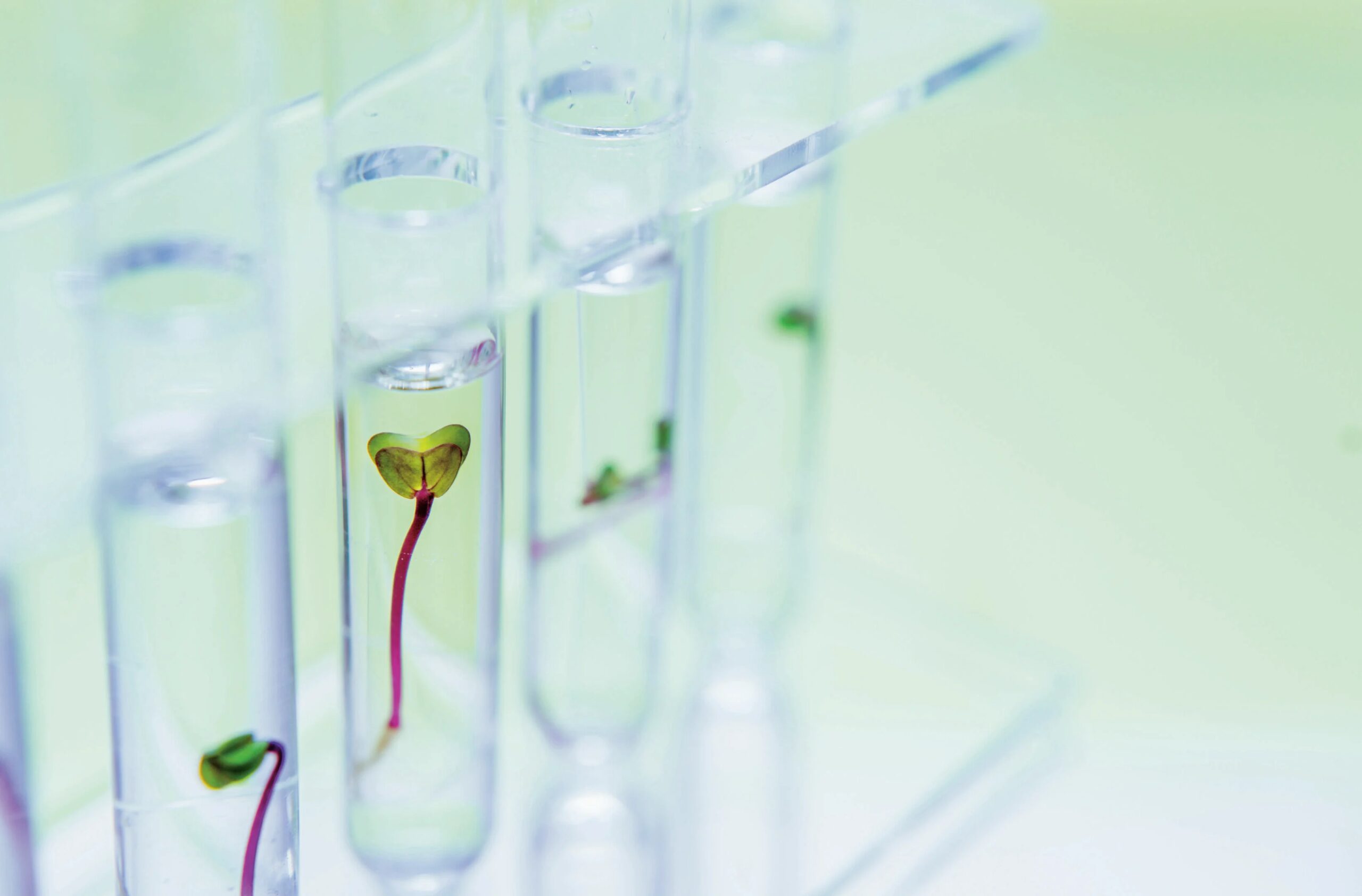
Organisms that are grown together with technological elements. The “green” that is enhanced with nanoparticles to give us more oxygen, electricity, perhaps more prosperous crops. The era of biohybrid nature has begun
In the beginning it was the tree, an immutable symbol of nature, rooted in time and in the cycle of life. Today, it has become something more than a natural organism. At least in laboratories, plants are changing their identity and function into something different – living beings transformed into technological platforms.
They call them biohybrid plants: organisms that combine biological elements, those of the same plant, with technological components such as, for example, nanoparticles. In this way, natural functions such as photosynthesis, growth, sensitivity to environmental stimuli are enhanced by engineered elements, without any intervention on the DNA. Therefore, no longer “pure” vegetation, but organisms halfway between nature and technology, in whose sap flow polymers, engineered nanoparticles capable of increasing photosynthesis.
The conceptual shift is radical: the tree is no longer just an element of the landscape, but also an advanced biological device, a green infrastructure that actively works to produce energy, capture carbon or monitor the environment. From Europe to the United States to Asia, this new discipline of biohybrid greenery is always enriched with new results. And perhaps the most striking one comes from Italy.
A group of scholars led by Manuela Ciocca, researcher in experimental physics from the engineering faculty of the Free University of Bolzano – in collaboration with the faculty of Agricultural Sciences, the Prime research group, the Bruno Kessler Foundation, Eurac Research, the Ludwig-Maximilians-Universität of Munich, the Institute of Materials for Electronics and Magnetism (Imem), the Cnr and Elettra Sincrotrone Trieste – managed to create the first completely biohybrid plant with an increased ability to photosynthesize.
«We worked on Arabidopsis thaliana plants, a model species widely used in plant research, and we chose as a technological component nanoparticles, a semiconductor organic polymer (P3HT) already studied for solar cells» explains Ciocca. «We realized that, thanks to their extremely small size – about five hundred times smaller than the diameter of a human hair – these nanoparticles could be absorbed naturally by the roots. For this reason we germinated the seeds in a hydrogel enriched with these nanocomponents, which then entered the root system of the plant and followed the normal internal flows of water and nutrients.”
In this way they were transported to the leaves and integrated into the biological processes of the shrub without invasive interventions and without altering its DNA. «In leaves, nanoparticles act like tiny antennas that capture green light, a frequency of the spectrum that plants do not normally absorb. It means improving the conversion of solar energy into chemical energy so as to increase the increase in biomass and the absorption of CO2″, adds Ciocca. In short, this research demonstrates that plants treated with nanoparticles grow much more than normal and accumulate more biomass. Once the techniques have been validated on the model, we can think about scaling the experiment to other species, grown in greenhouses or in conditions closer to the real ones, with larger sized plants.
Of course, when moving to full scale, additional factors come into play: variable climate conditions, the amount of nanoparticles to be administered to an adult tree, and their life cycle itself. Precisely for this reason we have verified that those used are compatible with the plant and with humans, and that, if they end up in the soil, their life cycle and degradation will have to be carefully studied.
«A truly significant fact is that we managed to insert the nanoparticles through the roots, starting from the seed» continues Ciocca. «But it must also be said that the result was good: we studied different concentrations of polymers, from zero up to one milligram per milliliter, always observing faster growth, up to 45% more growth compared to untreated plants and about 11% more biomass. By analyzing the roots with the fluorescence microscope, we found the presence of the nanoparticles also in some leaves, where they contribute to the absorption of additional light.”
There are many possible applications of biohybrid plants. «One of the most promising concerns CO2 capture and biomass production. Another is that of generating electricity, through the same principle as photovoltaic panels” explains Ciocca.
«As far as agri-food is concerned, it is still in its embryonic phase: there are no clear guidelines on toxicity, but the advantage of our technology is that it does not modify the genetics of the plant. The nanoparticles integrate spontaneously and the plant is positively enhanced. This opens up interesting prospects for sustainable agriculture: if plants grow more and accumulate greater biomass, it is possible to increase the productivity of crops in a natural way, reducing waste and improving the efficiency of plantations.”
The Italian experiment is just one part of a global scientific movement. Various laboratories around the world are studying nanobionic plants capable of increasing photosynthesis thanks to the integration of nanoparticles. A first line concerns biohybrid microalgae, in which unicellular photosynthetic organisms are integrated with metallic or polymeric nanoparticles to improve the absorption of light and the transfer of electrons in photosynthetic processes. This allows us to increase the production of natural pigments (such as carotenoids and modified chlorophylls) and metabolites useful for the pharmaceutical and food industries, without intervening on DNA but exploiting the physical interaction between inorganic materials and biological structures. A second trend, developed mainly in Scandinavia, at Linköping University, aims to make the roots of plants conductive by integrating electronic organic polymers directly into plant tissues.
The shrubs themselves favor the formation of electrical conduction structures along the root system, transforming them into a sort of biological capacitor. These “electronic” roots do not replace the vital function of the plant, but support it, transforming the plant tissue into a functional material that combines metabolism and electrical conduction.
A third trend concerns greenery as a living environmental sensor: the integration of nanomaterials (such as carbon nanotubes or conductive particles) in leaf or vascular tissues allows us to read the electrical and chemical signals that the organism naturally produces when it undergoes water stress, variations in salinity, the presence of heavy metals or air pollutants. These indications can be collected and transmitted to digital devices, creating environmental monitoring networks based on live “sensors” that react in real time to soil and air conditions.
In all these cases, the key element is not genetic modification, but the construction of hybrid systems in which biological functions are amplified or made readable thanks to nanostructured materials, giving rise to new forms of “plant electronics” and energetic and sensorial biomanufacturing. In this scenario, plants stop being just passive organisms and become active biological infrastructures: sensors, energy accumulators, environmental monitoring platforms.
The frontier of plant bio-nanotechnologies does not promise science fiction “superplants” capable of solving our energy problems, but organisms capable of communicating with digital systems and the environment that surrounds them, making processes invisible today invisible. If this research manages to leave the laboratories without altering the ecological balance, the future of electronics could literally sprout from the ground.