30-year-old ships and new units arriving: the US Navy risks everything to avoid naval disaster in the Strait
Left alone by their allies, the US military will have to face the increasingly likely demining operations in the Strait of Hormuz alone. Even if from the beginning of the war operations it was the precise intention of the USA to limit the Iranian ability to place orders in the 33 km of sea that are crossed by ships and especially by oil tankers, the Navy will have to put into practice the various capabilities at its disposal to restore navigation in the Region to safety. According to the US Office of Naval Intelligence, the Iranian Islamic Revolutionary Guard Corps (IRGC) Navy considers mines a fundamental pillar of its military strategy, while according to what was communicated by the US, these forces began to lay them in the strait last week, even if at the moment there is still no evidence of these operations.
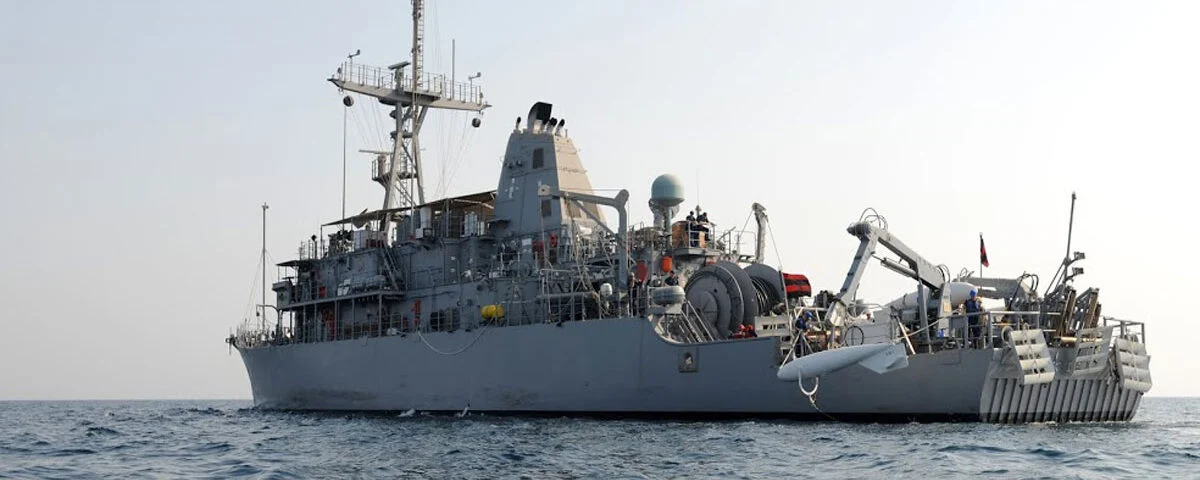
The American concern is dictated by the fact that the US Navylast year, decommissioned four Bahrain-based Avenger-class minesweepers because they were obsolete, having been launched more than 30 years earlier. The Central Operations Command (Centcom) said on Monday that US forces destroyed Iran’s naval mine arsenals during an attack on Kharg Island, also destroying 16 minelaying ships. According to US intelligence, Iran possesses around 6,000 mines of various types: magnetic ones, which are manually attached to a ship by divers; moored mines, which float beneath the surface of the water and are anchored to the seabed; bottom mines, which rest on the bottom; and those drifting mines, floating on the surface of the water and detonating on contact.
How mines are found and destroyed
To be able to remove them, different types of means are therefore needed, starting with minesweeper of the Avenger class, four of which are stationed at Sasebo Base, Japan, who could deploy to the Middle East after a trip of at least two weeks. These ships use sonar and remotely operated vehicles (called ROVs), controlled by cable, to identify mines beneath the surface of the water, and were used during the Gulf War to destroy over a thousand mines positioned off Kuwait. The request for help from the allies starts right here, i.e. from the long intervention time and the need to empty the sector of the Pacific closest to Taiwan. And, according to the tracking websites, since yesterday the USS Tripoli, the USS New Orleans, the USS San Diego and the 31st Minesweeper Unit on board, would be heading towards the Strait to support theOperation Epic Fury.
Once mines are identified, these ships destroy them, either by detonating them with an acoustic device that emits a noise designed to activate sound-sensitive mines, or by emitting a strong magnetic field to fool the trigger sensors that detect the presence of the hulls. Among the procedures, there is also that of using large shears to cut the anchor cables of the mines which, once freed, rise to the surface and are detonated. Minesweeping ships are built of wood and fiberglass to produce a non-magnetic “signature”, and their propellers are specially shaped to emit a low acoustic footprintso as to limit the possibility of triggering mines. They are also equipped with two .50 caliber machine guns and two Mk 19 grenade launchers for their own defense, but against air attacks they must be protected by other assets.
Another fundamental type of ship is the Independence class shipswhich are replacing the old minesweepers present in Bahrain; they are equipped with an electromagnetic and mechanical mission system. Of these, the USS Canberra is in the Indian Ocean, the USS Santa Barbara and the USS Tulsa are already en route to Bahrain.
They are units made of aluminum, and do not possess the same property as undetectable minesweepers. As a result, they can only operate outside a mine-prone area, advancing on-board underwater robots or remotely controlled surface and underwater vehicles to reach areas where mines have been laid, in order to locate and destroy them. For their defense, compared to the Avenger-class minehunters, these ships feature enhanced armament that includes a 57 mm MK-110 cannon, the SeaRam self-defense system, and .50 caliber machine guns.
The importance of helicopters equipped with a laser system
However, aerial means are fundamental for sighting: the Mcm (Mineral Counter Measures) package of the Independence class ship and the An/Aes-1 laser mine detection system are installed on the Sikorsky Mh-60S Seahawk helicopters, capable of identifying floating and moored mines at medium distances. For neutralization, the An/Asq-235 apparatus is used instead, which sends a underwater bomb-drone to intercept and destroy the mine. There is no certainty, however, that there are still two old Sikorsky Mh-53E Sea Dragon helicopters in service, which at the time of the Gulf War were the main mine-clearing aircraft of the US Navy. These use an Aqs-14A side scan sonar to search for mines, tow the Mark 105 “magnetic sled” for detection and the Mk-103 mechanical system for destruction.