In Seoul, in the symbolic heart of Korea, in front of that building that for centuries has observed the passage of history between dynasties, crises and rebirths, BTS do not simply return to a stage: they once again rewrite the very meaning of presence, transforming Gwanghwamun into an emotional, cultural and visual epicenter where the past meets the future and does so in a light that is not only scenographic but identity-building, almost political, certainly unrepeatable.
We’ve been in Seoul for a few days now, and it’s been here for countless hours that everything happens before it actually happens, with the square slowly transforming before the eyes of those who observe, passers-by by chance or ARMY. The construction of the stage that becomes a show within a show, with the curious multiplying hour after hour, with that wait that is never static but grows, is stratified, thickens until it becomes almost physical, a shared anxiety that rises every minute, which can be read in the glances, in the raised phones, in the sudden silences and in the continuous noises, because Gwanghwamun does not simply fill up: it builds, it prepares, it is charged with an energy that precedes BTS and at the same time announces them.
Then comes the moment. Night falls. The countdown begins. The wait is feverish. Seven of them appear again. Side by side. The stage lights up. It is not a collective illusion. BTS is back.
They open with Body to Body, a restart of the engines that has the flavor of a declaration of intent and at the same time of a return calibrated to the millimeter, with that almost institutional echo that recalls Arirang, while the stage machine turns on a city that does not observe but participates, that does not witness but is transformed, because Seoul is no longer a capital but a living, pulsating surface, crossed by a wave that is no longer just purple, but surprisingly red, a saturated, decisive, chosen red, which becomes symbol of a new phase, of a new visual and narrative grammar.
The first live impact of the album is shocking. For those who had harbored even just the slightest doubt while listening to the album on headphones, everything dissolves in the space of a few seconds, because live everything is recomposed, amplified, clarified: it is a Bangtan World in its purest form, where every element finds its place and every choice, even the riskiest, proves necessary, inevitable, almost predestined.
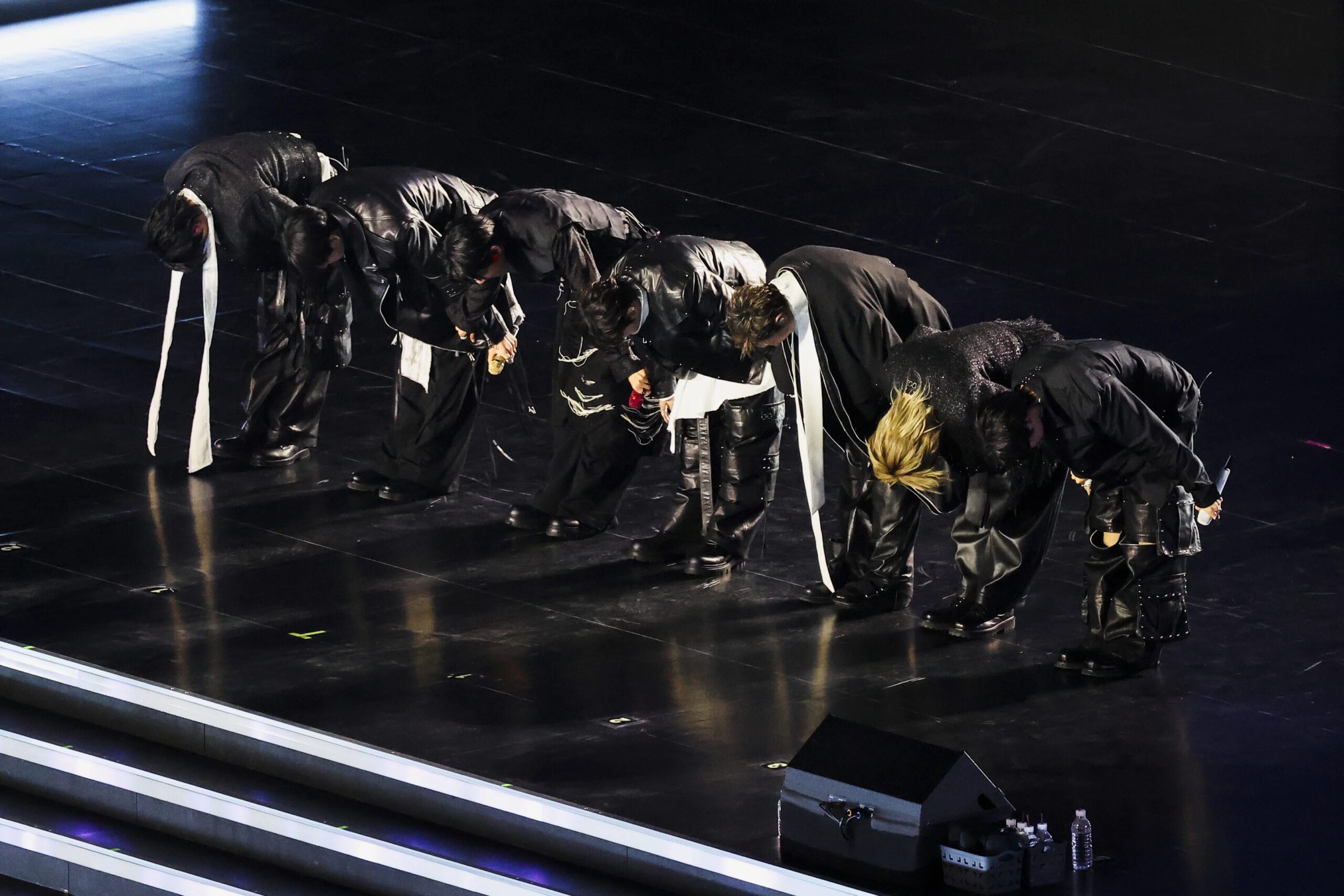
Butter and Mic Drop arrive as familiar but never predictable coordinates, while the seven kings of Seoul move with what can truly be defined without hesitation as the king’s walk, a gait that has no need for ostentation because it is based on an authority that is now acquired, sedimented, recognized globally, and which translates into a style that slips between an apparently effortless grunge chic and a maniacal aesthetic construction, made of leather, tears, clear contrasts between black and white that almost become a visual code of this new era.
Swim, the lead track, imposes itself live with a force that overwhelms any initial hesitation, confirming once again how BTS never gets a title track wrong, because their ability is not simply to anticipate the taste, but to build it, to educate it, to take it exactly where they want, while the voices intertwine with an almost surgical precision and at the same time emotionally devastating. In the finale, V and Jin’s vocal line becomes a necessary caress, the one that transforms a great song into something invincible, memorable, destined to remain, because that is where sound becomes memory and memory becomes identity.
It is here that everyone takes their own space and transforms it into a statement: RM, with his ankle out of commission, doesn’t spare himself a second, transforming his physical limit into an even more powerful form of stage presence, almost a silent challenge to fragility; Jin holds together elegance and emotional stability, becoming the invisible axis on which everything is supported; Suga works with subtraction and precision, with a control that is now a stylistic feature; j-hope is pure but never dispersed energy, a direction, a continuous push that structures the performance; Jimin transforms every movement into language, every gesture into a story; V plays on the contrast between vocal depth and almost cinematic presence; Jungkook closes the circle with a versatility that evolves, continues to surprise, to define the standard.
Gwanghwamun is full, but it is not just a question of numbers, it is an image, perhaps the most powerful image of this historical phase: a square that contains a nation and at the same time the whole world, while the seven voices – finally seven again – merge with a naturalness that has something moving and inevitable, as if no interruption had ever existed, as if time had simply waited.
Like Animals becomes the moment in which the narrative amplifies and at the same time leaves room for pure emotion, the one that crosses the square and overcomes geographical borders, reaching everywhere, because what happens there is not confined to Seoul but expands, replicates, is reflected in millions of screens and hearts.
And the memory inevitably runs to Busan, to what had been the last concert of seven, a moment that no one really wanted to imagine as such, and which today is loaded with a new, almost retroactive meaning, as if everything had found meaning only now, in front of that building which embodies Korean history and which becomes the perfect backdrop for a new departure.
When j-hope says it openly “BTS 2.0 just getting started”, it is not a slogan, it is a position, it is the declaration of a new chapter that does not erase the past but incorporates it, expands it, makes it a solid basis for something that is already bigger.
Dynamite arrives as a statement, a reaffirmation of cultural dominance, while the city around it transforms into a real temple: BTS are everywhere, on billboards, in shop windows, on the front pages, in a mobilization that has nothing forced but everything organic, almost inevitable, as if Seoul itself had decided to make itself manifest.
They close with Mikrokosmos, and the thread with ARMY doesn’t break, it has never been broken, because what binds BTS to their audience is not just affection but a shared construction of meaning, collective memory, identity.
They hold hands, say goodbye, ask to stay safe, to return home safe and sound, they worry about the cold of a March evening which, despite spring upon us, continues to bite, and they promise that this is only the beginning, that there is more, much more.
It is a concert that does not close a circle but opens a new one, broader, more ambitious, more aware. And there’s only one thing left to do. Swim. With them.
Because in the end, the question that stands out everywhere above Seoul, between the lights and the history, is only one: what’s your love song?
And this generation’s love song already has a name: BTS.