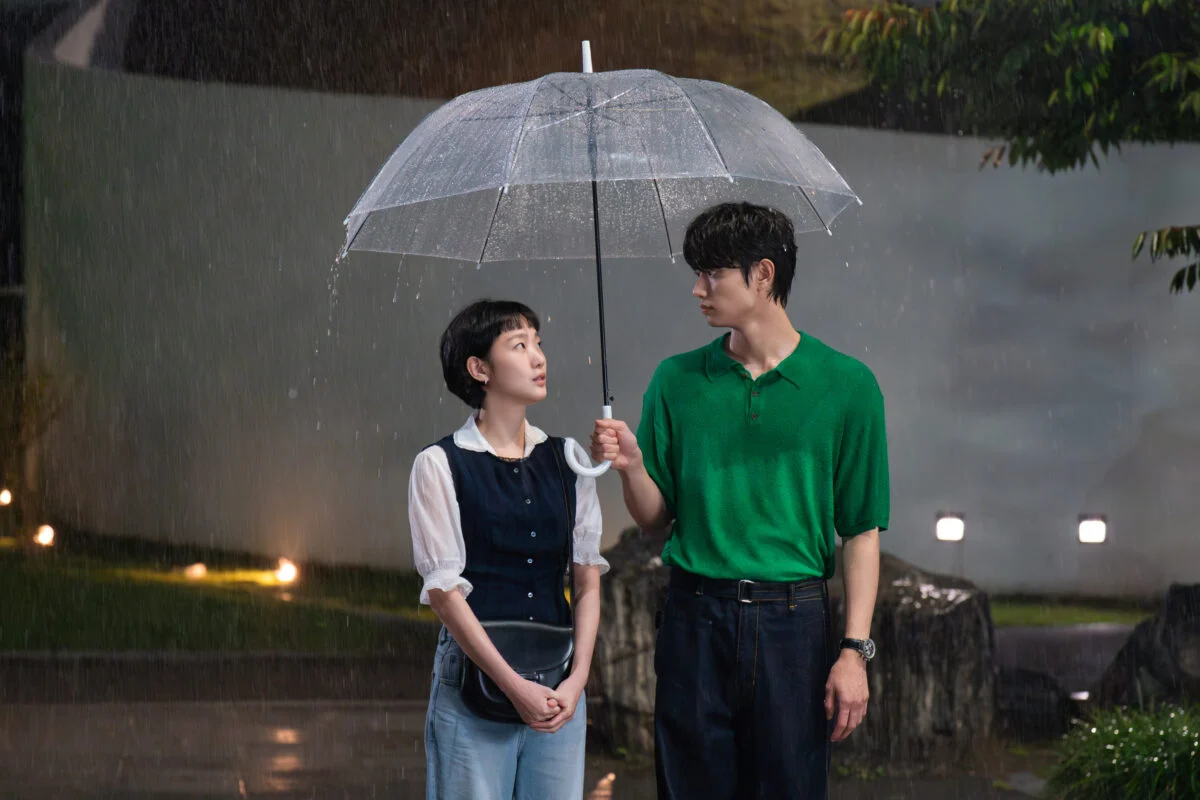
The moment a series manages to transform something intangible like everyday emotions, hesitations and contradictions into a recognizable language, it is no longer simply working: it is building a system, and that’s exactly what happened with Yumi’s Cellsa project that from the beginning has worked on an intuition that is as simple as it is difficult to sustain over time, that is, making visible what normally remains invisible.
Yumi, even before being a character, is a recognition mechanism: not a protagonist to follow, but an emotional structure to inhabit, an unstable balance between impulse and control, between what you think and what you really do, and it is precisely this split, made visible through the cells, that has allowed the series to do something that K-drama rarely tries to do: not tell about love, but tell how you come to feel it.
When the project was born as a manhwa, the intuition was already there, and when it became a series in 2021 it was not simplified, but amplified. The integration between live action and 3D animation is not a distinctive element: it is a language. And this is what allows the first season to work on falling in love without ever telling it directly, and the second to enter a more fragile area, one in which relationships – even the strongest ones, even those embodied by the characters played by Ahn Bo-hyun and Park Jin-young – stop being answers and become questions.
The first season works on falling in love as an all-encompassing phase, in which the cells take control and completely rewrite the perception of reality; the second introduces a more subtle crack, one in which relationships are no longer enough to support an identity which has changed in the meantime, passing through figures who are not simply partners but moments of transformation. The third season, the final one, does not raise the tone, does not accelerate, does not look for a twist: it works on something much more difficult, that is, what happens next, when apparently everything has been achieved.
Studio Dragon is behind this operation, but talking about it as a simple production company would be an understatement, because what it has built in recent years is a system that works on seriality as architecture, not as a product, developing content that is not adapted to the global market but designed to function within it from the beginning.
Yumi’s Cells is one of the clearest examples of this strategy: a project that takes a deeply local material, a manhwa built on specific emotional dynamics, and transforms it into a universal format without ever betraying it, maintaining that complexity which, instead of being a limit, becomes its main strength.
It is in this context that this collection of interviews is inserted, exclusively in Italy for Panorama.it – which does not function as ancillary content but as direct access to a process, to a way of building stories that is not limited to telling but organises, structures and makes visible.
Yumi after success: when control becomes a limit
The third season opens at a point that series rarely addresses with precision, because there is nothing left to conquer, at least apparently: Yumi has become a successful writer, she has transformed her talent into a stable, recognizable structure, and for this very reason she finds herself in a condition that is neither crisis nor equilibrium, but something more subtle, almost a suspension.
It’s not an obvious change — and it couldn’t be — because, as Kim Go-eun points out, “the Yumi of season 3 hasn’t changed drastically compared to before. She’s still Yumi”, only that continuity hides a deeper shift: “this is the Yumi who has achieved success in her career”, and therefore a version of herself who has stopped searching but has not yet learned to stop.
It is there that the story finds its most interesting tension, because work – which in previous seasons was a space of possibilities – suddenly becomes all-encompassing, almost exclusive: “after having worked tirelessly to become a successful writer, her life has become totally centered on work”, to the point that the problem is no longer what to do, but what is left out, “she no longer knows what to do besides work and even wonders how to rest”.
It is a condition that Yumi’s Cells it never emphasizes, it doesn’t dramatize, and for this very reason it manages to convey it with rare precision, because – as Kim Go-eun herself admits – the whole project has always moved on a very subtle balance: “this series captures the small and complex emotions we feel in our daily lives”, avoiding weighing them down, instead letting “the cells prevent Yumi’s situations from becoming too heavy, giving subtle smiles”.
And it is exactly this apparent lightness that allows the third season to go even deeper, working on an emotional saturation that does not need to be declared.
Soon-rok: rationality as interference
It is in this space, rather than in a real void, that Soon-rok enters, and the way in which he is introduced already says it all, because it is not a response but a deviation, a presence that does not fit in harmoniously but alters the system.
Kim Jae-won tells it starting from an almost technical element, but which immediately becomes narrative: “he is the editor responsible for the writer Yumi”, a figure therefore built on control, structure, rationality, “extremely disciplined, calm and rational at work, with a great analytical ability”.
It’s exactly the opposite of the way Yumi has always experienced her emotions, and that’s why the relationship between the two cannot be immediate, nor linear. It’s not meant to be.
And in fact it isn’t.
“Yumi, who is like a cell of love, and Soon-rok, who is like a cell of reason, have a relationship that slowly seeps in over time, like paint absorbed by a sponge.”
It is not a dynamic that explodes, but one that filters, which progressively modifies the balance, and it is precisely this slowness that makes it coherent with the language of the series, which never works by acceleration but by accumulation.
Even in the way Kim Jae-won describes the character, this double nature emerges, this continuous gap between surface and depth: on the one hand a controlled, almost rigid figure, on the other something that loosens, opens up, becomes humanized “once he returns home, when that rigidity fades, revealing a much more relaxed and adorable side”.
It is in this oscillation that the relationship takes shape, not as a traditional romantic construction but as an interference between two different systems.
Cells: the language that makes the invisible visible
But if Yumi’s Cells continues to work even after three seasons, it’s because it doesn’t limit itself to telling relationships but builds a language, and that language is the cells, which allow you to transform something abstract into a legible, immediate, shared mechanism.
It is no coincidence that Kim Jae-won himself goes so far as to define the series in almost radical terms: “this is, in a certain sense, a series in which the viewer becomes a cell himself and follows Yumi’s entire emotional journey”, completely shifting the point of view, eliminating the distance between the story and the viewer.
And precisely in this space, where identification becomes total, those apparently secondary details that instead define the tone of the series are also inserted, such as the way in which Kim Go-eun talks about her “favorite cell”, oscillating between irony and awareness: “personally, I have a weakness for the sensual cell… but officially, I will say that it is the cell of love”.
It’s a joke, but not only, because inside there is the whole logic of the project: a continuous shift between what is shown and what is hidden, between surface and structure.
An ending that does not close, but moves
At this point, simply calling it “final” becomes almost reductive, because Yumi’s Cells it doesn’t really close a story, but it completes a process, and it does so without ever changing register, without artificially raising the stakes, remaining faithful to that logic that made it recognizable from the beginning: working on micro-variations instead of events, on passages instead of turning points.
“I think ‘Yumi’s Cells S3’ is a drama that naturally makes people smile. It’s a series that brightens the mood just by watching it,” says Kim Go-eun, and it’s a definition that might seem light, almost superficial, if it weren’t precisely that lightness that supports everything else, that makes possible a narrative that constantly moves on two levels.
In the same way, when she talks about her own path within the series, the discussion broadens, stops being just about Yumi and becomes something more personal, almost a reflection on time: “I feel like I have entered the second chapter of my acting career thanks to ‘Yumi’s Cells S3′”, a passage that perfectly reflects that of the character, but also that of the series itself.
On the other hand, Kim Jae-won enters this balance with a different awareness, that of someone who enters an already built system and must find his own space without altering it too much: “it was an honor to participate in a work that receives so much love”, he admits, allowing a glimpse of that tension between expectation and control that also runs through his character.
And maybe this is exactly where Yumi’s Cells 3 finds its most interesting point, because instead of seeking a definitive closure it chooses something more complex, and therefore more true: not to resolve, but to continue to observe, to record, to let the emotions remain exactly what they have always been, that is, unstable, contradictory, difficult to fix in a definitive form.
In the end, what remains is not so much Yumi’s path – which is also completed – but the way in which that path was constructed, observed, made legible.
And in this sense, more than an ending, it is a statement of method. Because Korean serials no longer limit themselves to telling stories. He organizes them.