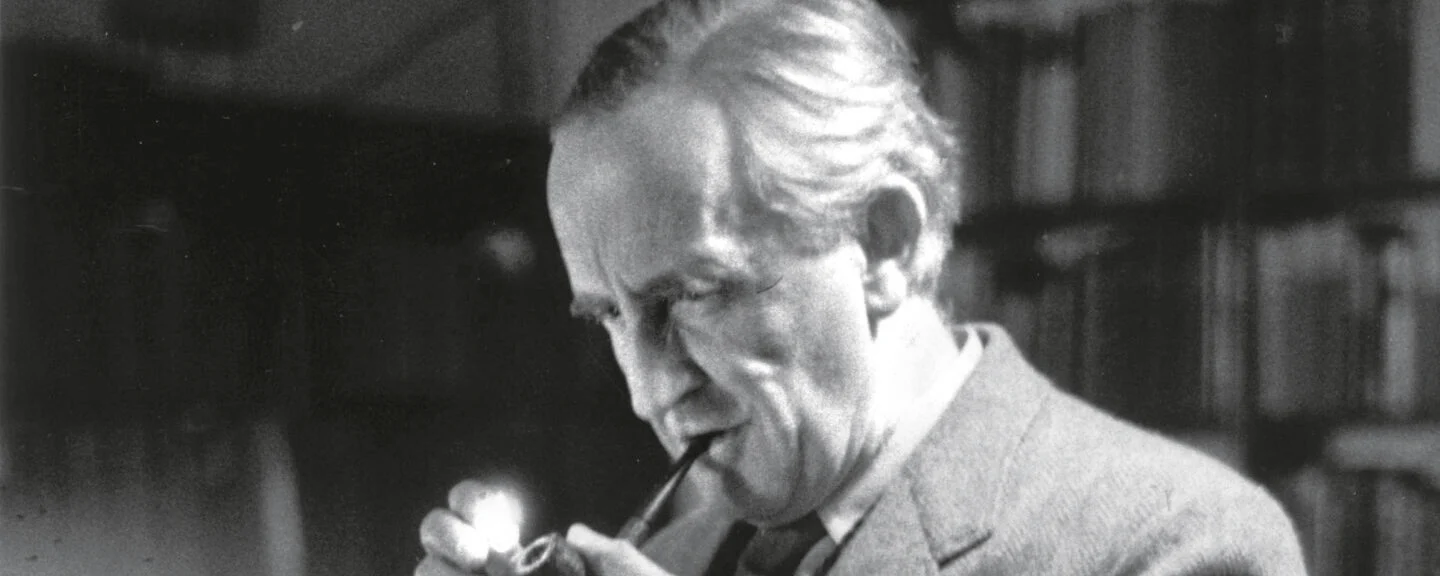
JRR Tolkien’s jacket, inevitably elegant, must also be rather worn at the bottom: there have been queues of people pulling it on for years. Those who think they have grasped its political message with crystalline clarity, those who think they have finally translated its purest essence, those who believe that it is undoubtedly time to send it to the attic because after all it is nothing more than a very pretentious fantasy.
And, in fact, finding yet another book on the Lord of the Rings and similar on the shelves is all too easy to have your mind clouded by prejudices: what original thing can one ever say about the English novelist that hasn’t already been said and refuted and re-said and refuted? And then aren’t all the unpublished and unfinished and the drawers emptied by eager heirs and publishers already enough? And yet – surprise – Rick DuFer’s essay entitled The Encouraging Thought. Tolkien in defense of the present (Bompiani) is anything but obvious, anything but banal. Indeed, it is even a book that is not only beautiful, but also profoundly effective, even useful.
Riccardo Dal Ferro, born in 1987, philosopher and popularizer on the Internet, author of theatrical shows and, as they say badly, “Internet personality”, is capable of speaking to millions of people online and expressing thoughts in a particularly captivating way. He is successful but, despite this, he remains original almost with shamelessness: in the flat Italian cultural panorama we are almost surprised to note the absence of envious excommunications towards him. He is young, he will have time to prove us wrong, but so far he has not become homogenized, and the volume on Tolkien demonstrates this powerfully. It is the book of a lover, of someone who explains with shining eyes how the author has “changed his life”, and who can’t wait to let others discover it. It is a praise of competitive, athletic thinking, of the courage to live, a drop of healthy antidote to the depression that at all costs they want to bring down on young and old.
«I believe that his is the epic that best describes our generation and not only that», he tells us, «the one that offers the most food for thought to better address certain problems of the present. An example. I am convinced that today we live in a historical moment in which we are completely reluctant to address the issue of mortality. Yet Tolkien wrote The Lord of the Rings – and indeed The Silmarillion and The Hobbit – as a great reflection on mortality. Whether we like it or not, death is the great event of our life, together with birth. The fact that we do not reflect on this issue is a cause of great anguish.”
Let’s start like this, from death, from the great repressed, from the deepest fear that seems to annihilate the present. «Tolkien is certainly an annoying voice for an era like ours. If there is a word that truly corresponds to the spirit of the times it is “anesthesia”. We use technology, we use entertainment, we use pharmacology, we use many elements, sometimes even philosophy, as an anaesthetic, as a search for consolation, for comfort. We live in a situation that is refractory to the idea of achieving goals through sacrifice, through effort. Tolkien goes completely against the trend and does so in the most unexpected way, building characters like the hobbits who are the exact opposite of the hero, the exact opposite of the adventurer. We can already see it in The Hobbit, but then even more so with Frodo Baggins, Pippin, Sam. The message that the author sends us, and which I believe is very current, is that if you live in your “county”, in a comfortable situation of well-being, you must remember that protecting that well-being could take you very far from home”.
Tolkien, for DuFer, is the singer of sacrifice. A topic that couldn’t be further from the limelight, totally anti-modern and also annoying for most. «What are Frodo and Sam doing going up to Mount Doom against all odds, all reason? They protect the Shire. They realize that the Shire does not exist alone, it is not detached from the world, but that it is in a network of events that are much bigger than their daily lives. And so they embark on this mission knowing that they might not even benefit from saving the Shire. The Lord of the Rings therefore brings us a message, again, annoying for our time. Today we do not want peace, but we want to be left in peace. We don’t want to protect the Shire, we want the Shire to be given to us. And we want to convince ourselves that we exist in a sort of limbo or Eden, protected from everything and everyone.” Tolkien dismantles all this rhetoric. And he firmly states that the mission that awaits everyone involves, in one way or another, a sacrifice.
“Sacrifice,” DuFer tells us, “is the toil of toil.” He’s right. Let’s look around: the widespread ambition seems to be that of living in an artificial paradise, in a hyper-protected pharmacological county. A constructed and digital happiness that every second reveals its inconsistency and shows pockets of profound discomfort. We refuse sacrifice and remain half-men, less than Hobbits, incapable of forming ourselves as adults.
“I love using the word abrasion,” insists DuFer. «Self-knowledge happens through abrasion, not through labels, not by buying an identity at the supermarket, not by saying: I want to be this thing here. You have to find out who you are. That discovery is an abrasive act. Why? Because in reality we spend a large part of our lives, especially when we are young, attaching labels to ourselves that seem to work in the world. As a teenager you have mimetic thinking: you see that model, that idol, that admired person and you try to stick masks on yourself to see which one works. And then what I call the “streetcars on the teeth of life” arrive and break your masks. What remains after this act of abrasion, after this initiation rite, is you, is truly you. What we cannot accept is once again linked to death. Borges said: I spend my whole life drawing a landscape, a mountain, a city, a night of celebration, and, only at the end, do I realize that I was drawing my own face. It means that we discover who we are, if we are lucky, only at the end, because everything else in life is precisely an act of discovery. Tolkien, a bit like the Nietzschean idea of becoming yourself, tells you that you are the path you take during life. And that path is never defined, it is never determined, it is never concluded. You must always be ready to get back into the game. His characters do just that, the positive ones at least. They decide to overcome the image of themselves by embracing the role that they have discovered to be theirs.”
In this sense, the most emblematic figure is certainly Aragorn. «A wanderer, who feels his lineage as a burden, who does not want to let his existence be dominated by the past. But he realizes that he must surrender to his character, therefore to what makes him the king of Gondor, the king of human beings. And so he embraces this destiny, through a sacrifice. He enters the mountain, meets the army of the dead and obviously puts everything at risk: no one gives him a guarantee that things will go as legend says. And it is through this sacrifice that he finally sheds his masks. Aragorn wants to be normal, he doesn’t want to be king. He doesn’t want power. This is precisely what makes him the most suitable for that role and when he embraces it he discovers who he has always been.”
This is the imperative: become yourself. Not by indulging every desire but, on the contrary, by denying immediate desires, sacrificing them, dying to be reborn, making life a wonderful chivalric romance. This is what Rick Dufer’s book says at the end. And it moves.