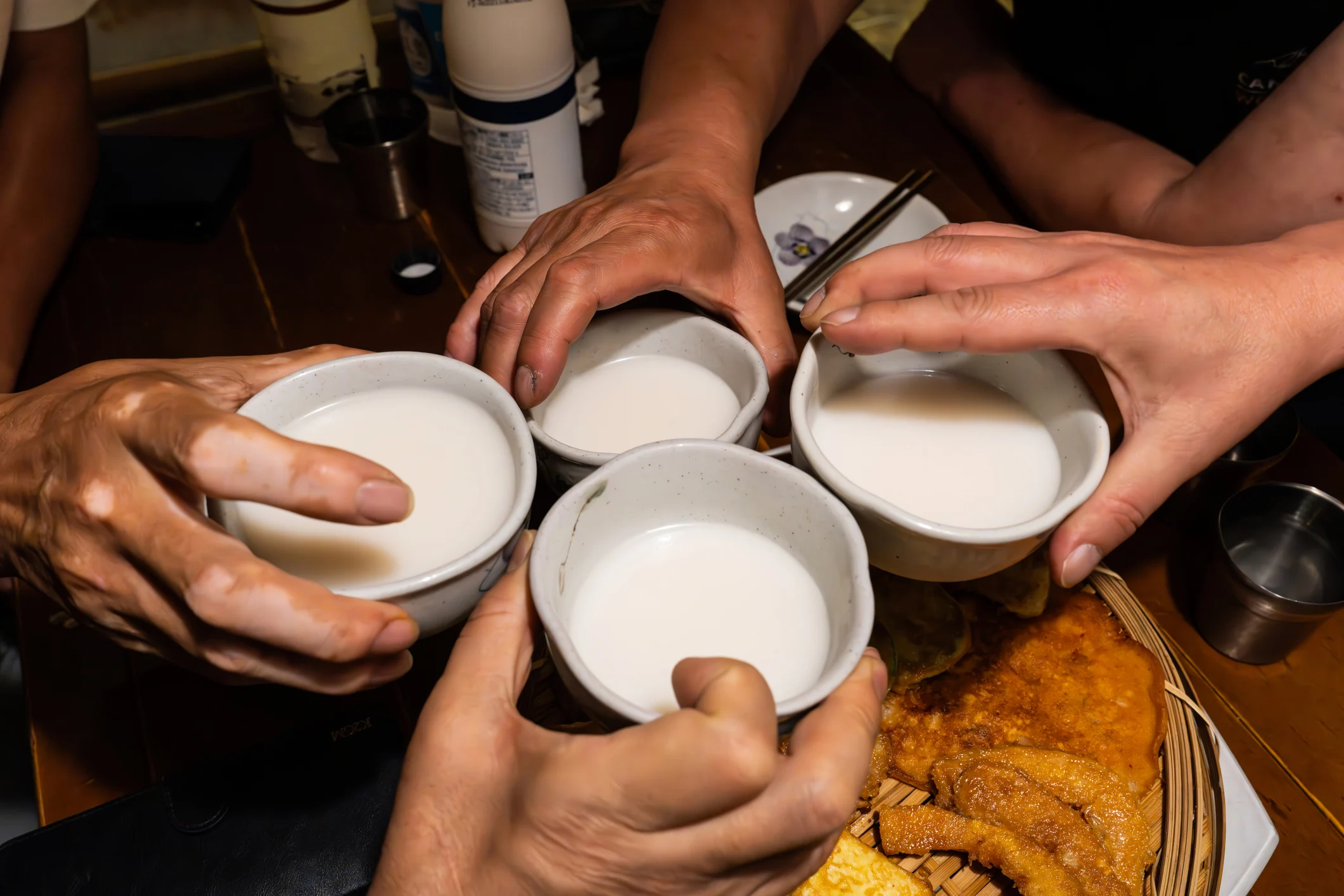
To really understand what is happening in South Korea today you don’t necessarily need to enter a K-pop concert, a Seongsu beauty flagship store or the set of a Netflix drama. Sometimes just looking at a bowl of makgeolli is enough. White, opaque, slightly sparkling, with that soft and irregular fermentation that for decades has above all described rural, agricultural Korea, far from the hyper-modern aesthetic that the country has exported to the world in the last twenty years.
Yet today that very ancient drink has become one of the most interesting symbols of contemporary Korean cultural transformation.
In Seoul, makgeolli is experiencing something that goes far beyond simple gastronomic rediscovery. It has entered cocktail bars frequented by Gen Z, new Korean cuisine restaurants, premium tastings, concept stores, places where minimalist design meets traditional fermentations. And above all it entered into a much broader story: that of a Korea that is learning to transform its cultural identity into a global language without giving up its roots.
From farmers’ drinks to Seoul rooftops
For years makgeolli was considered almost a drink “from another Korea”. The Korea of the countryside, of agricultural workers, of traditional restaurants frequented mainly by elderly people. A popular, cheap drink, often served in simple metal bowls and perceived as distant from the sophisticated, international image built by Seoul during the global explosion of the Korean Wave.
Then something changed.
In recent years, Korea has begun to experience a gigantic rediscovery of its cultural heritage. But not in the nostalgic way the West often looks at the past. Seoul isn’t preserving tradition under glass: it’s transforming it into a contemporary experience.
Makgeolli suddenly became cool. Not artificially, but through a very Korean process of aesthetic and narrative reinterpretation. The bottles have changed design. Independent breweries have begun experimenting with premium fermentations, regional ingredients and artistic collaborations. The locals have built sophisticated pairings. Bartenders have started using it in contemporary cocktails. And the young public has stopped considering it “the parents’ drink”.
Today it happens more and more often to see twenty-year-olds discussing makgeolli with the same naturalness with which in Milan we talk about natural wine or craft beer. The labels change, the language changes, but the cultural mechanism is surprisingly similar: the return to authenticity also becomes a response to global standardization.
The Seoul laboratory: what the makgeolli fair tells us
This transformation does not remain theoretical. It can also be seen very clearly in events such as the Korea Makgeolli Expo in Seoul, where makgeolli is no longer presented as a simple traditional product, but as a cultural universe made up of tastings, contemporary packaging, regional producers, gastronomic pairings, cocktails, crafts, tourism and the story of the territory. It is here that the drink stops being just a peasant memory and becomes a platform: a place where Korea showcases its ability to make what is ancient current, without having to trivialize it or dress it up as a passing fad.
Walking through the stands, you can clearly perceive how makgeolli is experiencing a transformation very similar to that experienced by natural wine in Europe: small independent breweries that tell the story of the territory, almost obsessive attention to ingredients, artisanal fermentations, bottles constructed as aesthetic objects, a sophisticated visual language and above all a young audience willing to consume tradition as long as it is told with contemporary codes.
The point is not just how many bottles are tasted or how many stands attract creators and lifestyle influencers. The point is that makgeolli, within a fair of this type, becomes legible as a cultural phenomenon: a tradition that is organised, told, positioned and tries to speak even outside Korean borders. Exactly as has already happened with cinema, music, beauty and cuisine, traditional alcohol also enters the broader vocabulary of Korean soft power.
Korea rediscovering itself
The transformation of the makgeolli actually tells something much deeper about contemporary Korea.
In recent years, Seoul has experienced a very powerful return to all that is tradition reinterpreted: restored hanok transformed into cafés, craftsmanship brought back into contemporary design, historical fermentations rediscovered by chefs and young entrepreneurs, traditional ceramics become lifestyle objects, historic neighborhoods transformed into creative hubs.
Areas like Ikseon-dong, Seochon or even some areas of Seongsu clearly show this new cultural direction. Korea no longer wants to choose between modernity and the past. He wants to transform the past into an extension of his own contemporaneity.
And this is exactly where the makgeolli becomes interesting also from a cultural and political point of view. Because it is not just a drink: it is a piece of national identity that is repositioned within the global market.
The new Korean soft power
For years, Korean soft power has relied mainly on music, drama and beauty. Today, however, the Korean Wave is entering a different, broader and probably more mature phase. It no longer exports just pop content, but a complete cultural style.
International Korean cuisine, the boom in gastronomic tourism, the growth of interest in traditional fermentations, heritage aesthetics, design linked to rural culture, the global success of Korean literature: everything seems to be part of the same ecosystem.
And it is interesting to observe how Korea is trying to build ever deeper connections through written culture and not just visual or musical culture. In Italy this process also passes through initiatives such as the “Korean Books in Italy” portal, created by the Consulate General of the Republic of Korea in Milan to collect and promote the main publications by Korean authors in Italy and by Italian authors on Korea. A platform that has already exceeded 200 thousand views and which explains well how the Korean Wave is progressively entering a more structured and cultural dimension.
Because today’s Korea isn’t simply exporting entertainment. It’s building cultural familiarity.
A new image of Korea
Observing the contemporary success of makgeolli therefore means observing a Korea that is very different from the most common Western stereotypes. Not just technology, K-pop, Gangnam lights or skincare. But also fermentation, rituals, rural heritage, gastronomic memory and territory.
And this is perhaps precisely the most interesting phase of the contemporary Korean Wave: the one in which the country stops seeming like just a hyper-fast pop power and instead begins to describe itself as a complex, stratified cultural civilization, capable of transforming even an ancient drink into a contemporary language.
Today makgeolli is no longer just traditional alcohol. It is design, branding, lifestyle, experience, tourism and identity. And it’s probably one of the most accurate images of Korea that’s coming now.