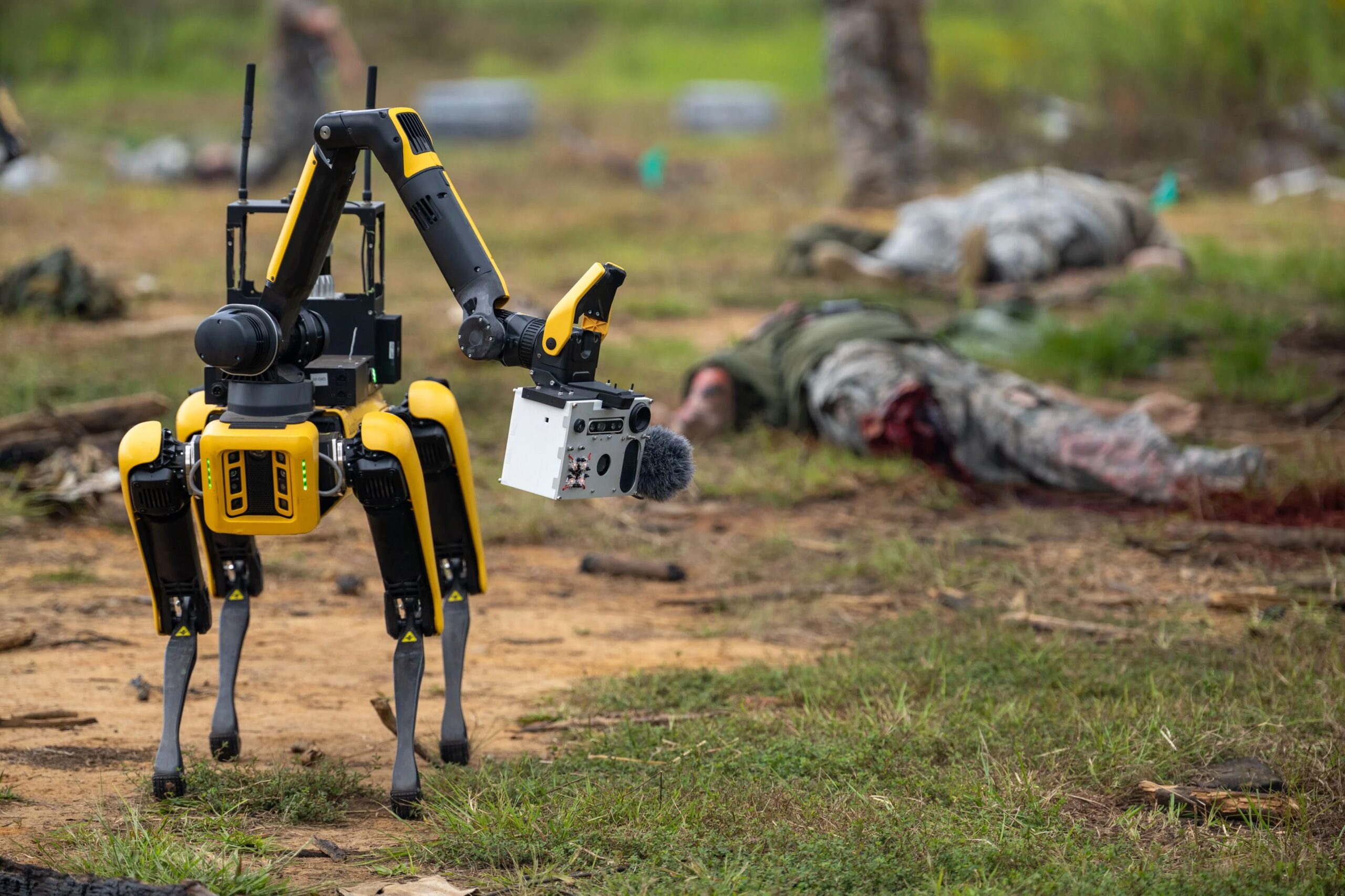
After artificial blood, Darpa launches a tender to design automatons that can diagnose the conditions of the wounded, administer treatments and evacuate soldiers from the battlefields.
Someone now elderly will remember a famous scene from the Star Wars saga “The Empire Strikes Back” in which some robots take care of the serious wounds suffered by the protagonist Luke Skywalker. Well: a robot capable of caring for the wounded in battle is what the United States Military Research Agency (Darpa) is thinking of designing. During high-intensity combat, medical care in the field is overwhelmed, so engineers have imagined a swarm of robots that can join together in order to be able to drag the wounded to safety. Such automatons would also be able to establish the conditions of the injured and, if necessary, administer life-saving drugs, even transforming themselves to create splints around fractured limbs. All this is what is specified in a tender whose objective would be to lead to the design of a “mobile, autonomous robotic solution, capable of self-availability, assessing injuries, operating in swarms and self-connecting, to help reach and move the injured and perform life-saving interventions where needed.” The deadline for submitting proposals will be in early June and several proposals are expected from already known companies but also from Californian startups. Underlying the requirement is the understanding that the current battlefield medical system in recent years may have worked for counterinsurgency operations conducted by small units, but is unable to handle casualties resulting from large-scale conflicts. Thus, Darpa stated that future large-scale combat operations foresee incidents with high numbers of casualties, delays in evacuations and insufficient capacity of the medical system. Delay in medical treatment on the battlefield entails a high probability of death due to lack of control of bleeding, the main cause of death but also the potentially avoidable one. In its study, the Agency believes that all this is achievable thanks to recent advances in robotics and the cooperative capabilities of drone swarms. Any proposed solution will also have to meet at least two of the four requirements listed in the tender and one of these involves the machine’s ability to drag a wounded soldier a short distance, at least ten metres, even when he is not on a stretcher. The swarm concept is necessary both in the case in which a single robot does not have enough power for a transport, and must therefore act in a group, and in cases in which multiple machines must wrap themselves around an injured limb to immobilize it and prevent further physical damage while the injured person is dragged to safety. The third requirement is related to the possibility of injecting drugs after placing tourniquets. To understand the conditions of the injured person, it will be essential to read the so-called wearable devices, i.e. the wearable sensors that communicate the vital parameters both to the robots and to the command and control centers. The announcement states that among the operational conditions that make such a war strategy possible is the fact that the number of human fighters will be lower than that of autonomous machines. Thus the robots would self-organize and reassemble themselves into useful shapes to ensure the control of massive hemorrhages. The goal will also be to be able to create an intelligent tourniquet capable of tightening autonomously around injured limbs to stop arterial blood flow but at the same time loosen it to preserve the limb. Darpa’s idea is that such medical robots could interact with unmanned ground vehicles to hasten the evacuation of the wounded without increasing the risk to other soldiers. The first phase of the project will include demonstrating the system’s multiple capabilities, including being able to identify injuries, as well as mobility on rough terrain. Subsequently, we plan to create a prototype to be validated in the field using cadavers, animal models or phantoms for high-fidelity medical training. The impact will also be notable in the civil field: in cases such as the collapse of buildings, the presence of fires and dangerous chemical substances, it may be impossible to reach civilian victims without the aid of robotic and autonomous systems. But with robots, life-saving first aid can provide the necessary time for stabilization while waiting for medical rescue teams to arrive.