Over 18,500 km and up to 22 hours without refueling with 238 passengers seated in four classes. The first delivery for Qantas is expected in April 2027.
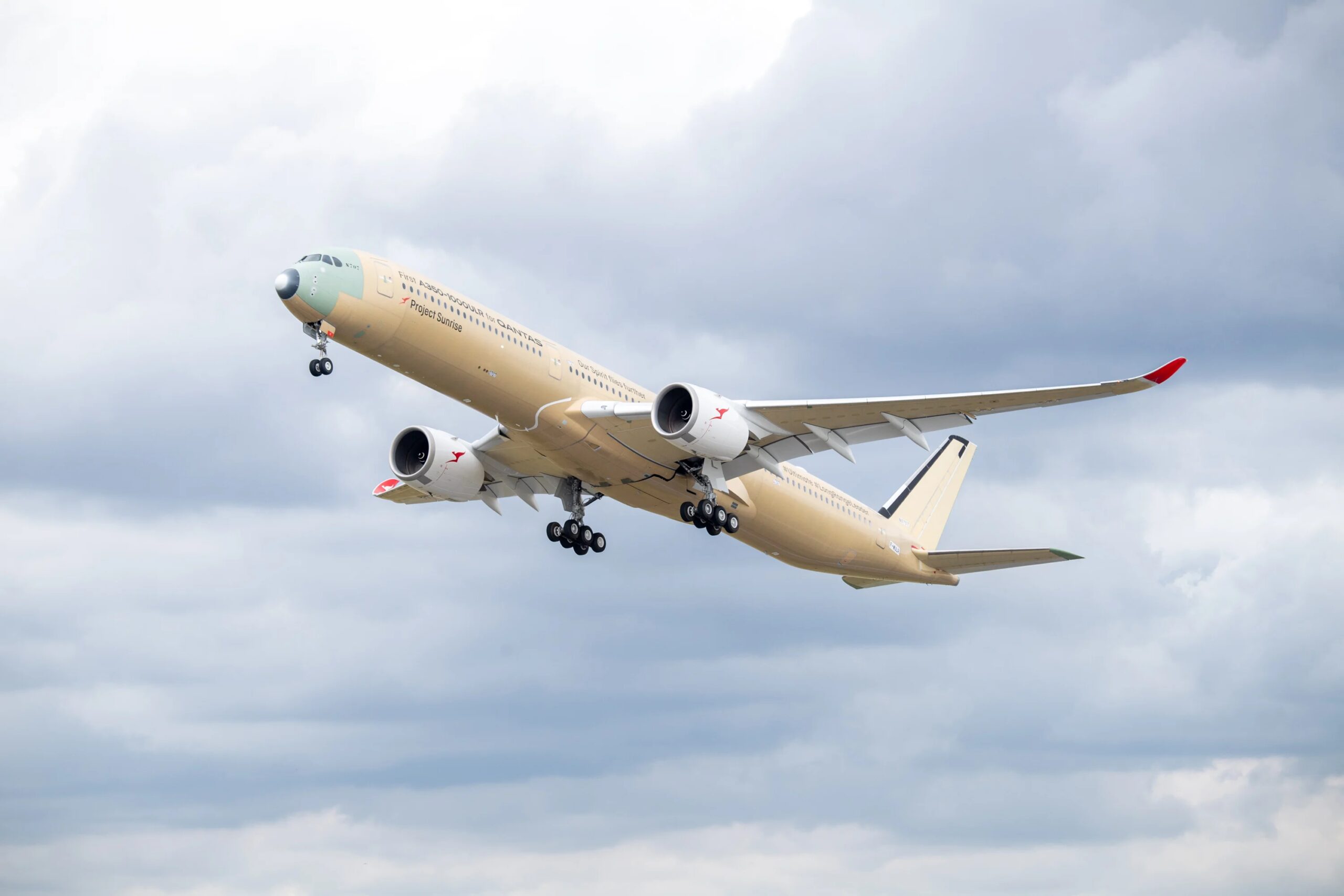
The Airbus A350-1000ULR (Ultra Long Range), currently the commercial airplane with the longest range in the world today, flew for the first time from Toulouse airport yesterday, June 2nd. Equipped with the specific instrumentation to complete the certification program approved by the European (EASA) and US (FAA) aeronautical authorities, it is the first of the twelve aircraft specifically developed and then ordered by the Australian company Qantas for its “Sunrise” project.
The large twin-jet therefore flew for three hours and 43 minutes, reaching an altitude of just over 41,000 feet (almost 12.5 km) with the expected results, that is, proving to be fully compliant with what was expected in terms of performance and flight quality. This was confirmed with satisfaction by experimental test pilots Thomas Wilhelm and Anthony Flynn together with test flight engineer Laurent Rossignol. Also on board were chief test engineers Tuan Do, Alexia Plumet and Vincent Frayssinet.
Qantas Airways’ request was for an aircraft that would allow for the first time ever non-stop flights between Sydney and London, a distance of almost 10,000 nautical miles (over 18,500 km), with flight times of up to 22 hours. This was made possible mainly by the integration into the structure of the aircraft of an additional tank in a central rear position (called Rct), which further improves the autonomy of the aircraft by extending it by approximately two thousand kilometers compared to the previous one.
During the first flight, the crew carried out general checks on the aircraft’s performance and evaluated the new architecture of the engine fuel system. This marks the start of a flight test campaign that is expected to last at least two months to certify the modifications.
Furthermore, a new galley air cooling system will also be certified on board, featuring lighter and more efficient refrigeration units for very long-haul flights. Another system to test thoroughly is that of the ventilation and temperature control of the cabin. Once everything has been validated, the aircraft defined as “Msn 707” will be adapted to Qantas’ commercial specifications, furnished as expected with a four-class seating configuration and delivered by April 2027.
Meanwhile, the second example is being assembled and will be taken to the paint shop in the next few days. The “-1000ULR” variant is the fourth passenger variant of the A350 family and the best-selling. It joins the A350-900, A350-900ULR and A350-1000.
Together, these aircraft have set new standards in long-haul air travel, with dramatic reductions in fuel consumption and carbon emissions, as well as new levels of comfort for passengers. These series will soon be joined by the new A350F freighters, also currently under development at Airbus, with the first flight expected by the end of this year.
The A350 program proves to be highly successful: by the end of April 2026, 1,579 orders had been received from 68 customers, with over 700 aircraft in service with 41 operators, mainly on long-haul routes around the world. Qantas has ordered twelve A350-1000ULRs as part of the Sunrise project designed to overcome one of the last limitations of direct flights from Australia.
The Australian carrier has also ordered a dozen standard A350-1000 aircraft for future operations on its long-haul network. The new -1000ULR airplane is 73.79 meters long, has a wingspan of 64.75 and is 17.08 meters high. The dimensions of the habitable part of the cabin are 58.03 by 5.61 metres, with a maximum height of 190 centimetres. The interior of the plane includes six “First suites”; 52 Business suites; 40 Premium-economy seats and 140 economy seats.