The G7 in Evian-les-Bains opens under the sign of Donald Trump and the Strait of Hormuz. As the leaders arrive in the elegant French resort overlooking Lake Geneva, the summit hosted by Emmanuel Macron immediately takes on the most concrete and riskiest form of contemporary geopolitics: energy, war, sea routes, Iran, Ukraine and global security. Not a family photography summit, therefore, but a high-tension meeting, in which every declaration weighs on the markets, chancelleries and military balances of the Middle East.
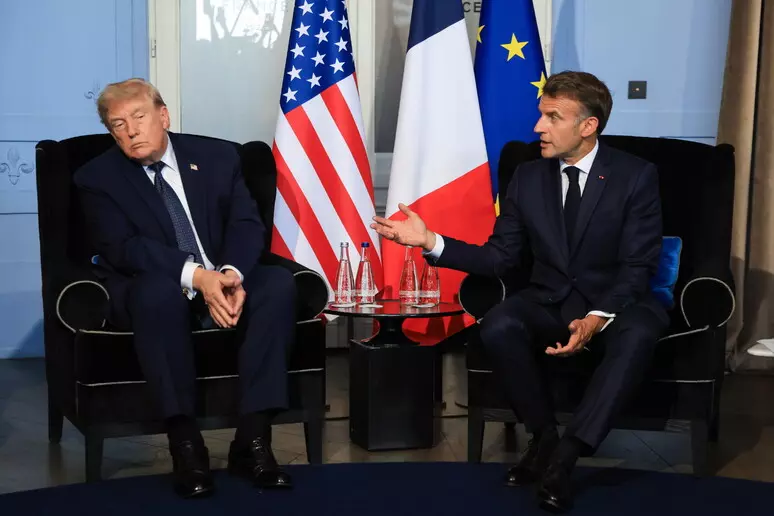
The American president arrived at the Evian Resort welcomed by the French head of state, with whom he had a first bilateral meeting before the official start of the works. And it was precisely at the end of the face-to-face meeting with Macron that Trump launched the message destined to dominate the day: “The Strait of Hormuz will be completely open on Friday.” A clear phrase, uttered while the world looks at one of the most strategic maritime passages on the planet, a fundamental crossroads for the transit of oil and a symbol, in recent months, of the fragility of an international order increasingly exposed to the force of regional crises.
Hormuz at the center of the summit
Trump explained that the United States would not need “much help” to reopen the Strait, but he still asked France for an operational contribution. “I wish France could deploy one or two ships,” he said, addressing Macron. The French president’s response came immediately, with a diplomatic but very concrete tone: Paris would be ready to make fighters available as early as tomorrow for reconnaissance missions, frigates within 48 hours and, subsequently, also an aircraft carrier.
It is an availability that captures the double level of the summit well. On the one hand the Western need to show unity in the face of the Middle Eastern crisis, on the other the European, and French in particular, desire not to appear as a simple spectator of American decisions. Macron hosts the G7 with the ambition of bringing together often divided allies, divergent strategic interests and an American leadership which, with Trump, remains unpredictable even when dictating the line.
The agreement with Iran and the issue of sanctions
The Iranian dossier remains the political heart of the day. Trump made clear that the deal with Tehran does not include any immediate easing of sanctions. «It’s really a question of behavior. If they do what they have to do…”, he said, implying that any future openings will depend on Iran respecting the commitments made.
The point is decisive, because behind the reopening of Hormuz there is not only the safety of ships or the resumption of energy flows, but the possibility of building a credible truce in a region that has reached a very high level of tension. The American president claimed the result as a passage already underway, also claiming on Truth that some ships, many of them loaded with oil, were starting to move and exit the Strait through what he defined as a safe and protected “southern highway”.
As often happens with Trump, political communication precedes and accompanies diplomacy. The message is designed to be read by the markets, allies, adversaries and American public opinion: Washington returns to center stage, decides the timing, measures the aid requested from the Europeans and ties every concession to Tehran’s behavior.
Evian, the leaders’ catwalk becomes a crisis table
The arrival of the leaders in Evian completed the picture of a summit built around major international emergencies. In addition to Trump and Macron, the Prime Minister Giorgia Meloni, the President of the European Commission Ursula von der Leyen and the President of the European Council António Costa are present, together with the British Prime Minister Keir Starmer and the Canadian Prime Minister Mark Carney.
The guests also include Brazilian President Luiz Inácio Lula da Silva, Japanese Prime Minister Sanae Takaichi and Egyptian President Abdel Fattah al-Sisi. A composition that broadens the scope of the discussion and confirms how the G7 can no longer afford to think only within the traditional club of industrialized powers. Today’s crises, from energy to food security, from regional wars to technological competition, cross continents and force Western leaders to seek external interlocutors, not always aligned, but increasingly necessary.
In this scenario, Meloni’s presence takes on a significant value. Italy comes to the table at a stage in which the wider Mediterranean has once again become central, between Lebanon, Iran, North Africa, energy routes and maritime security. The Evian summit thus also becomes the place where Rome can try to reaffirm its role as a hinge between Europe, the Mediterranean and the Middle East, in a game where stability is no longer an abstract concept, but an issue directly linked to prices, supplies, migrations and national security.
Macron seeks balance, Trump shifts the center of gravity
The host Emmanuel Macron tries to give the summit an imprint of multilateral coordination, but Trump’s arrival inevitably shifts the center of gravity. The American president does not limit himself to participating in the summit: he passes through it with his agenda, his announcements and his direct, often brutal language, always capable of imposing itself on the public debate.
This is also demonstrated by the message published in Truth before landing in Geneva, in which Trump wrote: «Unfortunately, if you import people from Third World countries, you quickly become a Third World country; and there’s nothing you can do about it.” A phrase destined to fuel controversy, especially in an international context in which immigration, security, national identity and social cohesion remain among the most explosive issues on the Western political agenda.
He is the most recognizable Trump: the one who alternates international negotiation and identity message, diplomacy and permanent rally, operational declarations and cultural provocations. At the G7, this double posture weighs even more, because the summit should be the place of synthesis between allies, while the American president tends to transform it into the stage of vertical, personal and muscular leadership.
Ukraine and Lebanon remain in the background, but weigh on the table
After the bilateral meeting with Macron, Trump made it known that he now wanted to focus attention on the war in Ukraine. The dossier remains one of the most delicate of the summit, also because support for Kiev continues to represent a test for the West’s stability. The Ukrainian issue adds to the Middle Eastern front, Lebanon in flames and the need to prevent open crises from coalescing into a single great global instability.
Ursula von der Leyen’s words on Lebanon, according to which there cannot be lasting peace as long as the country remains “in flames”, clearly indicate how much the G7 is forced to move on multiple levels at the same time. No dossier is isolated. The reopening of Hormuz speaks of Iran, but also of energy. Lebanon talks about regional security, but also about relations with Israel, Hezbollah and the Arab powers. Ukraine talks about Russia, but also about European defense, military industry, public spending and the future of NATO.
The leadership under pressure
Outside the official table, tension was also seen in the protests against the G7, with clashes in Geneva between the black bloc and the police during the “No G7” march. A now usual side dish for large international summits, but not irrelevant: while the leaders discuss security and stability, a part of the square contests the model of global governance represented by the G7, considered by many to be an organism incapable of addressing inequalities and climate crises without reproducing existing power relations.
Evian, with its orderly and almost suspended image, thus becomes the perfect theater of a contradiction. Inside, heads of state and government try to hold together an increasingly fragmented world. Outside, the protest reminds us that trust in multilateral institutions is anything but a given. In the middle, there is reality: open wars, energy routes to protect, agreements to verify, alliances to keep up.
The G7 begins with a promise: Hormuz open on Friday
Trump’s promise to fully reopen the Strait of Hormuz by Friday is the first major test of the summit. If confirmed by the facts, it could mark an important step in de-escalation with Iran and reduce pressure on energy markets. If, however, it were to prove more fragile than expected, the Evian G7 would risk being born already a prisoner of the distance between political announcement and reality on the ground.
For now, the picture of the day is clear: Macron hosts, Trump dictates the pace, Europeans seek space and the world looks to Hormuz as a thin line between stabilization and new crisis. Evian was supposed to be the pinnacle of great international challenges. It became so immediately, without preamble, in the most concrete way possible: through a Strait, some ships, many promises and the usual, enormous question that accompanies every global summit of the present era. Who really has the strength to turn statements into order?