- Researchers at the University of Cambridge recently developed the world’s first vaccine designed by artificial intelligence (AI) and successfully tested it in humans.
- The vaccine was created to protect against viruses in the sarbecovirus family, including both SARS and SARS-CoV-2, the virus that causes COVID.
- Medical News Today spoke with a virologist and an AI scientist to discuss vaccine safety and effectiveness, and how AI can help scientists develop universal vaccines.
The world’s first human vaccine designed by artificial intelligence (AI) and developed by scientists at the University of Cambridge has passed its initial testing successfully and is currently undergoing further testing.
What makes this vaccine different from traditional vaccines is that, instead of being developed in response to current strains, it uses a predictive design.
To achieve that, scientists used AI to analyze multiple coronaviruses to create a “super antigen.” With this super antigen, they were able to target the common features of viruses in the coronavirus family and, in a sense, future-proof the vaccine against current and future coronavirus mutations.
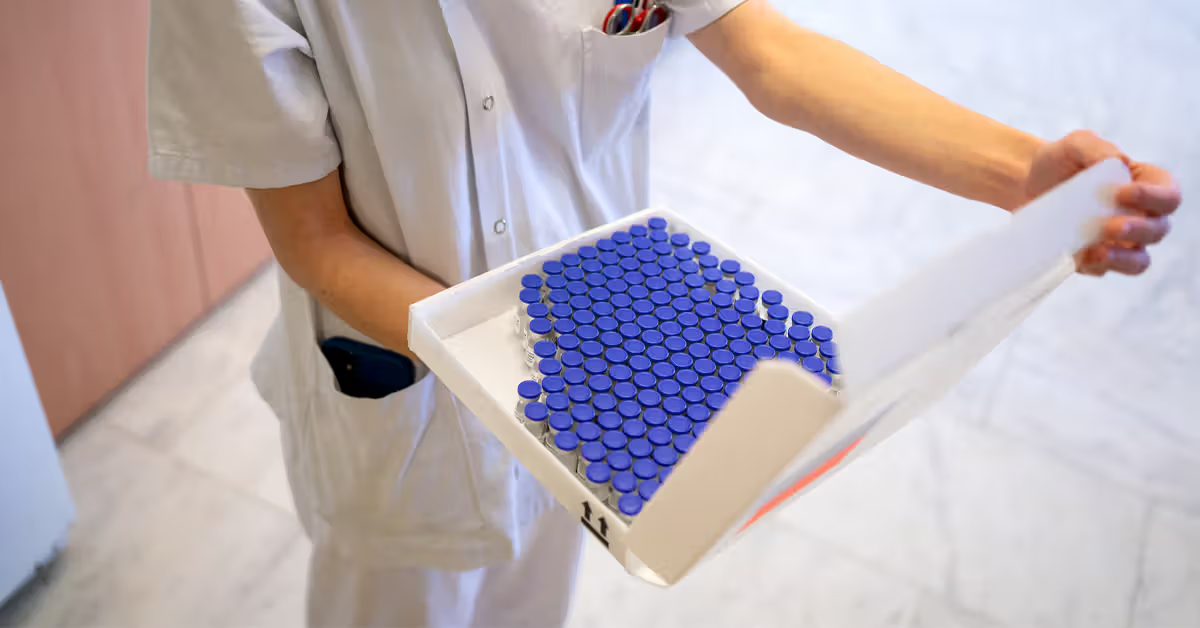
The vaccine also has a needle-free design, using a specialized jet injector via the PharmaJet Tropis system. Rather than piercing the skin with a traditional metal syringe, it uses fluid dynamics to deliver the vaccine ingredients exactly where they need to go.
However, the technology remains highly experimental, and the first human trial included only 39 people.
The results of the trial were published in the Journal of Infection.
To decipher what this trial means for the future of vaccine development and how this technology works, Medical News Today spoke to two experts who were not involved in the research:
- Monica Gandhi, MD, MPH, an infectious disease specialist and professor of medicine at the University of California, San Francisco,
- and Marc Boubnovski, senior AI Scientist at Novo Nordisk.
What the phase 1 trial results show
The trial was small, with only 39 people as participants, and was designed to test the vaccine’s safety. A second trial involving 200 participants is currently underway to determine how effective it is.
The vaccine produced what scientists described as a “modest” immune response in humans. This, compared to a
“The trial achieved what phase 1 trials are mainly meant to test: early safety and tolerability. It also showed some evidence that the design can focus responses on conserved sarbecovirus regions,” Boubnovski said.
He has also reiterated that the vaccine needs to undergo much larger trials before it is deemed safe and effective for the real world.
“(The trial) did not yet show the strong, broad immune response you would want before calling it a protective universal coronavirus vaccine,” Boubnovski said.
Meanwhile, Gandhi pointed out an important fact regarding individual and herd immunity against SARS-CoV-2.
“I was not surprised that the population (in the trial) already had good immune responses to SARS-CoV-2 by the time the study was conducted. The COVID-19 pandemic started in 2020, and virtually every adult across the planet has been exposed to the virus already, generating strong immune responses, or has received a vaccine,” she said.
“The computational design platform is sophisticated and ambitious, but the paper does not let us judge whether the AI algorithm itself is exceptionally advanced compared with other state-of-the-art antigen-design methods,” Boubnovski told MNT.
“It’s not ‘pure AI’ in the sense of a system that designs a vaccine end-to-end by itself. It’s more like computer-aided engineering for vaccines,” he explained.
“The researchers used computational biology to compare related coronaviruses, identify conserved parts of the spike receptor-binding domain, and design a synthetic antigen intended to focus the immune system on shared weak spots across that virus family,” he continued.
“The computer helps generate and prioritize candidates, but biology still gets the final vote through lab testing, animal studies, and human clinical trials,” he added.
The intellectual property for the vaccine is owned by DIOSynVax Ltd, University of Regensburg, and Cambridge Enterprise Ltd.
Designing a vaccine for a virus yet to exist?
Boubnovski urged caution in overinterpreting the abilities of AI-designed vaccines to protect against viruses that are not yet known. The science shows that AI employs advanced pattern recognition to identify how viruses in a particular family operate.
“(This technology) cannot design a guaranteed vaccine for an entirely unknown virus. What it can do is design against a family of related viruses. That is why the claim should be limited. It is plausible for related future variants or related viruses, not for a completely unrelated new pathogen,” he stressed.
Gandhi explained how scientists set their target for the vaccine.
“(The research) was heartening in that immune responses were generated to SARS, SARS-CoV-2, and related Sarbeco-Coronaviruses by this AI-generated vaccine because common elements from each virus were quickly determined by the AI platform, and then a vaccine was generated against those common elements. This is exactly how this technology could design a vaccine against a virus that doesn’t exist yet,” she said.
Gandhi said that a vaccine that can generate an immune response against common elements of coronaviruses would help provide broader protection, including “even ones that have not evolved yet in nature.”
“These elements are called ‘conserved’ and that just means that they are pieces of the viruses (often buried deep in the virus) that are the same across species, or common, and don’t change much even when a new coronavirus emerges,” she said.
And could this vaccine technology help against other diseases?
The researchers behind this vaccine are currently applying the same AI technology to develop universal vaccines for influenza (the flu) and Ebola.
“If we know that influenza viruses and coronaviruses are the two types of viruses that have the most pandemic potential because they are easily transmitted from human to human by respiratory contact, we know a novel coronavirus (such as SARS-CoV-2 in 2020) can be very dangerous to a non-immune public,” Gandhi said, highlighting how this technology could be helpful in preventing future outbreaks.
“I think an AI-derived vaccine for viral infections is an excellent idea because AI has the power to scan sequences of viruses quickly to determine common elements that allow for cross-protection to different viruses. This was illustrated in the case of (this) vaccine, which provided cross protection against more than one virus in the sarbecovirus family, including both SARS and SARS-CoV-2.”
—Monica Gandhi, MD, MPH
“I think the public would accept this type of vaccine design as this vaccine is needle-free, provided by a transdermal patch, which will increase acceptability,” Gandhi told MNT.
“mRNA vaccines seemed to the public to be developed too quickly, and misinformation on their safety surrounded their rollout, which brought down trust in the public.”
“Hopefully, misinformation will not accompany the roll-out of AI-generated vaccines, and public health officials can explain their derivation and why AI helps generate vaccines more quickly in an accessible, trust-generating manner,” she explained.