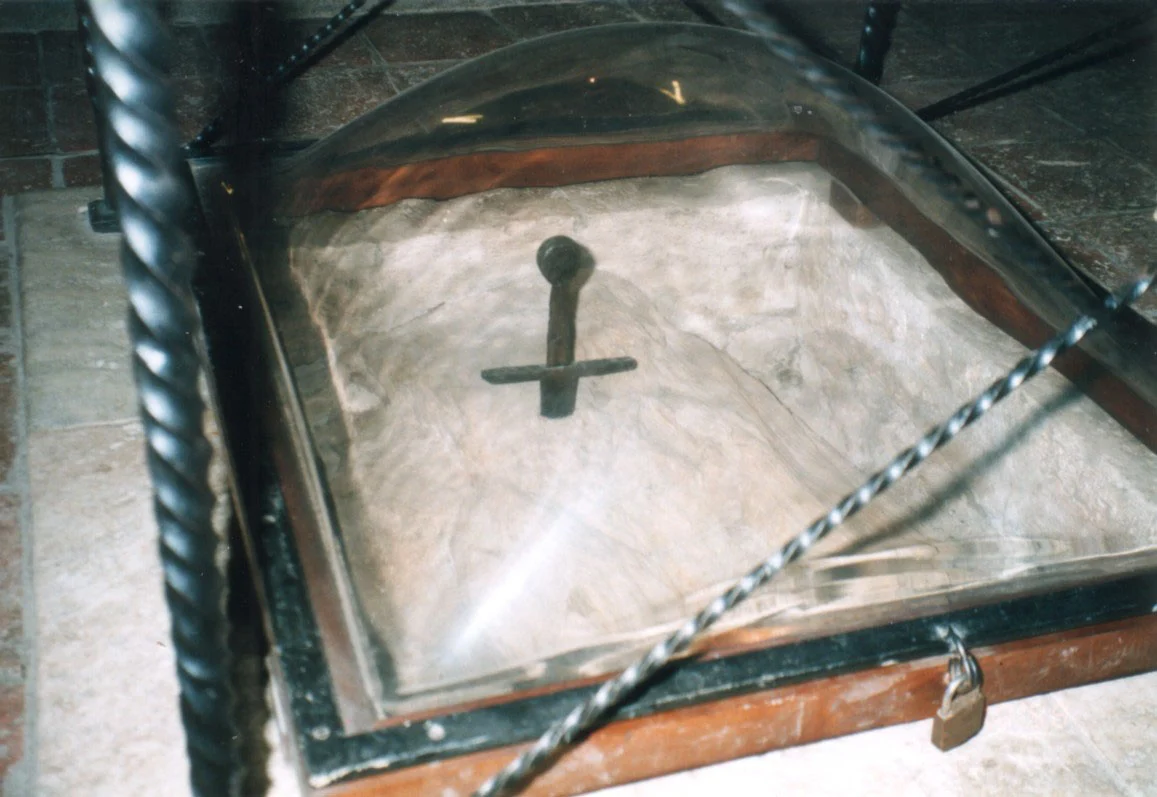
It is not in England, but in Tuscany: in the Rotonda di Montesiepi there is the sword in the stone of San Galgano, amidst history, faith and legend.
For millions of people, the sword in the stone belongs to fantasy, to the tales of Camelot, to the young Arthur called to extract the blade destined to consecrate him king and become a symbol of a superior power. Yet there is a real sword in the stone, kept not among English castles nor in the Welsh countryside, but in the heart of Tuscany, on the hills surrounding Chiusdino, in the province of Siena.
For over eight centuries a medieval blade has emerged from the stone inside the Rotonda di Montesiepi, the chapel overlooking the Abbey of San Galgano. It is one of the most fascinating places in Italy, where history, faith and legend coexist in a surprising balance and where the question that accompanies every visitor is always the same: is that sword really authentic? And above all, could its story be older than the myth of King Arthur as we know it?
The story of the knight who renounced violence
The story begins around 1180, when Galgano Guidotti, a young knight belonging to a noble family from Chiusdino, decides according to tradition to abandon his weapons and retire to a hermit’s life after a radical conversion.
To make that choice visible, Galgano would have stuck his sword in the stone. The hilt, facing the sky, symbolically transformed the weapon into a cross. It was not a gesture of defiance, but of renunciation; not the beginning of a conquest, but the end of a life founded on violence.
This is where the Tuscan legend becomes even more powerful than the Arthurian one. In the stories of Camelot the sword is extracted from the stone to receive power, while in San Galgano the sword is left in the stone to give up power. Two myths built on the same object, but with an opposite meaning.
Where the sword in the stone really lies
Many visitors think that the sword is located inside the famous roofless Gothic abbey, which has become one of the symbolic images of Tuscany. In reality the blade is kept a little higher up, in the Rotonda di Montesiepi, a circular chapel built in the place where Galgano would have lived his last months.
Protected by a shrine, the sword still continues to attract pilgrims, scholars and the curious. Its charm arises precisely from this suspended position: close to the abbey, but separate; inside a sacred place, but linked to a chivalrous gesture; steeped in history, but still surrounded by mystery.
What science says about the sword of San Galgano
Over the years the sword has been the subject of studies and analyses. Among the most cited references are research attributed to Luigi Garlaschelli’s group, which indicated a compatibility of the weapon with a medieval sword from the 12th century.
This does not mean that every detail of the legend is proven, nor that we can reconstruct with absolute certainty what happened over eight hundred years ago. However, it means that the hypothesis of a modern fake built for tourists appears much less convincing. The artefact seems consistent with the era of San Galgano, and this is enough to make the story even more interesting.
Did San Galgano inspire Excalibur?
It is the most fascinating question, but also the most delicate. The story of San Galgano takes place in the same medieval context in which the great Arthurian tales take shape, but there is no definitive proof that directly connects the Tuscan sword to the legend of Excalibur.
Stories, however, traveled in the Middle Ages. They moved with the pilgrims, with the monks, with the knights, with the stories handed down along the roads of Europe. For this reason some have hypothesized a possible influence, while others prefer to speak of an extraordinary symbolic coincidence.
In any case, the comparison remains irresistible. Excalibur is the sword that legitimizes a king; that of San Galgano is the sword that marks the renunciation of a knight. One was born to found a kingdom, the other to end an internal war.
The charm of an Italian legend
Perhaps the strength of the Italian sword in the stone lies precisely in its overturning. It does not tell of a hero chosen by destiny to govern, but of a man who decides to change his life by leaving his weapon inside the stone.
It is a less triumphal and more human story, less linked to conquest and more to transformation. And this is perhaps why, after more than eight centuries, that blade continues to speak even to those who arrive in Montesiepi without looking for miracles or certainties.
It’s not waiting for someone strong enough to extract it. He remains there, motionless, remembering that sometimes the bravest gesture is not to hold a sword, but to leave it where it is.