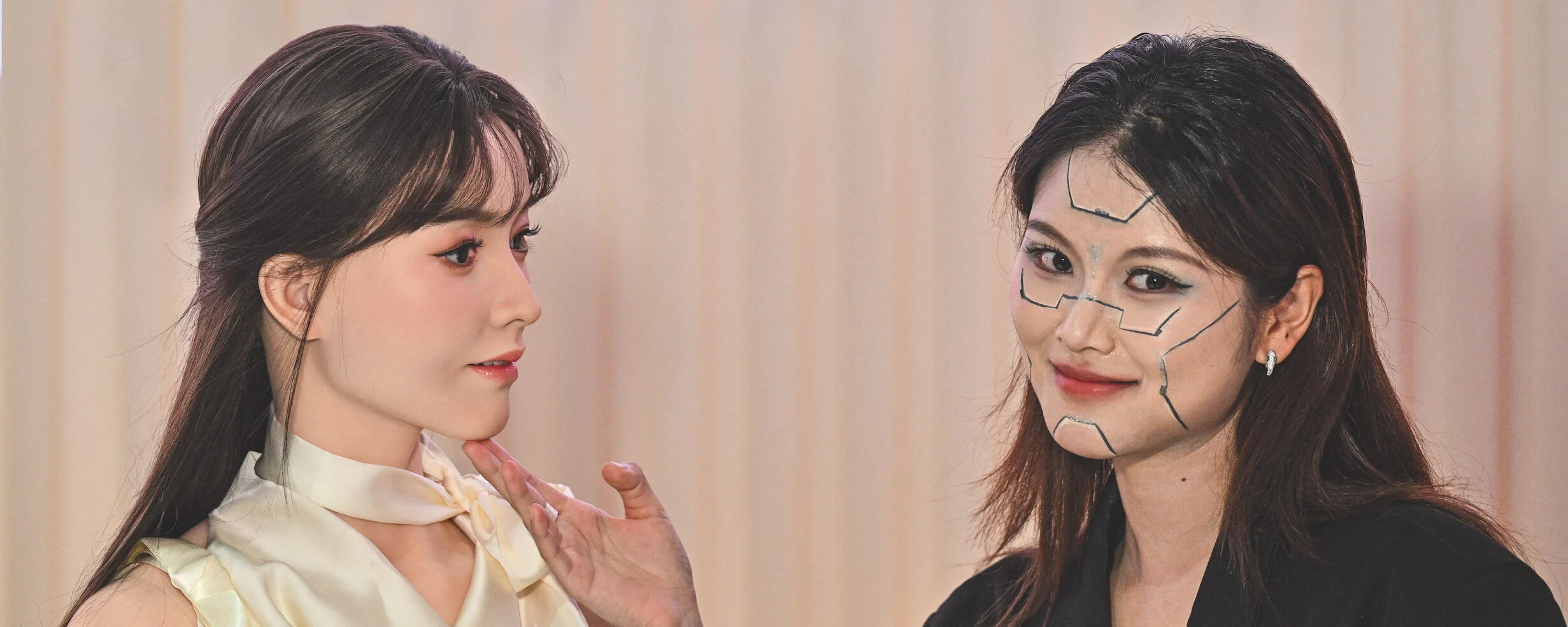
In a nursing home in Seoul, an elderly woman holds a little robot doll in her arms that speaks to her in a childish voice, asks her how she feels, encourages her to eat and take her medicine. Thousands of kilometers away, in a residence for the elderly in China, a woman stretches out her hand towards a humanoid with realistic skin, watches him dance, jokes with him and accepts that that artificial body enters her routine as a companion, alarm clock and reminder on days marked by little human contact. These are not tech fair curiosities. They are the sign of a concrete trend: after having invaded factories, robots are preparing to conquer our homes, starting with assistance for the elderly. And they do so driven by a demographic framework that leaves no easy alternatives.
International estimates indicate that those over 60 will rise from around 1.1 billion in 2023 to 1.4 billion by 2030, while the population over 80 is growing even more rapidly. To maintain current caregiver-patient ratios, industrialized countries would need to increase their long-term care workforce by more than 60% between now and 2040: a leap that no health system alone seems capable of sustaining. The Organization for Economic Co-operation and Development (OECD) reports that in 31 of its member countries the average number of workers in long-term care is stuck at 5 per 100 people over 65, a figure that has essentially remained flat for over a decade.
In Italy this tension is particularly evident. The third Report on domestic work by the Domina Observatory warns that by 2040 it will be more likely to live alone than in a household with children, single-member families with people over 70 will increase significantly and, to maintain the current level of assistance, at least 200 thousand more carers will be needed compared to the approximately 438 thousand regular workers in service today. Thus the temptation to entrust part of the assistance work to artificial systems is becoming more and more real.
Globally, the market for humanoid and social robots for health and elderly care exceeded 3.1 billion dollars in 2025, with estimates predicting a turnover of almost 13 billion dollars by 2035. It is now a stable industrial sector, fueled by public programs in Asia, research investments in Europe and private initiatives in North America. Within this universe there are two large categories. On the one hand, “companionship” and light assistance robots: humanoid figures or robotic soft toys that speak, entertain, remember medicines, allow video calls and help reduce loneliness and apathy. This segment, often called “companion robots,” is growing in the wake of digital welfare programs in countries like South Korea and Japan.
On the other side there are patient care robots, designed for more demanding tasks related to physical support: walking aid, support in bed-to-chair transfers, assisting the movement of fragile people, monitoring basic clinical parameters. This segment is the fastest, driven by staff shortages in facilities and the need to reduce injuries among caregivers. In the middle are “interactive” robots: platforms capable of speaking, moving, recognizing faces and expressions, integrating with sensors and telemedicine services, acting as an interface between patient, family and healthcare system.
China: between bionic company and robotic welfare
China is one of the most extreme laboratories. On the one hand there is the demographic pressure of hundreds of millions of people over 60; on the other, a political system that treats innovation as infrastructure, especially when it can ease the pressure on families and hospitals. Humanoids such as Xia Lan, Yang Yang and PeiPei appear in retirement homes in Shenzhen and Chongqing, with height similar to that of an adult, stylized faces, eyes that move and arms capable of simple gestures. PeiPei, in particular, is a robot-educator who welcomes guests, entertains them, asks questions to monitor their psychological state, offers cognitive games and remembers medicines and appointments: a digital entertainer who fills the dead hours of the day and, at the same time, keeps an eye on signs of distress. Alongside these social robots come devices on wheels that bring meals and medicines, allow video calls, and move between corridors and rooms like small autonomous delivery boys.
Within this panorama, the story that has attracted the attention of media around the world is that of UBTech and its U1. Presented in Shenzhen as a “life-size ultra-bionic android”, U1 is approximately 1.70 meters tall, weighs 60-70 kilos, has a body that imitates the complexity of human movement and silicone skin that covers the face and hands. The eyes maintain visual contact, the movement of the lips follows the synthetic voice, the arms are designed for light domestic tasks: carrying objects, folding laundry, arranging dishes.
The most controversial feature is the possibility of extreme customization. U1 can be configured with male or female features, with hair, clothes and features chosen by the user, to recall the physiognomy of a missing or distant family member. 3D facial reconstruction and voice replication technologies make it possible to bring the robot’s appearance and voice closer to that of a specific person: a deceased parent, a partner, even a celebrity. Inside, sensors, microphones and generative artificial intelligence models allow long dialogues, recognition of basic emotions, adaptation of responses to mood, management of reminders for medications, appointments, daily routines. The price, between 15 thousand and over 100 thousand euros depending on the configuration, places it in the luxury segment. But the requests and advances are pouring in.
South Korea: dolls that speak to the heart
South Korea has chosen a more intimate path. Hyodol is a robot doll a few tens of centimeters tall, soft, with a stylized child’s face and a voice that resembles that of a granddaughter of about seven years old. In its belly it has speakers, microphones, motion sensors and a connection module that connects it to a smartphone app and a web platform.
Family members and social workers can see if the elderly person eats, sleeps and moves; receive alerts if Hyodol records 24 hours without activity or phrases indicating suicide risk. The doll speaks, sings, offers quizzes, asks how the user is doing, remembers meals and medicines and, when necessary, alerts emergency services. Alongside Hyodol there are other robot dolls, such as Dasomi, and small humanoids such as Liku, just over 40 centimeters tall, with large eyes, front cameras and the ability to recognize faces and gestures to teach the elderly to use smartphones and messaging apps. In a Seoul Digital Foundation program, Liku trained thousands of seniors in digital literacy courses, narrowing the generation gap and making it less intimidating to enter online life.
United States: from physical aids to the Neo domestic robot
In the United States, an interesting experiment concerns the domestic robot. Neo, launched in a test version for the American market, is a humanoid about one and a half meters tall, with a torso, arms and head, designed to move around the kitchen, open doors, pick up utensils, mix, and in theory carry out part of the household tasks.
In practice, he currently struggles to do many of the activities shown during the demonstrations on his own, often requires remote operators to guide him and remains limited in environments that are too messy. The gap between the idea of a “general home robot” and current capabilities is still wide. But the fact that we have chosen to test on the market a humanoid designed explicitly for the home – sold as a daily aid rather than as a medical device – indicates that the movement of robotics from hospital wards to kitchens and living rooms has really begun.
Europe and Italy: the prudence of research
Europe is moving with greater caution, in a framework dominated by research projects and pilot experiments. The European Union has invested in programs dedicated to “robotics for aging”, while the United Kingdom has funded robots for social care. The European approach is less commercial and more regulatory: first we study, then we integrate, with a lot of attention to privacy, informed consent and security. In Italy the best known name is Pepper. About 1.20 meters tall, with a rounded head, bright eyes, a white plastic body and a tablet on his chest, Pepper is designed as a social robot. It moves on a mobile base, recognizes voices and faces, analyzes key words to estimate mood, offers cognitive games, puts you in contact with family members via video call. He does not have strong hands: his arms are designed for symbolic gestures, to indicate, welcome, not for lifting weights.
Pepper has been used in geriatrics and rehabilitation departments – for example at the Irccs Casa Sollievo della Sofferenza in San Giovanni Rotondo and at the Policlinico San Martino in Genoa – to stimulate patients with cognitive decline, guide light exercises, facilitate communication during hospitalization. Alongside him there are projects with semi-humanoid robots, which explore the liking of the elderly, resistance from staff, conditions in which the robot can truly become an ally. The point, however, remains the distance between experimentation and real scale. In Europe and Italy, assistive robotics is still above all a clinical and academic field, not a widespread phenomenon in the daily lives of the elderly.
The ethical issues
The scientific literature for now is based on studies with limited samples and short durations, with heterogeneous results. The most recurring benefits of humanoid robots for the elderly concern social interaction, cognitive stimulation and, in part, physical activity; the evidence on long-term effects on dementia, depression and quality of life is less solid. Older adults appear to have pragmatic preferences: they appreciate medication reminders and support functions, but are wary of tasks that are too invasive, such as carrying them up stairs or assisting with the bathroom.
There are at least three ethical issues. The first is privacy: these devices collect data, listen to voices, observe movements, record routines and, in some cases, interpret emotions. The second is emotional dependence: if an elderly person bonds with the robot as with a person, who guarantees that that bond is healthy, transparent, non-manipulative? The third concerns the replacement of care: a robot that accompanies, monitors or consoles can be a precious support; a robot used to justify cuts to human assistance becomes a social problem instead.
The question is no longer whether automatons will enter into care: they are already doing so, from Korean dolls to Chinese artificial caregivers, from American prototypes to Italian trials. The real question is how we will decide to live with it: which part of the care we will want to share with them and which, instead, we will consider non-delegable, because it touches the core of our idea of human dignity.