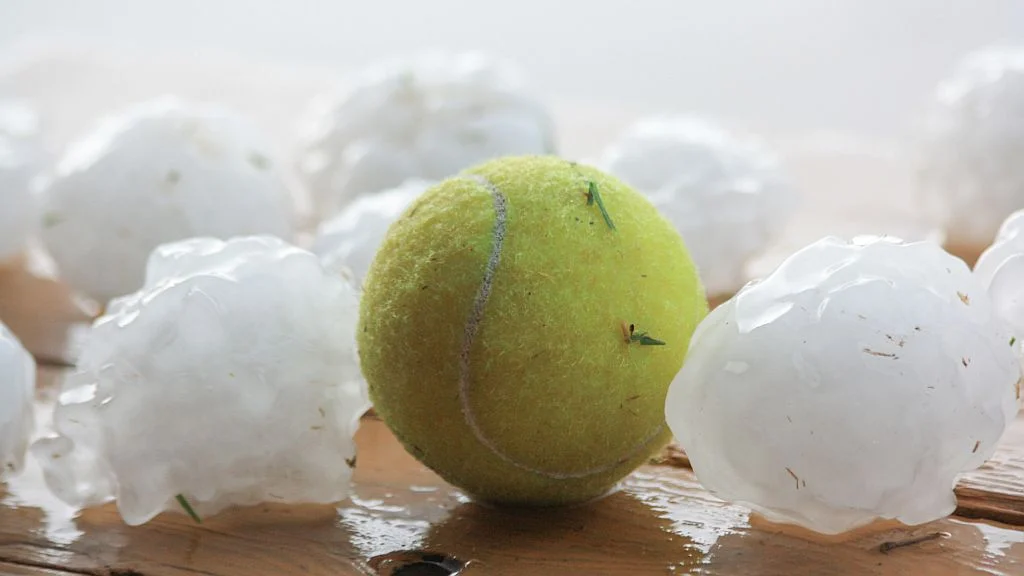
Eighty thousand people forced to leave a concert while hailstones several centimeters large fall from the sky. The ground was made slippery by the rain, the streets were partially flooded, spectators were looking for shelter and some injured people were hit on the head.
What happened on Saturday 18 July during Bad Bunny’s second concert in Milan, at the Snai La Maura Hippodrome, is not just an episode destined to become the news of the summer. It is also a warning about how storms are changing in Italy and the need to rethink the management of events that gather tens of thousands of people in open spaces.
The concert was first interrupted and then definitively cancelled. After an initial invitation to the public to remain on site, the worsening weather conditions forced the evacuation of the area. Several spectators were rescued by 118 personnel and Live Nation subsequently announced a full refund of the tickets.
The cell born in less than an hour above Lombardy
According to the reconstruction developed by Radarmeteo and Hypermeteo, a mass of warm and humid air was present over Lombardy, fed by the expansion of the African anticyclone. At the same time, a disturbance over central Europe was pushing cooler, more unstable air towards northern Italy.
The contrast between the two air masses, together with the more intense winds present at high altitude, created favorable conditions for the formation of locally violent thunderstorms.
The cell that would then reach Milan was formed around 8pm just west of Busto Arsizio. It intensified rapidly and, pushed towards the south-east by the winds at high altitude, hit the racecourse area between 8.50pm and 9.40pm. Hailstones up to four centimeters in diameter and gusts of between 50 and 60 kilometers per hour were estimated.
The problem is not only the intensity of the phenomenon, but its speed. In less than an hour, a localized storm can transform into a threat to an area containing tens of thousands of people, leaving very little margin for deciding whether to suspend a show, invite the public to take shelter or start an evacuation.
Over a thousand episodes of large hail in 2026
The data collected by the European Severe Weather Database and reprocessed by Radarmeteo provide a worrying picture. From 1 January 2016 to 20 July 2026, 7,526 episodes classified as “large hail” were recorded in Italy.
Of these, 1,006 would have occurred in the first seven months and twenty days of 2026, compared to 779 for the whole of 2025 and 687 in 2024. The highest figure in the series remains that of 2023, when the reported episodes were 1,479.
Raw reporting numbers, however, should be interpreted with caution. The European Severe Storms Laboratory itself explained that the greater capacity to collect testimonies, photographs and measurements may contribute to the increase in cases in the database. This does not eliminate the climate signal, but prevents each growth in reporting from being automatically considered as an identical increase in the real frequency.
However, scientific analyzes based on models confirm a basic trend. A study conducted by researchers from the European Severe Storms Laboratory and other European institutes has identified Northern Italy as one of the areas of the continent where large hail is most frequent. In the region, the probability of hail with a diameter of at least five centimeters would be approximately three times higher today than in the 1950s.
According to the calculations of Radarmeteo and Hypermeteo, in Italy the probability that a storm produces grains larger than five centimeters would have increased by 80% compared to the historical average. June and July represent the most critical period, while in August the risk generally tends to decrease.
Because the beans get bigger
Hail forms within thunderstorms characterized by strong updrafts. The water droplets are transported to the colder parts of the cloud, where they freeze. If the current is intense enough, the grain remains suspended and continues to grow through successive passages in areas rich in supercooled water, until its weight exceeds the force that supports it.
A warmer atmosphere can contain more water vapor. Increased moisture in the lower layers, combined with strong instability and differences in wind direction and speed at different altitudes, can fuel more organized thunderstorms and updrafts capable of supporting heavier grains.
Research published in 2026 and coordinated by the European Severe Storms Laboratory found that Europe is the region in which the increase in the frequency of hail larger than five centimeters is most marked. Among the main factors identified are changes in atmospheric humidity near the surface.
Even a warmer Mediterranean can provide energy and humidity to air masses, although it is not sufficient on its own to cause a hailstorm. In cities, the heat island effect is also added: asphalt, concrete and buildings retain more heat than vegetated areas and can locally accentuate upward motions when the atmosphere is already unstable.
The European record for 19 centimeter beans
The most impressive image of the ongoing transformation dates back to July 24, 2023. In Azzano Decimo, in the province of Pordenone, a hailstone with an estimated diameter of 19 centimeters was documented, considered the European record.
A few days earlier, again in Italy, a 16 centimeter grain had been reported. In 2023 alone, our country collected almost a third of all European reports of hail larger than five centimeters and over 70% of those relating to hailstones of at least ten centimeters.
These are not just spectacular phenomena. Grains of this size can break windshields, damage roofs and photovoltaic systems, destroy crops and cause serious injuries to people left outdoors.
The economic consequences are already evident. Between 1980 and 2024, extreme weather and climate events have caused losses estimated at €822 billion in the European Union. Germany, Italy, France and Spain are the countries that recorded the highest overall damage, while storms, wind, lightning and hail represent approximately 27% of the European losses considered.
The limit of 1.5 degrees and the Mediterranean warming
2024 was the first calendar year in which the average global temperature exceeded that of the pre-industrial era by more than 1.5 degrees, reaching an anomaly of approximately 1.6 degrees according to Copernicus.
This does not mean that the limit of the Paris Agreement has been formally exceeded: that value is evaluated on long-term averages, not on the basis of a single year. However, it remains a sign of the speed with which the planet is warming. Furthermore, Europe is warming at about double the rate of the global average.
Warming does not automatically produce more hailstorms in every location and in every season. The relationship between climate and hail is complex: higher temperatures can cause small grains to melt before they reach the ground, but at the same time a more humid and energetic atmosphere can favor the formation of much larger and more damaging hailstones.
It is precisely this evolution that is most worrying: not necessarily hailstorms everywhere, but more concentrated, violent and difficult to manage events.
Big concerts have to change
Live Nation argued that the evacuation of the La Maura Racecourse demonstrated the effectiveness of the procedures agreed with the Prefecture, Police Headquarters, Fire Brigade, Civil Protection, Municipality and health services. The absence of more serious consequences is certainly a positive element.
The case of San Siro, however, still requires reflection. A safety plan designed for rain, wind or an ordinary thunderstorm may not be sufficient when faced with hail of several centimeters, sudden gusts and exit routes used by tens of thousands of people at the same time.
We need meteorological monitoring systems dedicated to the event, direct connections with the operations rooms, pre-established thresholds for the suspension of shows, clear and immediate messages to the public, truly accessible shelter areas and coordination with subways, trains and public transport.
Because the point is not to establish whether exceptional hailstorms will become normal. It means acknowledging that phenomena once considered very rare are now probable enough to need to be included in ordinary planning. And that next time, in the midst of the hail, there could be eighty thousand people again.