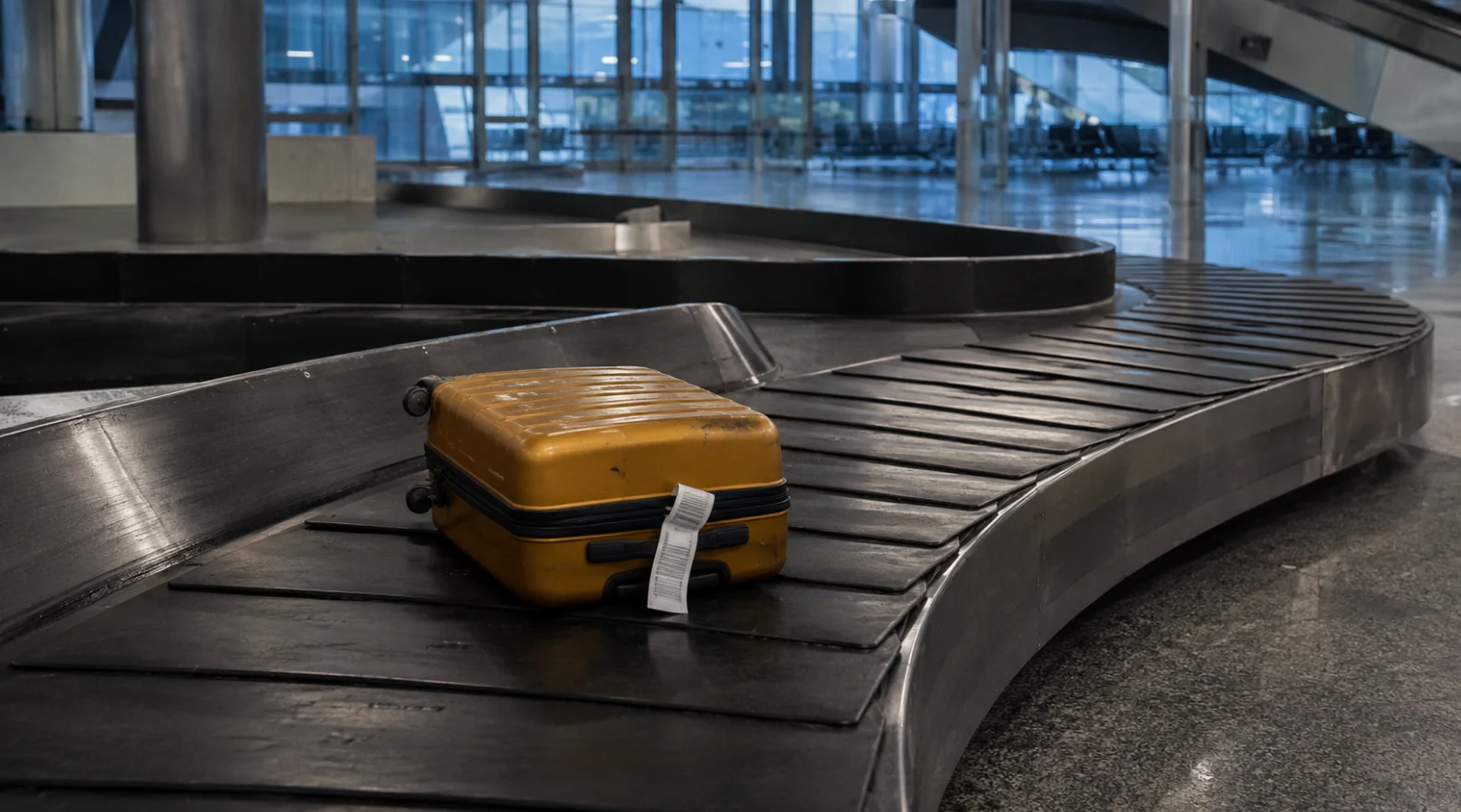
The moment in which a holiday turns into a problem has the monotonous noise of a conveyor belt that continues to turn without returning the expected suitcase, while the other passengers collect their luggage, leave the airport and only a few trolleys remain around that no one seems to recognize.
That suitcase, however, in most cases is not lost, but is simply in the wrong place: it remained at the departure airport, it did not make a connection in time, it was loaded onto another plane or it travels without the passenger to the correct destination. Only a small portion of the luggage disappears permanently, entering a little-known system of global databases, warehouses, manual searches and, ultimately, auctions, donations, recycling or destruction.
According to the SITA Baggage IT Insights 2026 report, approximately five billion people traveled by air in 2025 and 24 million pieces of baggage were handled irregularly, a category that includes suitcases delivered late, damaged or permanently lost. The figure is down 23 percent in a year and is below pre-pandemic levels, but continues to cost the airline industry $6.3 billion.
Behind every suitcase that doesn’t arrive there is therefore a personal story, but also a huge logistical and economic problem, because a single poorly handled bag costs on average 260 dollars and can wipe out the profit produced by more than thirty passengers.
The invisible journey of a suitcase
When a suitcase is delivered to the check-in counter, it receives a label with an identification code that links it to the passenger, the flight and the destination. From that moment it enters an automated network of belts, scanners, sorting systems and operators who must accompany it to the hold of the plane and return it to the correct belt.
IATA Resolution 753 requires member companies to track baggage at at least four points: delivery by the passenger, loading onto the plane, passage through the transfer area and return on arrival. In theory this chain should create a complete and verifiable story; in practice, different IT systems, damaged labels, too tight deadlines and information not shared can break the connection.
The most fragile point is often the airport, because the suitcase must be unloaded, recognized, transferred and loaded onto a second aircraft in an interval that can become insufficient due to a delay of a few minutes. If the passenger runs and manages to get on the next flight, it is not at all certain that his luggage will be able to follow him.
Even the enormous amount of data available does not always solve the problem, because, according to SITA, more than 40 percent of companies and around a third of airports still do not share all the necessary information. The system often knows where the suitcase was last seen, but cannot always immediately reconstruct where it ended up afterwards.
WorldTracer, the global luggage detective
When the suitcase does not appear on the belt, the passenger must open the so-called PIR before leaving the airport, Property Irregularity Reporthanding over the baggage tag and describing as precisely as possible the brand, colour, size and recognizable characteristics.
The information generally enters WorldTracer, the system developed by SITA together with Iata to cross-reference passenger reports with those of baggage found at airports. The comparison does not only take place through the code of the label, which may be illegible or has detached, but also through itinerary, surname, type of suitcase and description of the contents.
When a match is found, the bag is classified as rush bagthat is, a suitcase that must travel without the owner to reach him, and is normally sent on the first available connection before being delivered by courier to the passenger’s home or hotel.
Personal locators, such as AirTags, can help the owner understand which airport the suitcase is in, but they do not replace the official procedure nor allow the passenger to enter the operational areas to retrieve it. The data provided by the device can be communicated to the company, while it is up to the employees to verify, identify and resend the baggage.
After 21 days the suitcase becomes legally lost
The Montreal Convention establishes that luggage can be considered lost after 21 days from the expected date of arrival, but this deadline mainly concerns the rights of the passenger and the initiation of the compensation request, it does not mean that on the twenty-second day the suitcase will be immediately sold or destroyed.
Companies can continue searches and store unidentified bags for longer periods, often moving them from airports to central warehouses where they are examined again. If the label is missing, the employees can open the suitcase in search of documents, receipts, addresses or other elements capable of tracing it back to the owner.
It is also for this reason that inserting a piece of paper inside with your name, telephone number and email can be more useful than yet another colored tape applied to the outside: if the main and personal labels are torn during handling, a contact kept between the clothes can become the only remaining link.
Auctions, shops and the charm of mysterious suitcases
When every attempt at identification has failed, there is no universal destination valid for all countries and all companies. Baggage can be sold to specialized operators, entrusted to auction houses, donated, recycled or destroyed, according to national regulations and contracts stipulated by individual companies.
The most famous case is found in Scottsboro, Alabama, where the Unclaimed Baggage shop buys suitcases considered permanently lost from US companies after a search that can last about three months. The bags are bought without knowing their contents, then opened and subjected to a selection: usable clothes are cleaned, electronic devices deleted, valuables checked and what can be recovered is put up for sale.
Only some of the contents make it to the shelves, while the rest is donated or recycled. The shop, which has become a real tourist attraction, fuels the imagination of those who imagine jewels, designer clothes and mysterious objects hidden inside each trolley, although most of the suitcases simply contain used clothes, shoes, chargers, souvenirs and personal hygiene products.
In several European countries there are also auctions dedicated to baggage or unclaimed items, but the procedures change considerably. Some auction houses sell closed or generically described suitcases, others separate the contents and sell lots of electronics, clothing or accessories, while sensitive objects, documents and anything that cannot be sold follow different paths.
Lost baggage and forgotten item are not the same thing
A suitcase checked in at check-in remains the responsibility of the airline, while a phone forgotten at security, a wallet left in a cafe or a bag abandoned in a public area of the airport fall under lost property management.
The distinction is essential because the office to contact, the storage times and the return procedure change. Aeroporti di Roma, for example, keeps objects found in public areas for a year, in accordance with the provisions of the Civil Code, while for undelivered hold baggage the contact person remains the carrier with which you travelled.
Many passengers waste time by contacting the airport for a suitcase that must be searched by the company or, on the contrary, contacting the carrier for a computer forgotten at the gate. Understanding where possession of the object stopped is the first step in understanding who should look for it.
How much can the passenger get
In Italy, ENAC reminds you that the PIR must be completed before leaving the delivery area. If the baggage is found late, the passenger can request reimbursement of the necessary expenses incurred while waiting, keeping receipts and documentation; if it is not recovered within 21 days, you can submit a claim for loss.
For companies in the European Union and for those belonging to countries adhering to the Montreal Convention, the maximum limit of liability has reached 1,519 special drawing rights per passenger. However, this is not an automatic and equal reimbursement for everyone, because the contents, value and damage actually suffered must be documented, while jewellery, money, medicines and electronics of particular value should always be transported in hand luggage or covered by a special declaration and insurance.
Ultimately, a suitcase can disappear from the owner’s life without actually disappearing. For weeks it continues to be photographed, scanned, transferred and described, until its content loses its connection with the person who chose it and becomes an insurance claim, a cost for the company or a commodity purchased by a stranger.
This is the most curious part of the secret luggage journey: behind every trolley auctioned there is an interrupted holiday, a complicated return and someone who, for days, continued to stare at the same conveyor belt waiting for a suitcase that had already begun another story.