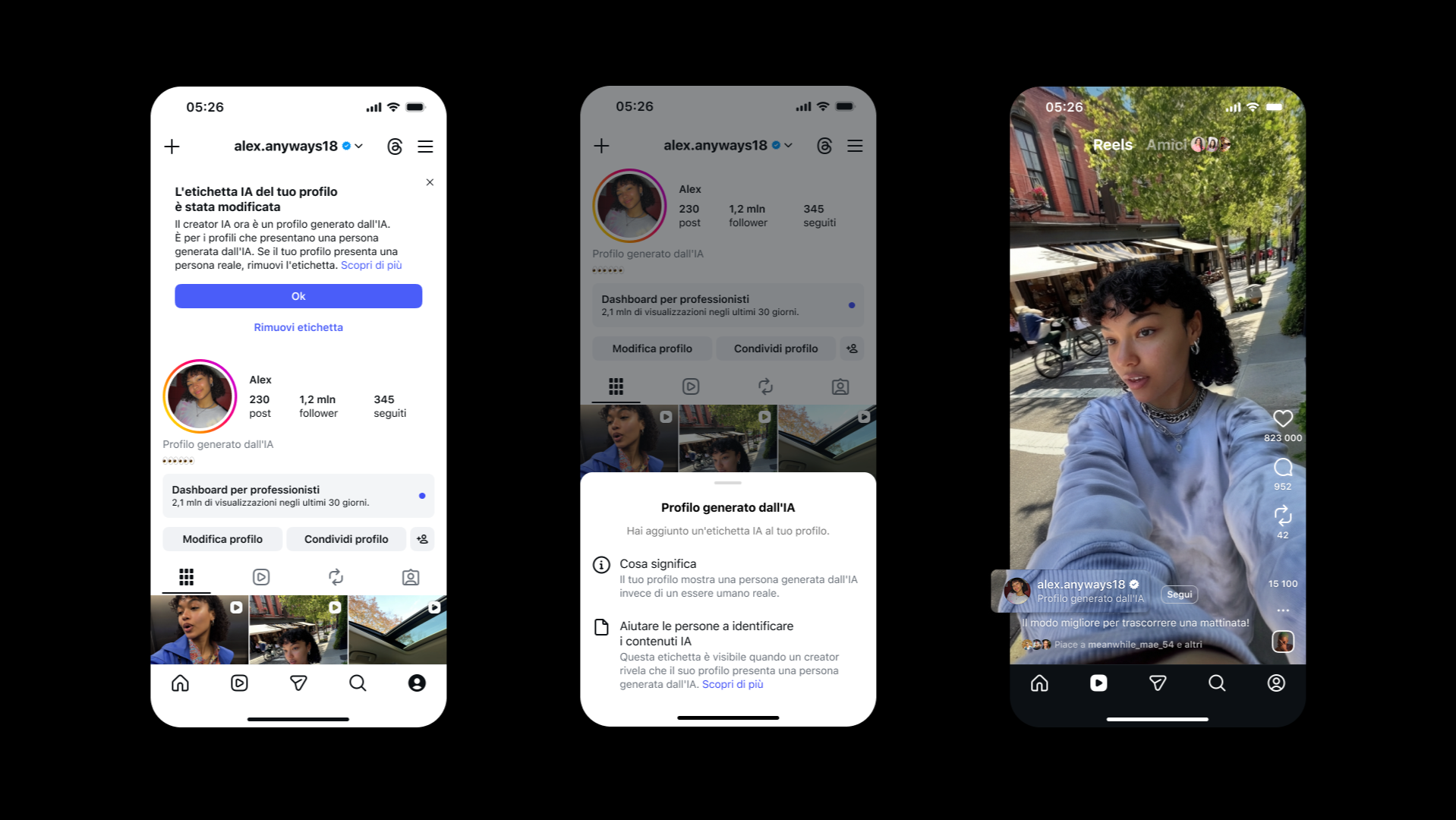
The platform replaces the wording “Creator AI” with “Profile generated by AI” and prepares a crackdown on accounts that show artificial people without declaring it. For those who do not adapt, the risk is disappearing from the recommendations aimed at non-followers.
On Instagram the line between a real person and a face constructed by artificial intelligence will have to become more recognizable. The platform has decided to rename the label “Creator AI”, which from today becomes “Profile generated by AI”, and is preparing to penalize accounts that are obliged to use it but continue to present themselves to the public without declaring their artificial nature.
The change is not only terminological, because Instagram has announced that profiles generated through artificial intelligence that do not add the required indication could soon see their visibility reduced. In concrete terms, once the relevant notification has been received, the account and its contents will no longer appear among the suggestions intended for people who do not yet follow it, thus losing access to two of the main growth tools of the platform: Reels and Explore.
The decision arises from a problem that has become increasingly evident with the spread of generative artificial intelligence. Many users come across accounts built around faces, bodies and identities that appear to belong to real people, only to discover later that the protagonist of the content does not exist. According to what Instagram reported, a specific request came from the community: to know immediately whether the person shown by a profile is authentic or artificially generated.
What changes with the new Instagram label
The previous definition “Creator AI” could be ambiguous, because it risked being interpreted as a label intended for any author who used artificial intelligence tools in their work. The new wording “Profile generated by AI” instead delimits the field of application more clearly and concerns accounts whose contents present an artificially created person as the protagonist.
The label, therefore, does not serve to signal the ordinary use of AI within the creative process. A photographer who uses an automated tool to edit an image, an author who uses a digital assistant to develop an idea, or a creator who uses artificial intelligence at some stage of production will not necessarily have to identify their account as an AI-generated profile. The requirement instead concerns those pages in which the identity shown to users, and presented as the central face of the content, does not correspond to a real person.
The stated objective is to make it immediately understandable who, or what, is behind an account, preventing an artificial character from being confused with a human being. Instagram therefore does not prohibit the presence of virtual influencers or synthetic creators, but asks that their nature be explicitly declared.
Unlabeled profiles risk disappearing from recommendations
The most relevant news concerns the consequences expected for accounts that do not comply. Instagram will be able to identify profiles that, according to its systems, should be classified as generated by artificial intelligence and send them a notification. If the label is not added, the profile and its contents may be excluded from recommendations aimed at users who are not already part of the account’s audience.
This is not a cancellation or a complete suspension: those who already follow the page will be able to continue to view its contents. However, exclusion from Reels, Explore and other recommendation spaces represents a potentially very heavy penalty, because it limits the possibility of reaching new people and makes it more difficult to increase followers, views and interactions.
For profiles built entirely around a virtual character, algorithmic visibility is often the primary driver of growth. Being removed from recommendations can therefore produce an effect similar to a large reduction in distribution, without resulting in account closure.
How to challenge Instagram’s decision
Affected accounts will be able to choose to add the new label or contest the classification through the “Account Status” section, the space in which Instagram communicates any limitations, violations and consequences on the distribution of content.
The possibility of filing an appeal is particularly important in cases where automatic systems may confuse a heavily retouched real face, an avatar or an artistic project with a person entirely generated by artificial intelligence. The platform has not detailed what elements it will use to determine whether a profile should display the label, but the dispute procedure should allow account holders to ask for a review of the decision.
Furthermore, the restriction does not seem to concern the individual content modified or produced with generative tools, but rather the overall nature of the profile and the person who represents the public identity. This is the central distinction introduced by the name change: what matters is not simply that AI has been used, but that the public is led to relate to a human figure who, in reality, does not exist.
Transparency becomes a condition for obtaining visibility
With the new system, Instagram is attempting to intervene on one of the most delicate aspects of the growth of synthetic content: the possibility of building trust, following and even commercial relationships around artificial identities without clearly informing users. The platform does not question the legitimacy of the profiles generated by AI, but links their possibility of being recommended to compliance with a principle of transparency.
The choice also reflects the change that has occurred in the perception of artificial intelligence. If initially virtual characters could be interpreted as easily recognizable experiments, the improvement of generative images and videos now makes it much more complex to distinguish a real face from a synthetic one, especially during a rapid scrolling of the Reels.
The new wording must therefore function as an immediate warning, allowing people to understand that the protagonist of an account has been artificially created before following him, commenting on his contents or attributing experiences, opinions and human characteristics to him.
There is no automatic visibility limitation for accounts that comply with the new rules. The penalty will be aimed at those who, despite falling into the category of profiles generated by AI, do not make this information explicit. Instagram’s message is therefore quite clear: virtual creators will continue to be able to inhabit the platform, but they will no longer be able to pretend to be real people without risking disappearing from the places where they gain new audiences.