In the police system they appeared dead, even if in reality they were alive, had been found and, at least when the respective reports were closed, were well. This is probably the most disconcerting detail that emerged from the review of the 298 files managed by Agent Boo, the Jeju policeman who ended up at the center of the missing persons scandal after the discovery of the bodies of two adults whose searches had been interrupted on the basis of information that turned out to be false.
What initially might have appeared as the very serious conduct of a single officer in two limited episodes took on much larger dimensions in the space of a few days. The examination of the activity carried out by Boo during the period spent in the missing persons squad of the Jeju West police station has in fact led investigators to identify another 25 files considered suspicious or improperly managed: ten concern people whose position and safety were not adequately verified before the closure of the report, while in the other fifteen the people had actually been traced, but information that did not correspond to reality, including causes attributable to the death, were entered into the police system to eliminate the files.
By adding these new anomalies to the two cases from which the investigation started, there are therefore 27 problematic files identified among the 298 examined. None of the 25 people involved in the new checks died: the police confirmed that they have all been traced and are alive and safe. It is precisely this circumstance, however, that makes what appears to have happened within the IT system used to manage missing persons particularly serious.
Living people erased from the system as if they were dead
According to what was reconstructed by the Jeju police, in the fifteen most singular cases the location of the missing person had actually been ascertained, in some cases thanks to the agents of the local stations, and there was therefore no longer any need to physically continue the search. The problem arose when the case was closed, when Boo entered information that did not correspond to reality into the national profiling system, also using reasons referring to the death to allow the cancellation of the name.
Among the false reasons reported in the files there would be formulas attributable to death in a road accident and unnatural death. People who were alive and whom the police had already tracked down thus ended up having an administrative history that did not correspond to what had actually happened.
The difference is not purely bureaucratic. The system used to manage missing persons allows investigators to reconstruct previous reports and can become particularly important if a person is reported missing again. Eliminating or altering a previous practice therefore means risking taking away potentially relevant information from the agents who have to deal with a new search.
The police do not yet consider Boo’s criminal responsibility definitively established for all 25 new episodes. The files have been sent to investigators for further investigations, while the officer’s responsibilities will have to be established in the judicial proceedings. What was ascertained by the audit is the existence of the anomalies which led to the expansion of the investigation.
Among the files also minors and vulnerable people
It is the detail that has emerged in the last few hours that makes the picture even more delicate. In fact, among the files affected by the cancellations there are also reports relating to people belonging to the categories protected by the Korean legislation on missing persons, including minors and, according to what was reported in the local press based on information from the police, students who had left home.
Investigators have not made public the exact number of minors involved nor their ages, underlining that the examination of these incidents is still ongoing. However, it was clarified that the people affected by the new checks were alive and that, in the fifteen cases relating to cancellation from the system, they had actually been traced before the disputed information was entered.
The data becomes even more significant when observing the composition of the entire archive passed into Boo’s hands. Of the 298 files that the agent had closed independently, 157 concerned adults, while 141, equal to 47.3 percent, related to categories subject to particular protection by Korean legislation, which include minors under 18 years of age and some vulnerable people, including individuals suffering from dementia or with certain disabilities.
Almost half of the cases handled by the agent therefore concerned people for whom the speed and accuracy of searches take on even greater importance. This does not mean, of course, that all of these 141 files present anomalies: the review did not produce such a conclusion. However, the number allows us to understand the sensitivity of the role played by the agent and the reason why the authorities decided to extend the checks.
Boo’s explanation and the burden of work
The expansion of the investigation also raises new questions about the explanation that Boo provided to investigators to justify the first false closures. The agent reportedly said that he had dealt with some reports excessively lightly because they concerned adults and that he wanted to avoid the workload resulting from maintaining an open file and the need to transfer it to the next shift.
Five profilers called to analyze his behavior identified among the main factors the accumulated work pressure, a negligent attitude and the tendency to avoid responsibility and further work. This is the reconstruction developed by investigators based on interrogations and behavioral analysis, not a definitive judicial conclusion.
However, the presence, among the new contested practices, of cases also relating to minors makes that explanation insufficient to describe on its own the entire phenomenon that emerged from the review. It does not demonstrate that a different motive existed and it would be premature to attribute one to him, but it inevitably broadens the questions that the investigation will have to answer.
The scandal started with two people found dead
The investigation into Agent Boo began after the discovery of alleged falsifications in the handling of two missing persons, both of whom were later found dead.
One of the cases concerns Jang Mi-ran, 37, who disappeared on May 12 after leaving the facility where she was staying in the Hallim area. After the disappearance was reported, Boo communicated that he had managed to speak to the woman by telephone and that she did not want to reveal his whereabouts. However, subsequent checks on telephone data would not have found any trace of that conversation.
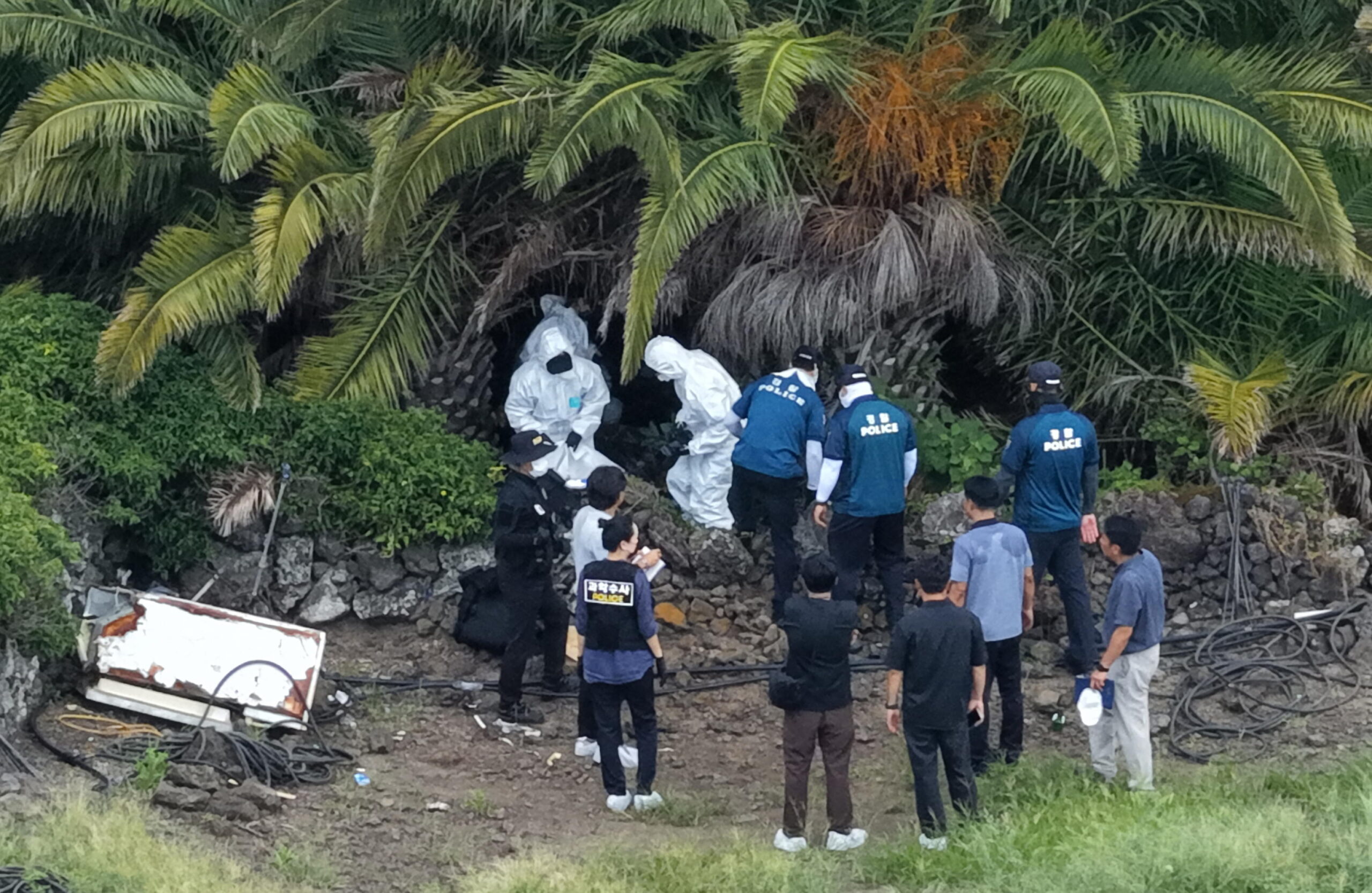
Jang would also have been registered in the missing persons management system using information relating to a road accident and subsequently eliminated from the list of people to be searched for. His body was found on August 24 in a palm plantation located a few hundred meters from the place where he had stayed, 104 days after his disappearance.
The cause of death remains a point on which it is necessary to maintain a clear distinction between hypotheses and established facts. The National Forensic Service was unable to determine her due to the advanced state of decomposition of the body. The investigators also carried out investigations on the hanging hypothesis and verified that the dynamics considered were not physically impossible, but the police specified that this does not allow them to definitively establish that Jang committed suicide and that the checks are continuing, keeping various possibilities open.
A few days before Jang was found, a man in his sixties had also been found dead, whose disappearance had been reported to the same officer. Even in that case Boo would have closed the case claiming to have managed to contact the man, a circumstance which subsequent investigative checks would not have confirmed.
The succession of the two discoveries pushed the police not to limit themselves to individual episodes and to systematically re-examine the files previously managed by the agent.
The 298 files and an anomaly in the numbers
The number that emerged from that check was already sufficient to show how extensive the scope of the case was. Between March 2025 and July 2026, 1,048 reports relating to missing adults had been registered in Jeju and Boo had independently closed 298 cases, an amount equivalent to 28.44 percent of the total.
The data does not mean that almost three out of ten disappearances in Jeju were handled irregularly and it would be incorrect to interpret it in this way. Instead, it shows the quantity of files that passed into the agent’s hands and explains why, once the first disputed falsifications emerged, the review of his activity became one of the central parts of the investigation.
The review has now identified 25 additional cases on which further investigation is needed, bringing the overall number of problematic files to 27 counting the two original episodes. Ten concern suspected closures without adequate verification of the person, while in the other fifteen the discovery actually occurred but the subsequent IT management contained false information.
The investigation expands beyond 298 cases
Boo was transferred to the Jeju Procuratorate for detention on September 1. The charges filed against him include abandonment of official duties, falsification and use of public electronic records and obstruction of the exercise of public functions by deception. As with any proceeding still open, the agent’s definitive responsibilities will have to be established by the judiciary.
The Jeju prosecutor’s office set up a team dedicated to the case, while the police decided not to stop the checks on the 298 files initially examined. In fact, before joining the team specializing in missing persons, Boo had also worked in the investigative division providing support to activities relating to disappearance cases. The investigators now also intend to check the files on which he had worked during that period.
This is probably the point at which the Jeju affair definitively ceases to concern only the conduct accused of a single policeman. Two people whose cases were closed based on information that turned out to be false were found dead; the subsequent review identified another 25 practices worthy of further investigation; living people would have been deleted from the system using information that classified them as dead and minors were also included in the files involved.
A question then remains that concerns not only Boo, but the functioning of the entire chain of control: how was it possible that practices containing information of this type were closed without anyone, before the discovery of the two bodies, realizing that something was wrong.