«We’re certainly going on a mission, since they’re calling us. We are at the end of May, in full retreat, in full disaster. Crews are sacrificed in the same way one would throw glasses of water into a forest fire. How do you weigh the risks when everything is falling apart? For the whole Francewe remained fifty large reconnaissance crews. Fifty three-man crews, of which twenty-three are here with us, in the 2/33 group. In three weeks, we lost seventeen out of twenty-three crews. We melted like wax. I said yesterday to Lieutenant Gavoille: “We will talk about it again after the war.” And Lieutenant Gavoille replied to me: “You don’t expect, Captain, to be alive after the war!”».
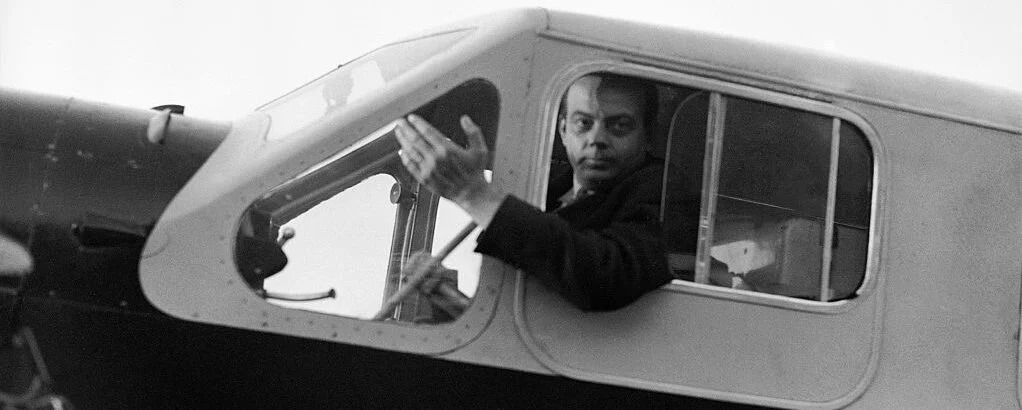
Antoine De Saint-Exupéry wrote these lines in the autobiographical novel War pilot. He completed it in the United States, where he had taken refuge in June 1940. He told of the heroic reconnaissance mission on the city of Arras (where the French defense was perched which was trying to slow down the German advance) carried out in May of the same year, an undertaking for which he was decorated with the War cross. Anyone who knows the biography of the French writer can read in those words a sad omen of what would happen shortly thereafter, after Antoine had started flying on the battlefields again, enlisted in the Allied forces. In fact, on August 1, 1944, the war bulletin reported the terrible news: «A very sad event diminishes the joy we all feel as victory approaches. Commander de Saint-Exupéry did not return.” He disappeared at 10.45am the previous day, July 31st. He left from the base in Bastia, Corsica. Several years later, it was learned that he had been shot down by a German pilot, who, until the end – so he said – had hoped not to be responsible for the death of one of his most beloved authors. This is the war which, as Saint-ex himself wrote, «is not an adventure. War is a disease. Like typhoid.”
The search for inner meaning beyond war news
War is not an adventure. Yet the French writer wanted to throw himself into it, although embittered and disillusioned, or perhaps precisely because of that. «If I subject myself to speed and high altitudes, to a patriarchal age for this profession, it is more to adapt to the curses of my generation than to the hope of rediscovering the satisfactions of the past. Maybe it’s a melancholy thought, or maybe no,” he wrote in Letter to an American of 1944 (published by Life). And he added: «Let’s take the military phenomenon of a hundred years ago. How much effort he made to give an answer to the spiritual, poetic or simply human life of man. Today, desiccated as we are more than bricks, we smile at such nonsense. Costumes, flagsand, songs, music, victories. There are no more victories nowadays, nothing that has the practical density of an Austerlitz. There are only phenomena of slow or rapid digestion. Every lirism sounds ridiculous, and men refuse to allow themselves to be reawakened to any spiritual life. They honestly carry out a kind of chain work. As the American youth say: we accept this thankless job honestly, and propaganda throughout the world beats its hips in desperationion. His illness does not come from the absence of particular gifts, but from the prohibition to lean, under pento appear pompous, on the great refrigerant mythsthe”.
To my beloved wife Consueloin June 1944, Saint-ex spoke even more sincere words: «I managed to become a Lightning pilot again for the distant photographic missions in France. I have a very strong need not to live these times as an intellectual spectator. I so hate all their big words, all their polemics, all their pretentious bigotry. They don’t mix anything of their own flesh into their problems. Consuelo, dear child, I can’t think of anything that I don’t pay for myself. And being involved in real war allows me to feel absolutely pure and completely exempts me from having to demonstrate whatever I think through formulas of hatred and condemnation. I am what I think, simply. I’m not mad at anyone in these dark times. Men are not capable of thinking anything clearly. They go in blind. They are unhappy. Simply being frees me from getting too lost in words. Consuelo, my dear love, if any misfortune ever happens to me, don’t feel bad about the decision I made. I’m certainly the only old pilot in the world waging war in a fast plane (the Lightning is the fastest plane in the world). And I hold on. But I may get a trip from God, somewhere in France. Know that then I will regret nothing, absolutely nothing, except making you cry or no longer being able to protect you, my favorite child. I will regret nothing else because I have nothing to do in these times of rancorous causes and imbeciles.”
Antoine sends these last letters from Algherofrom the splendid land of Sardinia. He arrived there in May 1944 together with his friend John Phillips, a Life photojournalist. He had joined, although he had exceeded the required age limit, the other pilots under the command of Captain René Gavoille, which will allow him to carry out eight missions instead of the planned five.
Citadel and Land of Men: the peaks to be rediscovered
The father of Little prince he spends his Sardinian days in a villa in Porto Conte, between large green hills and crystal clear sea, not far from the ancient tower built by the Spaniards. And it is precisely in those surroundings that the Mase is located, a small but well-kept Alghero museum dedicated to the great Frenchman. It is directed by Massimiliano Fois, author of a precious volume entitled Antoine De Saint-Exupéry in Alghero, which meticulously reconstructs the days spent by the novelist in that paradise. The days and especially the nights, which Saint-ex used to write. He wrote to Consuelo, obviously, but he also dedicated himself to the manuscript of Citadelan immense masterpiece which was recently published in its entirety in Italy by the publishing house Aga. French copies are exhibited in the Alghero museum, together with those of other famous works (in original and in Italian).
Among these obviously Land of men which, together with Cittadella, represents perhaps the author’s most successful attempt to recover that spiritual dimension which – in war-ravaged Europe – he saw as irremediably lost.
Apogeo has just sent a new translation to bookstores with the title Wind, sand, stars. In the premise, one probably finds the profound sense of the Frenchman’s human and literary adventure, his constant drive for action and challenge, the ferment of his daily battle. “The earth teaches us more about ourselves than books do,” we read. «Because he resists us. Man discovers himself when he measures himself against the obstacle. But, to do that, he needs a tool. It needs a planer or a plow. The farmer, in his work, gradually wrests some of its secrets from nature, and the truth he reveals is universal. In the same way, the plane, the instrument of aviation, leads man to confront ancient problems. I always have before my eyes the image of my first night flying in Argentina, a dark night in which only the rare lights scattered across the plain shone like stars. Each one signaled, in that ocean of darkness, the miracle of a conscience. In a house we read, we reflected, we exchanged confidences. In another, perhaps, we were trying to probe space, we were consumed with calculations on the Andromeda nebula. There, however, we loved each other. From one point to another in the countryside, fires were shining, demanding their nourishment. Up to the most discreet, the lights of the poet, the teacher, the carpenter. But, among those living stars, how many closed windows, how many extinguished stars, how many sleeping men… We must try to find ourselves. We need to try to communicate with some of those lights that shine here and there in the countryside.”
Saint-ex tried to find himself by putting himself to the test until the end. He was able to leave behind the wonders of the land and sea of Alghero to fly towards his death, and vanish into the sky while trying to communicate directly with the light of the stars.