For years we have been accustomed to considering it a children’s disease, one of those infections that belonged to the past and which, thanks to vaccinations, seemed destined to disappear definitively from our lives. Yet measles continues to circulate in Italy and, above all, to affect people who have long since passed the age of childhood, transforming what in the collective imagination remains a disease characterized by fever and red spots on the skin into a public health problem that also affects adults, families and those who work in hospitals.
The bulletin of the Higher Institute of Health relating to January 2026, when 84 cases of measles were reported in Italy, after a two-year period already characterized by a high circulation of the virus, with 1,055 cases in 2024 and 532 in 2025, reignited attention. The data that deserves greater attention, however, does not only concern the number of infections, but the age of the people involved and the consequences of the disease: the median age of patients is 28 years and more than one in three has developed at least one complication, demonstrating that measles cannot be considered a harmless infection to worry about only when you have young children.
Not just children: those who risk falling ill with measles
The data on the age of those infected tells a reality that should not be underestimated, because measles continues to be associated above all with childhood, while the ISS numbers show a decidedly more complex situation: in January 2026, 57.1% of reported cases involved people between 15 and 39 years old, to which is added a further 10.7% of patients at least 40 years old. In other words, almost seven out of ten infected people were at least 15 years old, although the highest incidence was recorded in the range between zero and four years, particularly vulnerable to the consequences of the infection.
It is precisely this distribution that makes measles a problem that concerns a much wider audience than that of parents with young children, especially because among adults there may be people who have never received the vaccine, who have only partially completed the vaccination cycle or who do not remember whether they contracted the disease during childhood.
The risk of getting sick concerns those who are not immune to the virus, regardless of age, while the risk of developing complications is particularly high in children under five years of age, adults, pregnant women and people with a compromised immune system. For the latter categories, an infection that is still frequently described as a normal exanthematous disease can have particularly important consequences.
Because measles can also be dangerous for adults
Measles is one of the most contagious infectious diseases known and is transmitted through the air, when an infected person breathes, coughs or sneezes, with a capacity to spread that makes it possible to contract the virus even without having direct contact with the sick person. Infection can occur as early as the four days before the appearance of the characteristic red spots on the skin and continue in the following four days, an interval in which a person could continue to hang out with family members, colleagues and acquaintances without knowing they were infected.
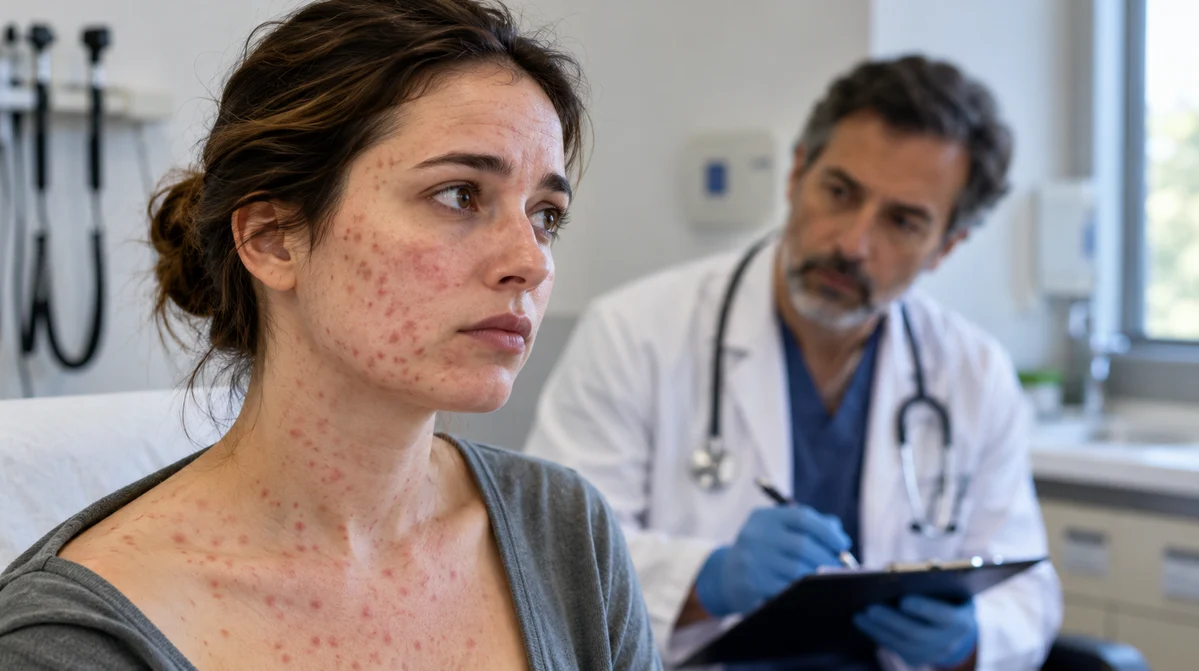
The first symptoms are generally fever, cough, cold and conjunctivitis, to which is later added the skin rash which initially appears on the face and neck, and then spreads to the rest of the body. Most people recover, but measles can cause complications affecting the respiratory system, nervous system and other organs, making hospitalization necessary in the most serious cases.
The consequences of the disease emerge particularly clearly from Italian data: among the 84 cases reported in January 2026, 30 people developed at least one complication, equal to 35.7% of the total. The most frequent were pneumonia and hepatitis or increased transaminases, each recorded in 12 patients, while other complications included respiratory failure, diarrhea, ear infections and eye problems. The bulletin also documents a case of encephalitis in an unvaccinated adult, a rare but potentially very serious neurological complication.
A further element concerns the impact of the disease on the healthcare system: in the same period, 39 people, equal to 46.4% of reported cases, were hospitalized and another 19 needed a visit to the emergency room. These are percentages referring to the cases notified in the period considered, which must not be interpreted as the general probability of hospitalization for anyone who contracts measles, but which nevertheless reflect the clinical relevance of the infections observed.
Vaccination: why measles continues to circulate
To understand why a disease preventable through vaccination continues to spread, we must also look at the vaccination status of the infected people. In January 2026, among the 77 patients for whom this information was available, 70 were not vaccinated, equal to 90.9%, while five had received only one dose and one had completed the course with two doses; for an additional vaccinated patient, the number of doses received was not known.
The presence of cases even among vaccinated people does not mean that the vaccine is ineffective, because no vaccination guarantees absolute protection, while completing the vaccination cycle significantly reduces the risk of contracting the disease. According to the Higher Institute of Health, two doses of measles vaccine confer protection of approximately 97%, but to limit the circulation of the virus it is necessary to achieve coverage of at least 95% of the eligible population with both doses.
The problem does not only concern those who have never received the vaccine due to a conscious choice, but also people who have not completed the expected cycle or who, especially among the adult generations, do not have reliable information on their vaccination history.
In Italy, vaccination against measles is normally administered through the combined vaccine against measles, mumps and rubella, with a first dose expected around 12 months of life and a second around five years of age. Non-immune adults can catch up on vaccination through a course of two doses, spaced at least four weeks apart, according to the indications of the doctor and vaccination services.
Who doesn’t remember being vaccinated: what should they do
For an adult who does not remember having contracted measles during childhood and does not know whether he has received one or both doses of the vaccine, the first step is to check his vaccination documentation, contacting his family doctor or the vaccination service of his local health authority to reconstruct, when possible, the vaccinations carried out and evaluate the possible need to complete the cycle.
The absence of precise memories does not necessarily mean that a person is not protected, but neither should it be considered a guarantee of immunity, especially when frequenting environments where there may be children too young to be vaccinated or people particularly vulnerable to complications of the infection. The evaluation of one’s vaccination situation is also important for healthcare workers, for whom the Ministry of Health recommends specific vaccination programs, both for individual protection and to reduce the risk of transmitting the virus to patients.
Particular attention must be paid to pregnant women and immunosuppressed people, for whom the live attenuated vaccine may be contraindicated and protection also depends on reducing the circulation of the virus in the population. For those planning a pregnancy, checking your immunity beforehand allows you to evaluate any preventive interventions with your doctor before conception.
There is also an issue that concerns those who have already come into contact with an infected person: in case of exposure to measles, it is important to promptly contact the doctor or health services, because vaccination carried out within 72 hours of contact can prevent the disease in susceptible people for whom the vaccine is indicated. For some categories that cannot be vaccinated, such as non-immune pregnant women and certain immunosuppressed patients, the doctor may instead consider the administration of immunoglobulins within six days of exposure.
The risk does not only concern those who get sick
The return of measles poses a question that goes beyond the number of infections recorded in a single month, because the spread of the virus also involves people who, for age or medical reasons, cannot yet receive the vaccine or cannot be vaccinated at all. A susceptible adult who contracts the infection can in fact transmit it to a child too young to be immunized, to a non-immune pregnant woman or to a person with a compromised immune system, contributing to the circulation of the virus even within environments where the consequences can be particularly serious.
It is no coincidence that, among the infections recorded in January 2026 for which the context of transmission was known, the family environment was the most frequently reported, followed by healthcare environments, while among the infected people there were also five healthcare workers.
This is where measles stops being an exclusively individual issue and becomes a problem of collective prevention, because the protection of the most vulnerable people also depends on the ability to limit the spread of the virus among those who can be vaccinated.
The data of the median age of 28 years of those infected represents, in this sense, a reminder for a generation that may never have considered measles a personal risk and which, for this very reason, may not have checked their vaccination situation. The virus, however, does not distinguish between those who attend a nursery school and those who work in an office, between those who are five years old and those who are forty: what makes the difference is above all the presence or absence of adequate immune protection, together with the individual conditions that can make the consequences of the infection more serious.