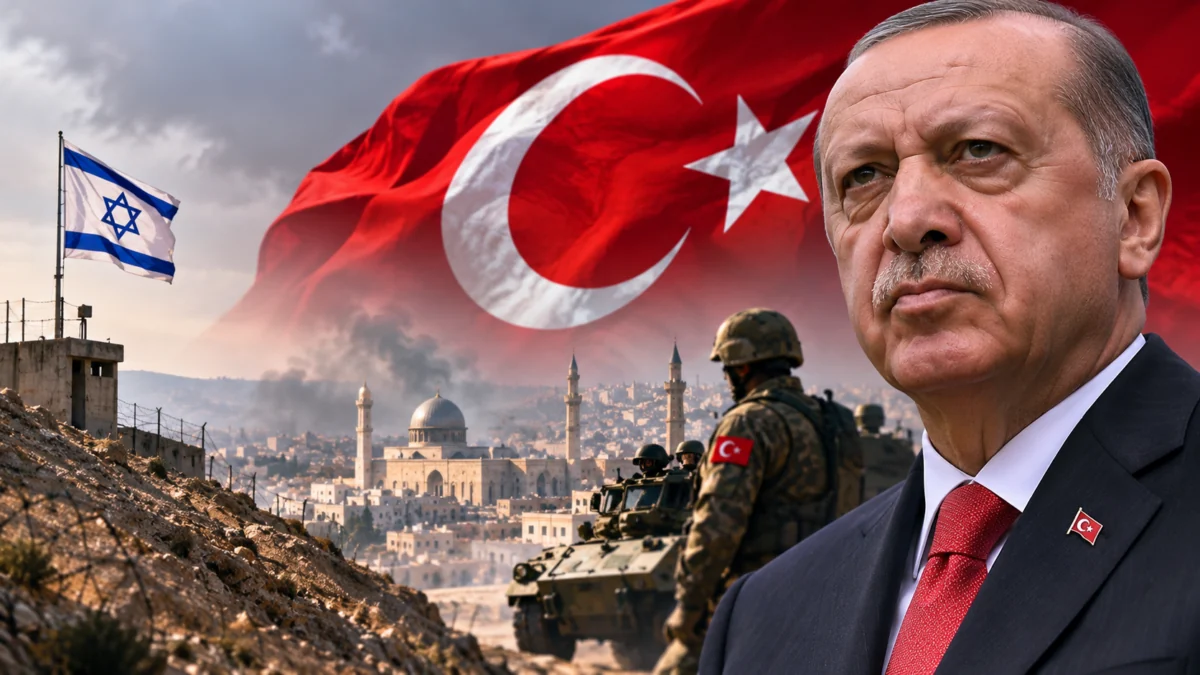
Ankara exploits international crises to extend its influence. Syria is the main area of confrontation with Jerusalem, while Europe continues to deal with Turkish dependence on the migratory front
Turkey’s Recep Tayyip Erdoğan is at the center of the dossiers they involve Europe And Israel: BORN, Ukraine, Russia, Syria, Kurds, Libya, Iran, Gaza And Eastern Mediterranean. After years of isolation, Ankara has recovered space. What project are you pursuing? Erdoğan and how much does it worry the allies? The topic was addressed in London on 19 November briefing of the Europe Israel Press Association (EIPA) «Turkey: NATO Ally, Regional Power or Source of Instability?». Dr. attended Remi Danielanalyst ofInstitute for National Security Studies (INSS) of Tel Aviv; Dr Alan Mendozaco-founder and executive director of Henry Jackson Society and Prof. Rosa Freedmanteacher atUniversity of Reading. Remi Daniel consider Erdoğan one of the beneficiaries of the last five years. In 2020 the Türkiye was isolated; regional normalization, war in Ukraine, October 7fall of Bashar al-Assad in December 2024, return of Donald Trump and conflict with Iran in 2026 have created favorable conditions. Ankara it emerged from the crises without being overwhelmed by them. Erdoğan consolidated the position by communicating with opposing interlocutors. Ankara he claims Kievbut did not adopt heavy sanctions against Moscow; stay in BORNconverse with Russia And China and take advantage of the position on the Black Sea. The Montreux Convention on the Straits is a strategic lever. Daniel highlights European military cooperation: technologies with Italy, Eurofighter approvals from London and Berlin, agreements with French industry. The risk is to strengthen Ankara without guarantees. Turkey is present in Iraq, Syria, Gaza, Gulf, Somalia, Red Sea, Africa and Eastern Mediterraneanand expands the weight with trade, defense and TRT World. Daniel describes a policy revisionist and Islamist-conservativewith support from Hamas And Muslim Brotherhooda line against Israel radical and 360 degree diplomacy with Fly And Beijing. Tensions remain Eastern Mediterranean.
SYRIA, THE TURKISH PRESENCE THAT WORRIES ISRAEL
Syria is the central theater for Ankara and the most sensitive dossier for Israel. Rosa Freedman calls the Turkish military buildup a little-discussed takeover attempt in West. Turkey does not aim to annex territories, but to a sphere of influence and the role of the main military, political and economic power. Ankara has sought roots in Libya and Iraq; in Syria, after the north, it is moving towards the center and aiming for a role in the missions in Lebanon. Influence is intertwined with Ahmed al-SharaaAlready Mohammed al-Jolanisupported by Türkiye and still linked to the Golan issue. The crux is the militias that joined the Syrian army: many trained and armed by the Turks, but control of al-Sharaa remains uncertain. Violence against the Druze a Sweida they highlighted the fragility of the chain of command. Freedman, after research in the fields UNRWA in Jordan, Lebanon, Syria, West Bank And East Jerusalem and meetings with Druze along the border, argues that Turkish expansion proceeds while West And United States they prefer not to face it. The return of refugees fuels caution. The Turkish presence near the Israeli borders alarms Jerusalem. The buffer zone in the south protects the Druze and prevents trained forces from Ankara arrive at the border. Daniel describes an unspoken division: the north under Turkish influence, the south conditioned by Israel. The balance avoids the clash, but penalizes the Kurds.
STRATEGIC AUTONOMY AND SUNNITE AMBITIONS
Alan Mendoza defines the Turkish line as a search for strategic autonomy: participating in alliances, maintaining freedom of action. Ankara supports Kiev without breaking with Moscow and remains cautious on Iran. It is not an ally of Tehran, but does not hope for the collapse of the regime, fearing uncontrollable instability. Mendoza recalls Turkish-Saudi cooperation in Libya, Sudan, Somalia and Ethiopia, where Ankara and Riyadh face an Emirati-led coalition. The agreement between Saudi Arabia, Pakistan and Turkey signals Sunni ambitions and coordination that recalls Article 5 of NATO. For MendozaTurkish accession to the EU is unrealistic: the negotiation is a «charade», but Brussels pours billions to manage migrants, offering Ankara leverage. Trump and Erdoğan have solid relations: the American president considers the Turk a strong interlocutor. Western silence on the democratic drift is a critical point. Mendoza denounces pressure on independent media and initiatives against the opposition. The end of the PKK’s armed struggle is an important achievement for Erdoğan, but within the framework of a democratic squeeze. Migration cooperation limits Europe’s ability to challenge Ankara. Freedman claims that Washington and the capitals present Syria as safe for the return of refugees, while the Turkish takeover remains little discussed. It is a regional presence that Europe seems unwilling to address.
F-35, RED LINES AND RISK OF COLLISION
The sale of F-35 remains delicate. Ankara maintains the Russian S-400s and, until he abandons them, Washington he is unlikely to authorize fighter jets. Daniel And Mendoza They warn that a deal would have consequences for Israel, as Turkey’s presence in Syria brings Ankara close to Israel’s borders. The briefing invites us to avoid head-on collisions, but to establish red lines. Ankara has influence, but limitations: backward air defense, economic crisis, skills drain, overextension and insufficient resources to rebuild Syria. Four Iranian missiles aimed at Turkish territory in 2026, he recalled Danielwere intercepted by NATO. Turkey is not “the new Iran”: it does not build proxies comparable to Tehran. Erdoğan wants to consolidate a sphere of influence by exploiting crises. Daniel suggests to Europe a long-term strategy, red lines and mediation between Ankara and Jerusalem.