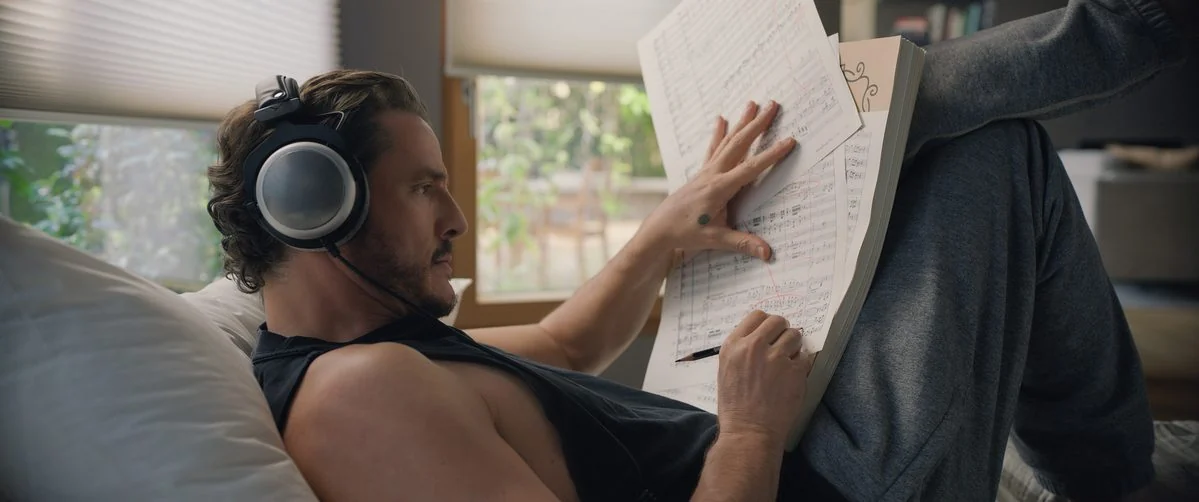
The evening before the last day of filming, while the rest of the crew was out having fun on the streets of Vienna, Pedro Pascal was in his hotel room studying Mozart. For three months he had spent four hours a day practicing the cello, an instrument that he had learned to take everywhere, even to the gym, and which he kept next to his bed so that it was the first thing he saw in the morning and the last thing before falling asleep. An almost obsessive discipline, necessary to become Alex Serian, the protagonist of Behemoth! – A life. To be recomposed.the new film written and directed by Tony Gilroy, in Italian cinemas from 3 December.
Yet, in telling the character, Pascal inevitably ends up also telling himself, the relationship with success that came relatively late, the time absorbed by work, the need to belong and that particular form of loneliness that can accompany even one of the most loved and recognizable people in contemporary entertainment.
«I miss this character like I’ve never missed anyone else before», confesses the Chilean-American actor, born in 1975, who after going through some of the greatest narrative universes of the last fifteen years, from game of Thrones to Narcosfrom The Mandalorian to The Last of Usfound in Gilroy’s cinema an opportunity to deal with something much more intimate.
There are no worlds to save, fantastic creatures to fight or superpowers to learn to control. There is a man who has spent much of his life perfecting the language through which to communicate with others, without necessarily learning to live with them.
Behemoth!, the new film by Pedro Pascal
Alex Serian is a talented cellist who returns to Los Angeles after twenty years spent away from the city. The return leads him into the world of musicians who record Hollywood soundtracks, forcing him at the same time to confront his own family history, the relationships left unresolved and the consequences of the choices made throughout his existence.
Alongside Pascal, the cast includes Olivia Wilde, Eva Victor, Will Arnett, Matthew Lillard and Margarita Levieva, while behind the camera is Tony Gilroy, former author of Michael Clayton and of Andorbuilds a story in which music becomes the device through which past and present meet, bringing back memories, regrets and questions left unanswered.
The idea for the film dates back to the recording sessions for the soundtrack of Rogue One: A Star Wars Storywhen Gilroy, observing the work of the orchestra, began to imagine a film dedicated to those people who contribute to making cinema images memorable without almost ever appearing on the screen.
To create it he involved nine composers, including James Newton Howard, Michael Giacchino, Alan Silvestri and Emily Bear, entrusting music with a narrative function that goes far beyond that of accompaniment.
Pedro Pascal and the comparison with Marcello Mastroianni
Among Gilroy’s cinematic references there is also Italy. The director was looking for a protagonist capable of giving the film a particular combination of melancholy, irony, charm and lightness, evoking the sensitivity of the great Italian cinema and of Marcello Mastroianni.
An association that found its ideal interpreter in Pascal.
“He had all that panache, that charm, that natural ability to draw you towards him,” Gilroy explained, recalling their first meeting.
The reference to Mastroianni also became part of the personal relationship between director and actor: Gilroy gave Pascal a film poster featuring the Italian actor, while Pascal gave him that of A call girl for Inspector Klutea film loved by both of them, jokingly asking him to return it to her once filming was finished.
But behind the lightness that Gilroy recognizes in his protagonist lies a preparation work that is anything but simple. To make Pascal credible as a professional musician, a real training structure was organized, with some of the best cellists in California committed to accompanying him daily in his study of the instrument.
It wasn’t a question of transforming him into a concert performer, but rather of making his gestures, posture, physical relationship with the cello and that familiarity that only someone who spends an entire life next to an instrument can possess.
Pedro Pascal: «Home is where the people I love are»
Alex is a man constantly on the move, seemingly without a place to call home. What does home mean to you?
«I recently had a very interesting conversation on this topic. I had bought a house and realized I was incompatible with that experience. Maybe it wasn’t the right neighborhood, I also had terrible neighbors. I sold it and immediately felt freed from a sort of psychological burden. I realized that, because of the way I grew up and the nomadic life I lived, home is where the people are. And this makes me feel very comfortable.”
His character has dedicated much of his existence to art, perhaps sacrificing personal relationships. Is it something you recognize yourself in?
«I don’t think I consciously chose a career to the detriment of relationships. Rather, it is an identity that began to take shape when I was very young and has continued to evolve, making me the adult I am today.”
Pascal remembers his childhood spent at the cinema with his father, his first requests to attend an acting course when he was just eight years old, his passion for swimming gradually replaced by that for the theater and, subsequently, the years spent on the American stage, when small television roles were mainly used to pay the rent.
Now, however, the perspective has changed.
«I would be lying if I didn’t recognize how much time the work takes up and how unreal the perception of time on a set can become. Before starting a film someone tells you they’re pregnant, then you finish filming, start another project, the baby is born and when you finish the next one it’s already a year old. It’s something that, in a certain sense, worries me. Maybe I should slow down a little. I would like to pay more attention to the things that happen off set, so that they don’t escape me.”
From Game of Thrones to The Last of Us, the role that changed his life
Before becoming one of Hollywood’s most in-demand faces, Pedro Pascal spent nearly two decades building his career away from the spotlight of major productions. The international success, which arrived when he was almost forty, had a precise turning point.
Which role represented the defining moment of your career?
«There was a television role that changed my life and to which I am still indebted today: that of Oberyn Martell in game of Thrones. Nobody forgets how extraordinary the writing was on that series.”
What Pascal remembers with greatest gratitude are not necessarily the great battles or the special effects, but rather the scenes built around the dialogue between two characters, moments of tension in which the spectacular gave way to the quality of the writing and acting.
TO game of Thrones followed Narcosan experience the actor compares to a long succession of independent films shot in Colombia, before the arrival of The Mandalorian And The Last of Ustelevision productions capable of reproducing, even on the small screen, the spectacular dimension of cinema.
«But I grew up watching films, going to the cinema and dreaming of cinema. A role like this is something I’ve wanted since before I even went to university.”
Pedro Pascal and the challenge of learning to play the cello
How do you build such an authentic relationship with an instrument you’ve never played before?
«Tony’s first suggestion, even before agents or contracts came into play, was to get me a cello and take it everywhere. It was important that the physical relationship with an instrument of that size was credible, as much as the position of the fingers or the movement of the bow.”
For Pascal, the greatest difficulty was accepting the distance between the correctness of the gestures and the sound actually produced, continuing to practice without the gratification that normally accompanies learning a musical instrument.
Preparation included studying passages by Mozart, Bach and Tchaikovsky, as well as original compositions created for the film, so that each movement corresponded to the music recorded by professionals.
The actor, however, categorically rules out a future in the orchestra.
“I wouldn’t be so cruel as to inflict that level of delusion on someone,” he jokes.
The success, family and fragilities of Pedro Pascal
Among the most personal dimensions of Behemoth! there is the relationship between Alex and his brother, played by Will Arnett, which allowed Pascal to draw on his own family experience.
How much of your private life did you bring into building this relationship?
«I am very close to my brothers. I have an older sister, a younger brother, and a younger sister, and the four of us are extremely close. There is a side of us, a vulnerability or anger, that only a brother, a partner or a child could have seen.”
It is precisely through this relationship that Alex, a man accustomed to expressing his emotions through the cello, manages to show aspects of himself that he normally keeps hidden.
For Pascal, playing such a complex character also meant dealing with his own vulnerabilities, the expectations that accompany relationships and the need to learn to forgive himself.
What did Alex leave her?
«Some of the love I feel for him and the ability to understand him represents a form of healing for me. It means turning your gaze towards yourself, towards your own vulnerabilities, and being able to forgive yourself enough to have the courage to leave another person free.”
At 51, Pascal says he has also learned to appreciate the experiences that acting allows him to live, including those that do not directly belong to his existence. Being married, becoming a father, going through imaginary worlds: possibilities that the actor encountered through his characters and which today he looks at with gratitude, rather than focusing on their absence from his own life.
Learn to be yourself
Ultimately, Alex Serian’s journey poses a question that concerns anyone who has spent a considerable part of their existence trying to match the expectations of others: when does the time come to stop being what the world expects and start understanding who you really are?
Is there a moment when we need to free ourselves from other people’s expectations to live authentically?
«The sooner it arrives, the better. But I believe that we cannot reach that point without going through a path of mistakes, disappointments towards ourselves and fears to face, to discover what we really want, what keeps us anchored and what matters most.”
This is perhaps the most interesting dimension of contemporary Pedro Pascal. Just at the moment when Hollywood seems unable to do without him, the actor discovers in the portrait of a fragile and unresolved musician the possibility of questioning the price of success, time and the freedom of not always having to be what others want.
Even when what others desire is Pedro Pascal.