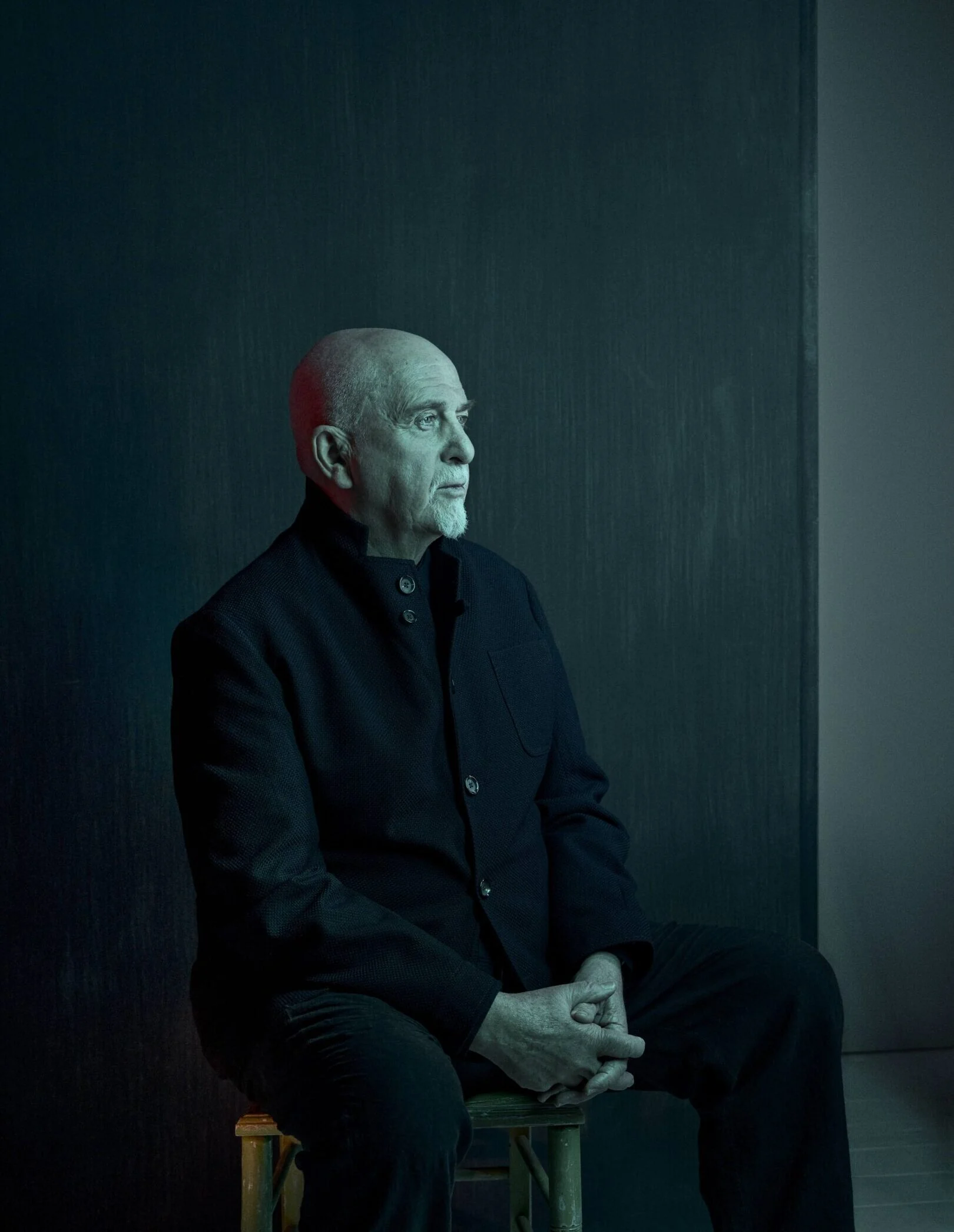
At seventy-six years old Peter Gabriel he retains a quality that many musicians lose well before reaching artistic maturity: curiosity. That willingness to question the world, to be surprised by its transformations, to search for something in music that goes beyond the reassuring re-proposition of an acquired identity. Just three years ago Ian almost negligible interval if compared to his recording habits, oi returns the portrait of an artist still fully immersed in his own time, capable of dealing with the anxieties of contemporaneity through songs of notable musical and emotional depth.
The new work ideally completes the previous one, giving life to a corpus of twenty-five compositions. The reversal of the title suggests a different direction of gaze: from interiority towards the world and from the world towards interiority, in a continuous exchange of information, sensations and experiences. Gabriel addresses the perspectives opened by artificial intelligence, the possibilities of manipulating thoughtthe relationship with nature, the precariousness of existence and the need to redefine our place in the universe.
However, it would be reductive to consider oi above all for the scope of his philosophical reflections. The true richness of the album lies in the quality of the songs, in the ability to transform complex issues into sound matter, to give a sensorial dimension to even the most abstract of intuitions.
Put the Bucket Down it is, in this sense, one of the most convincing results of the entire work. A composition in which the most inventive Gabriel forcefully resurfaces, the one capable of making the rhythmic anomaly seductive, of making the irregularity of an electronic pulsation coexist with the immediacy of a memorable melody. Tony Levin’s bass, David Rhodes’ guitar, the layering of the keyboards and the progressive expansion of the orchestral space contribute to the construction of a piece that is as sophisticated as it is physically engaging.
The contribution of the wind instruments is invaluable, with Paolo Fresu present in the Bright-Side Mix. Here we find that particular conception of rhythm that runs through his entire production: a generating force around which the song takes shape, acquires movement, changes perspective. A splendid song, in which the best traits of Gabriel’s writing can be recognized without the reference to the past becoming nostalgia.
It is no less fascinating Been Undoneplaced at the beginning, with its suspended atmosphere and the almost liturgical character of the keyboards. The piece develops slowly, acquiring rhythmic consistency and expressive depth. The voice interprets a confusion that concerns the human condition in its entirety.
The cinematic dimension of Gabriele’s writing finds a particularly significant expression in What Lies Aheada composition with a long gestation, which had already surfaced in previous years and has now reached its discographic form. The strings accentuate its melancholic character, while the song seems to question a horizon that moves away every time we try to reach it. It is one of those moments in which Gabriel manages to convey through music the feeling of waiting, the mystery of something that is about to happen and whose nature we are still unaware of.
Till Your Mind Is Shining introduces another nuance to the complex emotional geography of the album, while Won’t Stand Down it reaffirms the civil dimension of an artist who has never completely separated his aesthetic research from his political commitment. The urgency of the message translates into more explicit writing, in which music also takes on the function of a call to collective responsibility.
It is definitely enthralling Who Are We Talking To?an episode that brings to mind the Gabriel of the Eighties, his ability to combine funk, polyrhythms, electronics and pop sensitivity. The percussion, the guitar’s incursions and the play of the voices give the composition a contagious vitality. Gabriel knows the communicative value of the body, of movement, of dance: even when he addresses existential questions, he knows that music can reach a truth through rhythm even before words.
The beautiful one is of a completely different nature Yes, It Will Goa ballad in which the piano, the voice and the delicacy of the wind instruments create a space of rare intimacy. The theme of impermanence, of the dissolution of everything we believe is destined to last, is addressed without emphasis. Gabriel seems to rediscover that particular emotional intensity that had made pages like this unforgettable Here Comes the Flood, Mercy Street.
With One by Onewhich in the Bright-Side version is almost ten minutes long, the pleasure of a musical form freed from the conventions of duration emerges. Gabriel allows himself the necessary time to articulate his own speech, and in this willingness to dilate the musical time the freedom conquered by the artist is felt.
The change of register is interesting A Hard Lessonwhere the electronic components meet a blues matrix reworked through a contemporary sensitivity.
Face the Wall instead it belongs to the most collected pages of the work. Aging, the confrontation with limits and the awareness of death acquire the weight of a lived experience. Gabriel’s singing today possesses an expressive quality different from that of his youthful years: less inclined to dramatic explosion, more interested in nuances, in the specific weight of words.
In I Belong to the Sky the feeling of belonging to something larger than the individual opens up a further perspective, while Looking for the Happywith its melodic brightness and the exuberance of the winds, claims the possibility of joy even in a present crossed by profound anxieties.
Closing the journey is Sacramentperhaps the most enigmatic episode of the album. The austere atmosphere, the almost recitative character of the voice and the tension towards a dimension that transcends immediately perceivable reality lead back to some of the darkest and most mysterious areas of his production. A conclusion that leaves open the questions accumulated over the course of the album, avoiding the temptation to offer definitive answers.
Naturally, an essential part of the charm of oi comes from the amazing musical community that surrounds Gabriel. Tony Levin, David Rhodes and Manu Katché represent much more than a proven instrumental section: they are custodians of a shared language, built through decades of collaboration. They are joined by personalities such as Brian Eno, Paolo Fresu and numerous other performers, as well as the interventions of the New Blood Orchestra and choral groups.
The double sound interpretation of the compositions, entrusted mainly to Mark “Spike” Stent for the Bright-Side Mix and to Tchad Blake for the Dark-Side Mix, is a way to remember how much the production work constitutes an integral part of the compositional process.
The beauty of oi it also lies in its status as a mature work, in the possibility of bringing together musical, cultural and human experiences accumulated over more than half a century without transforming them into a retrospective exercise. From Gabriel’s most adventurous season what remains above all is the desire to know, to explore the border areas between different languages, to assign technology a creative function rather than a merely ornamental one.
In a historical moment in which the possibility that machines can reproduce human creativity is being discussed, Gabriel responds with a work in which technological sophistication is continually crossed by the warmth of the voice, the unpredictability of the rhythm, the memory and the awareness of one’s own finiteness.
Almost fifty years after the beginning of his solo career, Peter Gabriel still has something important to say. And, above all, he still has the ability to say it through magnificent songs.