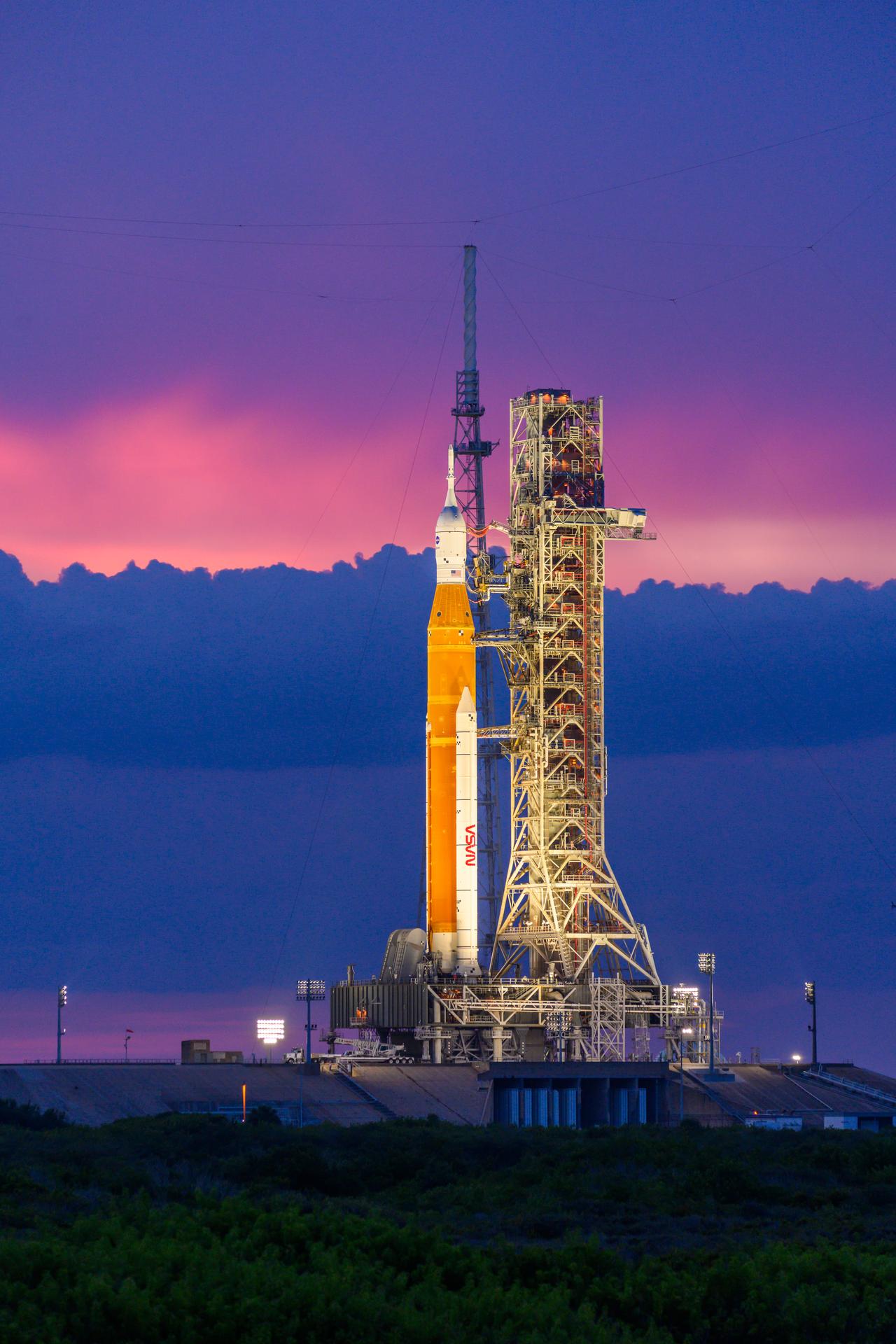
After several postponements, NASA will try the feat again on April 1st using one of the time windows between the positions of the Sun, Earth and Moon. It is essential to limit eclipses: in the dark, Orion’s solar panels do not produce energy. There is a one in thirty chance of failure
After several postponements, the new manned lunar mission of the Artemis 2 program could be launched on April 1st. NASA announced this on Thursday 12 March after the latest check on the state of flight readiness. US space agency officials said they aim to transfer the Space Launch System (SLS) rocket and Orion spacecraft to launch pad 39B by March 19 ahead of a launch attempt scheduled for the first day of next month, provided the remaining work is completed.
Postponement and loss of helium
The launch was initially scheduled for earlier this month, but a helium leak from the fuel system forced technicians to return the giant rocket to the assembly hangar. The work was carried out in record time and now everything seems ready to take advantage of the new launch window – dictated by the relative position of the Moon with respect to the Earth – which will occur from 1st to 6th April.
A historic mission after Apollo 17
There is a lot of anticipation especially for one fact: it would be the first manned mission to the Moon after Apollo 17 in 1972. In a post on the social network
The risks of the mission
When asked how risky this mission actually is, NASA preferred not to make any statements but to point out that it is necessary to proceed with every precaution, without taking risks, also because such an undertaking with this rocket has never been attempted before and therefore we have to deal with a scarcity of available information.” In fact, from the NASA center in Houston they recall that “all manned space missions are risky and Artemis 2 will be only the second flight of the Artemis program and the first to carry astronauts, so there is not yet sufficient data to correctly quantify the risks involved.
The launch windows
According to NASA there are six potential launch dates in April (1, 3-6 and 30); each window lasts 120 minutes on all these dates. This means there are only a few opportunities in a month and some of these may be canceled due to bad weather or the need to replenish materials such as rocket fuel.
Crew and mission
But if everything goes smoothly, Artemis 2 will take off from the Kennedy Space Center, Florida, with the Canadian astronaut Jeremy Hansen and the Americans Reid Wiseman, Victor Glover and Christina Koch on board on a journey of about 10 days around the Moon aboard the Orion capsule, which however will not head directly to the Moon: the SLS rocket will first take Orion into high Earth orbit, where the crew and teams on the ground will carry out a series of checks to ensure that the capsule is ready for its trip.
The trajectory of the Orion
Therefore, the launch day and time must allow the rocket to position the Orion in that orbit to be correctly aligned with the Earth and the Moon at the time of the translunar maneuver which, as the name suggests, will put the spacecraft on course for our satellite. Orion will fly over the Moon following a “free return” trajectory using lunar gravity to return to Earth, without the need for any other significant engine firings.
Energy and mission constraints
And fuel is precisely one of the variables to be carefully managed: Orion’s energy needs further limit the mission’s launch window. The trajectory must ensure that Orion does not remain in the dark for more than 90 consecutive minutes, so that the solar panels can receive and convert sunlight into electricity. So mission planners rule out launch dates that could lead to Orion entering prolonged eclipses during flight.
The return
In the final phase of the mission, during its high-speed re-entry from the Moon, Orion’s five-meter-wide thermal protection system will have to withstand extremely high temperatures to ensure the safety of crew members.
The numbers of risk
According to probabilistic studies, there is an overall risk of failure of 1 in 30 during a crewed Artemis mission to the lunar surface and 1 in 40 during the operational phase on the Moon. A high risk compared to that of SpaceX missions to the Space Station, of 1 in 200, but much lower than that of the Apollo missions of the 1960s, of 1 in 10.