Chinese Coast Guard ships open fire with high-pressure water cannons on two Philippine boats: the jet of water shatters the glass of the cockpits of the first and knocks down the antenna of the satellite communication system and the navigation radar of the second, making it blind to navigation. The victims of the attack, which occurred last winter, were engaged in a mission to supply water, fuel and food to the Filipino soldiers stationed in a military outpost on the Second Thomas Shoal atoll, almost two hundred kilometers from the mainland, created from an old stranded landing ship.
It is just one episode, but a good example, of the conflict that China fuels every day to dominate the body of water facing its southern coasts. In fact, Beijing claims control of 90% of its surface area, to the detriment of the neighboring Philippines, Vietnam, Malaysia and Brunei, violating their respective exclusive economic zones. It matters little that ten years ago an international arbitration at the Hague court ruled against China’s claims. The forces of the People’s Republic impose their maritime hegemony on the field, by sea and by land, eliciting equal and opposite reactions from their regional adversaries.
The conflict has so far remained in the gray zone between war and peace through the use of non-lethal force, although pushed to the limits of the definition, with weapons that also include long-range acoustic devices, to stun opponents with high-frequency sound waves and tactics such as ramming and naval blockades.
In the case of the Philippines, an obligatory precaution to prevent Manila from being able to appeal to the clauses of the Mutual Defense Treaty that binds it to Washington, forcing the stars and stripes ally to intervene.
The desire to reduce, as far as possible, the use of military means, and therefore the responsibility of governments for episodes of violence, is also one of the factors behind the exploitation of fishing fleets.
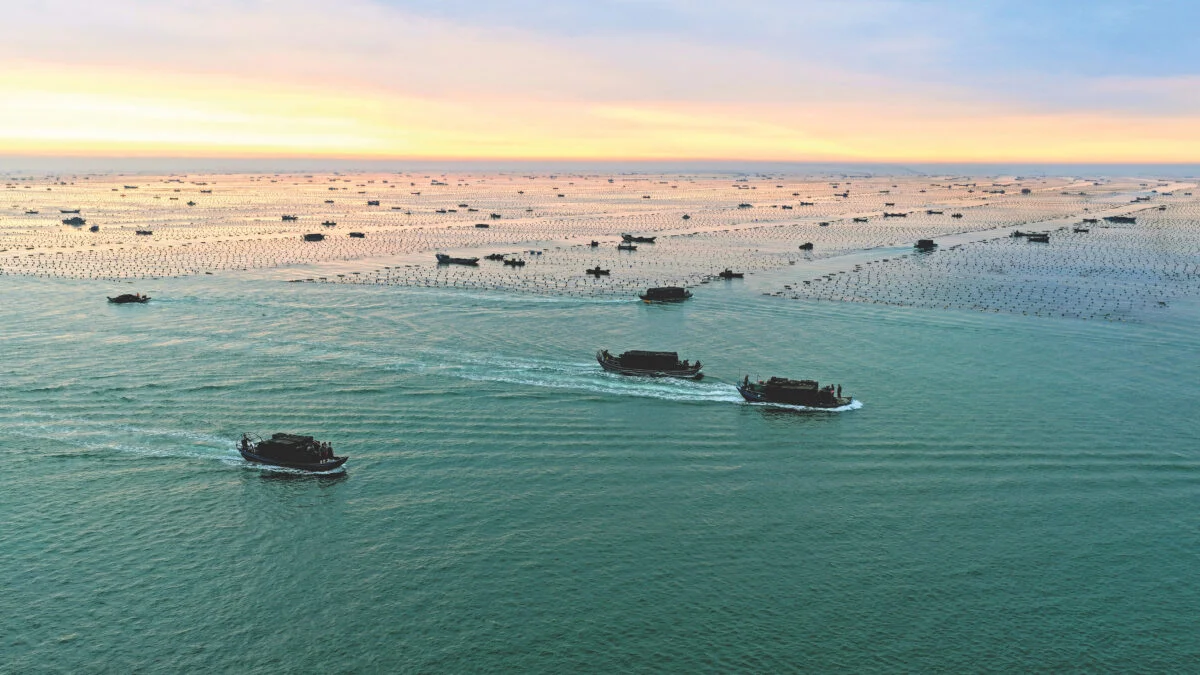
Fishing rights are, in fact, the most visible and immediate point of friction: the South China Sea provides 12% of the global catch, worth around ten billion euros a year, guaranteeing the survival of almost 200 million people. Decades of excessive exploitation, illegal practices such as the use of cyanide, pollution and destruction of the coral reef have consumed fish stocks, which have decreased by up to 95% compared to the first records in the 1950s. Thus, fishermen must push further into contested waters, depending on their governments’ support in terms of grants, supplies and escort patrols. Some have gone even further: Vietnam, for example, has integrated tens of thousands of fishermen into its paramilitary forces.
But it was the Dragon that raised the bar to a higher level. Its Maritime Militia, the largest in history, is made up of over 350 steel fishing boats, designed to ram and resist shocks, which often never drop a net. Formally civilian vessels, they serve only to physically implement maritime sovereignty.
For example, last March, more than 180 vessels tethered themselves to each other with thick cables to create an impenetrable floating barrier at the mouth of the Whitsun Reef atoll.
For the captains of this unofficial fleet, loyalty to the patriotic cause is a golden deal: Beijing provides fuel subsidies of up to 5 thousand dollars a day and “sovereignty bonuses” of 250 dollars a day per crew, provided they are stationed at least 280 days a year in the disputed waters.
However, the stratagem is not always sufficient, especially in hot spots such as the Scarborough Shoal atoll, another strip of sand and rock at the center of tensions between the governments of Beijing and Manila. Despite being located three times closer to the Philippine coasts than to those of the continent, Xi’s navy has effectively controlled its waters for 14 years now and has even declared it a nature reserve, to legitimize the rejections of Philippine fishing boats. However, recent shows of strength and diplomatic disagreements have raised the level of conflict, including a joint naval exercise between the Philippines and the United States and the ban on Manila’s defense minister from entering China.
Above all, the discovery, via satellite images, of a Chinese floating platform parked in the internal waters of the atoll was what triggered the red alarm among the Philippine leaders. Despite measuring just six by six metres, it was enough to elicit a piqued warning from brass in the Philippine military, who warned they would not tolerate any permanent presence on the disputed atoll. Finding a good listener in Beijing, which, despite proclamations of sovereignty and scientific research reasons, has made the platform of discord disappear.
For now. The agitation of the generals in Manila would seem paranoid, but it is instead founded in light of another peculiar phenomenon that characterizes the maritime risk that is played out in these waters: the transformation of atolls into artificial islands.
In fact, the waters of the South China Sea offer little foothold on which to plant one’s flag: the two archipelagos of the Spratly and Paracel islands and the other rocks and shallows that dot the waters are mostly semi-submerged coral atolls. Which all the contenders hastened to occupy in a messy and random mosaic of claims.
Where there was not enough space to set up military bases worthy of the name, the Vietnamese and Chinese literally dried up the sea. The first was the Dragon, with the “Great Wall of Sand” campaign: between 2013 and 2016, swarms of suction dredgers (ships often referred to as “magic island creators”) shattered the seabed of the atolls, vacuumed it up and pumped it at very high speed to create new land. Above, military bases have been built with fortified hangars, ports, radar systems, missile batteries and landing strips capable of hosting military jets and transport planes.
Real aircraft carriers, immobile but unsinkable, also useful for projecting the “great electronic ear” into the vast oceans. The main islands of the Spratlys – Mischief, Subi and Fiery Cross – are believed to host ISR facilities for the collection and analysis of critical information. At Fiery Cross Reef there would also be a detachment of the new Chinese Cyberspace Force.
After a decade of pause, in which Hanoi took the lead in atoll reclamation operations, Beijing has returned in style to the Antelope Reef atoll, in the Paracel disputes, where in less than a year it has already made an area the size of the center of Rome emerge from the salt water.
Manila therefore fears that Scarborough Atoll could be next, also because it would constitute the missing vertex of Beijing’s strategic triangle of bases in the South China Sea, thus allowing its radars, and its fighter planes, to be able to intercept any ship entering its waters.
Starting from those of the US 7th Fleet, which today regularly conduct patrols in the area, followed but not hindered by the Chinese shipping. Status quo unacceptable for Beijing in the event of conflict with Taiwan and barely tolerable when looking at the nearby Strait of Malacca, a bottleneck through which 80% of crude oil imports and two thirds of Chinese maritime trade pass.
This is the Dragon’s Achilles heel. Which, on the other hand, holds in its claws two formidable tools to soften relations with rivals across the street. On the one hand, the purse strings: China is the main trading partner for all the countries bordering the disputed waters. On the other, the family album: millions of ethnic Chinese live in the surrounding states, almost seven in Malaysia alone, in often centuries-old communities that have profoundly influenced local culture.
Factors perhaps not sufficient to bring about peace on the coral atolls, but which can help prevent one day from moving from water cannons to naval artillery. Unleashing another geopolitical storm that the world can happily do without.