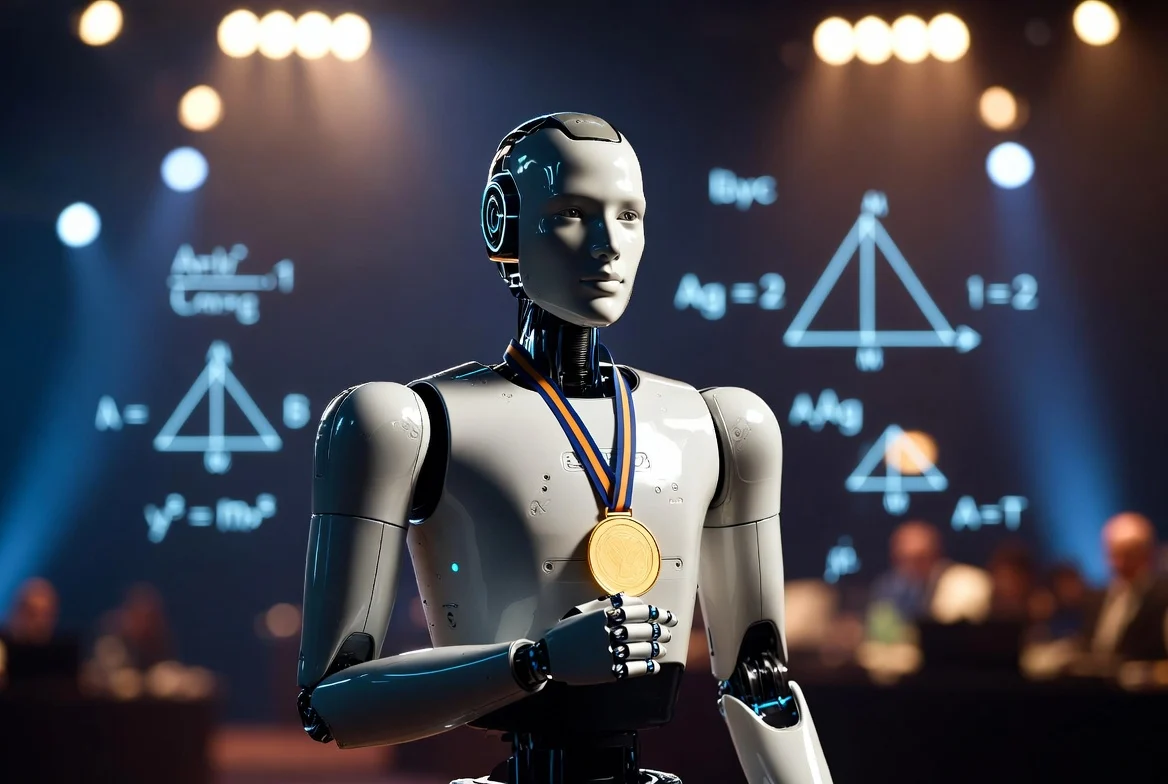
For the first time, two models, both developed in China by Huawei and RedNote, obtain full marks at the International Mathematics Olympiad: a sign of a technological overtaking that the West can no longer ignore.
The domination of artificial intelligence also passes through mathematics. Only, this time, there are no abacuses to slide with your fingers or scientific calculators crammed into pencil cases: there are increasingly advanced AI modelstrained to move between algebra, geometry and proofs as in now familiar territory.
For the first time, in fact, in the history of the International Mathematical Olympiad (IMO), an artificial intelligence obtained the full score. Actually, to be precise, two. Achieving the result that generations of prodigy students have chased for decades have been achieved Huaweiwith its system CeliaAnd Xiaohongshu (the social platform known in the West as RedNote), with the model dots-note-3.0.
It is a leap that illustrates the new technological watershed: AI is no longer limited to responding, summarizing or generating text. He begins to grapple with problems designed to undermine even the most trained mathematical minds. And the first perfect score reported to the IMO comes not from Silicon Valley, but from China.
What happened in Shanghai
It is not a multiple choice quiz, nor an exercise in which you just have to guess the final result. SILT, born in 1959 and considered the most prestigious global mathematics competition for pre-university students, requires rigorous demonstrations: logical steps, explicit conditions, flawless arguments. In other words, the reasoning counts, not just the answer.
The competition, which took place in Shanghaiended with a surprising result: up 666 competitors coming from all over the world, only seven they managed to get top marks. Until yesterday, a perfect score was the exclusive domain of a very small elite young minds under 20 (IMO regulation imposes this age limit on human participants). Today that privilege is no longer just human.
A surprising evolution
The data, probably more significant, is not the maximum score achieved by the AI models, but the speed with which artificial intelligence models have evolved over time. The recent trajectory of AI in math competitions has been really impressive.
In 2024, the systems AlphaProof And AlphaGeometry 2 of Google DeepMind had reached a level from silver medalwith 28 points out of 42. In 2025, Google DeepMind and OpenAI have risen to the level ofgoldboth with 35 points out of 42, solving five out of six problems. We are now at 42 out of 42.
The comparison with real competitors remains was not the purpose of the test but an important check which returns a result that is anything but trivial. AI has placed itself at the rarest end of Olympic mathematical performance, a level where excellence is no longer an average, but an exception.
China no longer chases
For years, the dominant narrative about artificial intelligence has had an obvious geography: the United States designs the future, China scales it. This story is no longer entirely valid. RedNote’s performance does not automatically demonstrate overall Chinese superiority over US AI; a single benchmark, no matter how prestigious, does not measure reliability, open scientific capability, energy efficiency, hardware, security or quality in everyday use.
However, it shows a fact that is difficult to ignore: China now has actors capable of working on frontier of artificial reasoningnot just to apply models developed elsewhere. After the gold results of Google DeepMind and OpenAI in 2025, the first reported 42/42 comes from a Chinese company. In an industry where competitive advantage depends on mathematical talent, data, computation, chips and the ability to turn research into products, the signal matters more than the trophy.
Episodes like this, combined with the results already obtained by DeepSeek with its open source mathematical models, tell a precise trajectory: the Chinese technological ecosystem no longer chases, but dictates the pace in some of the most prestigious and symbolic terrains of scientific comparison.
The technological primacy has long been a terrain of economic, military and diplomatic conflict between Washington and Beijing, and the ability to demonstrate algorithmic superiority on a test bench universally recognized as the Mathematics Olympiad has a value that goes beyond mathematics itself.
In a way, not even too veiled, it seems to be a message from scientific ambitioncapable of influencing investments, talents and global geopolitical narrative.