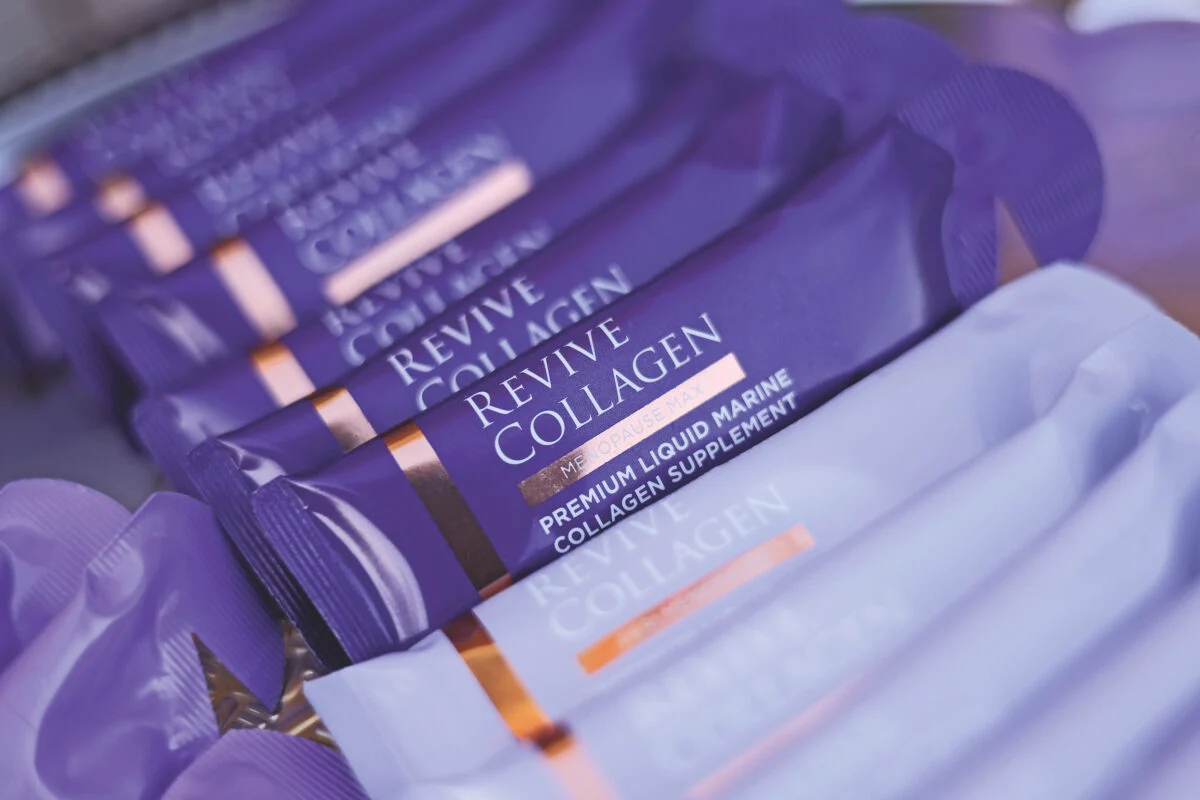
In drinks, in powder form, in foods. The most important protein in our body seems to have become a miracle ingredient for well-being. Between marketing and scientific evidence
It is found everywhere. In smoothies, in functional waters, in bars, gummy candies and in the inevitable jars of “powders” to dissolve in the thermos that we take to the gym and to the office. If until a few years ago it was a supplement known almost exclusively to athletes, today collagen has become the new master key to well-being: it promises healthier and less painful joints, firmer skin, thick hair, resistant nails, and above all the hope of slowing down time.
The question, however, is inevitable: does this “all-rounder” really work? Is there solid scientific evidence to support its benefits or are we faced with yet another wellness fad destined to deflate as soon as the next miracle ingredient arrives? First of all, we need to clarify what it is and how many types there are, because under the word collagen lies a much more complex universe than the advertisements and videos on TikTok suggest. «It is one of the most important proteins in our body: it is the “scaffolding” that supports skin, cartilage, tendons and bones» Filippo Ongaro, expert in longevity medicine, writer and former astronaut doctor of the European Space Agency, tells Panorama. «With age its production naturally decreases, already after the age of 25 a slow but continuous decline begins, which accelerates after the age of 40. However, when we talk about collagen supplementation we must make a precise distinction, because under this label very different products coexist, with distinct mechanisms of action, evidence and clinical applications».
Anyone who tries to look for this type of supplements online or on the shelves of specialized stores knows it well: there are products based on bovine, marine, vegetable, chicken, hydrolyzed, native, mixed, concentrated collagen: confusion reigns supreme. «What we find in most powder or capsule supplements is hydrolyzed collagen, of animal origin» continues Ongaro. «The idea is that these small fragments, once taken by mouth, “warn” the body that its reserves are decreasing, pushing it to produce them again. There are clinical studies that have shown modest, but real, effects on skin elasticity and hydration.”
The truly important effects, however, are those studied in medicine and clinics, especially in the field of rheumatism. «There are as many as 28 types of collagen in the body» clarifies Massimiliano Limonta, head of the Rheumatology Unit of the ASST Papa Giovanni XXIII in Bergamo. «The most important one for the joints is “native type II” collagen, which helps maintain the structure, resistance and elasticity of the cartilage, allowing the joints to withstand daily movements and loads. When it is necessary to supplement it, we mainly use that extracted from the chicken breastbone and generally taken at a dosage of 40 milligrams per day, for cycles of at least three to six months.” However, a fundamental point must be clarified: it is not a drug, it is not an anti-inflammatory and it does not provide immediate benefits. «We can define it as a chondroprotector, that is, a substance which, if taken continuously for months or years – always after medical evaluation – can slow down the progression of arthrosis and reduce the inflammatory phases responsible for joint pain».
Today the problem is that we talk about collagen as if it were a universal panacea, that it is sufficient to add any type of it to a smoothie or take it only for a few weeks to automatically protect the joints or take away pain, and above all that it serves to “cure more or less everything”. «It is a simplification that finds no confirmation in the scientific literature» continues Limonta. «Collagen has a precise therapeutic role: in the initial forms of arthrosis, especially mild-moderate, of the knee, hip and hand. It is in these stages that it can help slow the deterioration of cartilage. However, when the arthrosis is now advanced it makes no sense to expect results. Furthermore, it is important to dispel a widespread belief: it does not cure chronic inflammatory rheumatism such as rheumatoid arthritis. In these patients, therapy is based on immunosuppressive drugs and monoclonal antibodies. To say that collagen can replace treatments would be a very serious mistake.”
So far the medicine: then there is the “fashion”, the alleged benefits on the skin, the use in cosmetic surgery and even the theory that it can prevent or delay aging. A world opens up, made up of bodybuilders who ingest disproportionate quantities before and after training and ladies who are a little older in search of the elixir of long-lasting beauty. Even in this field it is necessary to clear the ground of false myths. «In aesthetic medicine we are very cautious about the effects that collagen supplements that are so popular today can have on the skin» says Andrea Spano, surgeon and founder of The Clinic, one of the best-known aesthetic clinics in Milan. «The point is that we don’t know how much of the collagen taken by mouth or applied with creams is actually used by the tissues. This is why we prefer another path: helping our body “from within” to produce it again rather than simply administering it. It is a more natural process and, in our experience, gives more concrete results.”
An approach that aims to reawaken skin that has become sluggish due to age and to remind it that collagen is good for you and therefore it is advisable to start producing it again, even if you have passed the fateful middle age. «The most modern treatments consist of technologies such as ultrasound, which stimulates fibroblasts in depth, or microneedling, done with small needles that send a stimulus to the tissues, so that the body responds by producing collagen» continues Spano. «If a person also wants to combine a supplement, there is no contraindication. But thinking that a powder dissolved in water or coffee is enough to rejuvenate the skin is an excessive expectation.”
If collagen therefore has precise indications in the health of the joints and in the treatment of arthrosis, and a role that is still debated on how much it helps the skin to regain its lost firmness, how does it really fit into the great theme of longevity? Is it really an investment we can make to age better, is it worth buying these products, or does their success rather say something about our era? «It certainly tells a lot about us, and about the fact that we live in a culture that has an ambivalent relationship with aging» states Ongaro again. «We fear it, we deny it, we fight it, but we struggle to face it as a biological mechanism to be managed with intelligence and sometimes with acceptance. Aging has become a problem to be solved rather than a process to be accompanied: in this context every solution that promises to counteract or slow down time finds a huge and reactive market.”
In the sea of anti-aging strategies, the right priorities should be given, which are certainly not collagen supplements, especially if chosen at random. Also because, around the corner, another pitfall lurks, namely the self-licensing effect.
«In behavioral psychology it is called the “licensing effect” concludes Ongaro. «In practice, when we do something that we perceive as healthy, such as taking a supplement, buying organic products, joining the gym, our brain tends to “compensate” by indulging in less virtuous behaviors in other areas. “I took collagen this morning anyway” unconsciously becomes a permission not to go for a walk, to eat poorly at dinner, to go to bed late or whatever. Of course, the opposite can also happen, that is, taking a supplement stimulates a series of positive changes. Let’s remember, however, that there are other winning strategies for aging well: physical exercise, quality nutrition, sufficient sleep and control of cardiovascular and metabolic risk factors.”
No shortcuts: the elixir of life, at least for now, continues to have a decidedly less glamorous flavor.