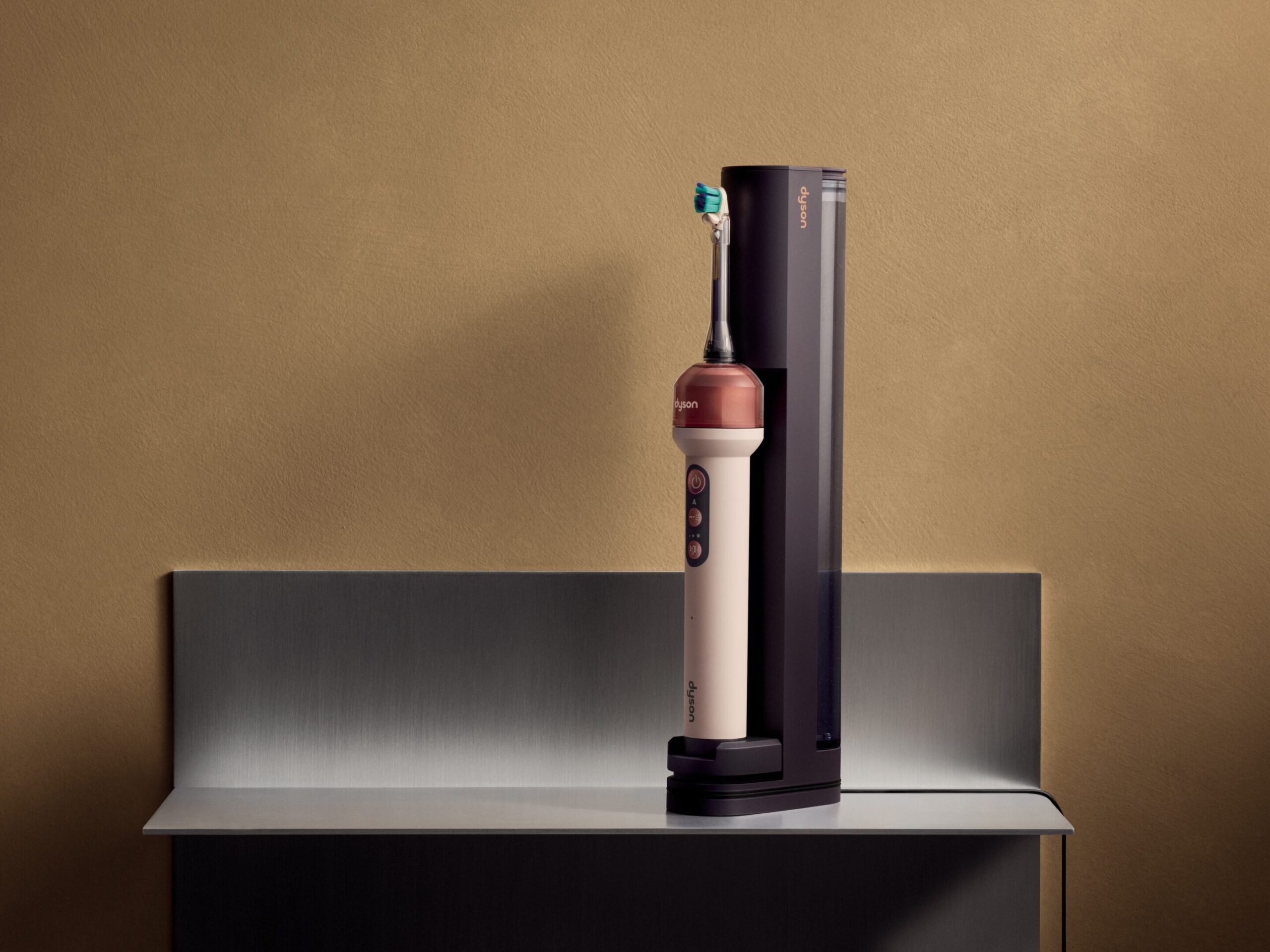
Precision and innovation for the new Dyson toothbrush which integrates a microcamera and a conical mouthwash jet to identify and clean the interdental spaces in real time.
Oral hygiene is a serious matter, for each of us but also for those around us on a daily basis; on the other hand, however, there are no fewer than 3.7 billion people who suffer from oral problems. It therefore means that the opportunity for improvement is still large.
The problem, moreover, does not just concern the aesthetics of the smile: the World Health Organization reports an increasingly recognized link between poor oral health and broader conditions, such as heart disease and Alzheimer’s.
Yet daily habits remain far from what is recommended, given that on average just 45 seconds are spent on brushing, compared to the 2 minutes recommended by the guidelines.
And with this in mind, Dyson wanted to fit in with the newest Dyson CameraJet. Like every product from the company founded by James Dyson, they wanted to do things big.
CameraJet it is in fact the first toothbrush in the world equipped with an integrated video camera, designed not to add a gadget to the daily routine, but to solve a problem that affects billions of people, often without them realizing it.
See what brushing doesn’t see
At the basis of everything is technology Gap Optical Targetinga 100,000 pixel microcamera, with a macro lens and guided by a machine learning algorithm.
The aim is to scan 28 images per second to identify in real time the interdental spaces, the areas where plaque forms more easily and which the mechanical gesture of brushing tends to neglect.
It only takes 100 milliseconds from detection for the device to activate a targeted jet of mouthwash, exactly where it is needed.
A conical jet instead of the needle
However, “seeing” better wasn’t enough, we also needed to rethink the way water removes plaque.
In fact, traditional water flossers use thin, point-like jets, capable of piercing the plaque but not detaching it completely.
Dyson worked for five years with the Faculty of Dentistry of the National University of Singapore to develop a synthetic plaque on which to test alternative solutions, arriving at a wider, conical jet, designed to remove more residue while remaining gentle on gums and enamel.
A head that doesn’t get stuck
The brushing gesture has also been revised. Analyzing in slow motion the sonic toothbrushes already on the market, the engineers Dyson they noticed that the bristles tend to get stuck against the tooth, especially in the hardest to reach places.
The answer is a variable sonic oscillation, which constantly changes angle to keep the bristles always moving. So much so that the company says that in laboratory tests it removed up to 69% more plaque than the main premium electric toothbrushes, precisely in the most neglected areas.
The picture is completed by a double bristle head, equipped with an RFID tag that tracks its wear and signals when it is time to replace it.
Not just a toothbrush
Like any product Dysonalso the CameraJet arises within a broader ecosystem. The picture is completed by a toothpaste without foaming agents, specially formulated so as not to “blind” the camera, a low-foaming mouthwash, a docking station that recharges the tank in just three seconds and the app MyDysonwhich allows you to review the cleaning you just carried out in private streaming, without any images being saved or retained.
All these products, namely the Dyson Dental System (toothbrush, dock, toothpaste and mouthwash), are already available in Dyson Demo Stores and at a selection of retailers, at the price of 479 euros, in the Ceramic Ultra Blue and Ceramic Pink colours.