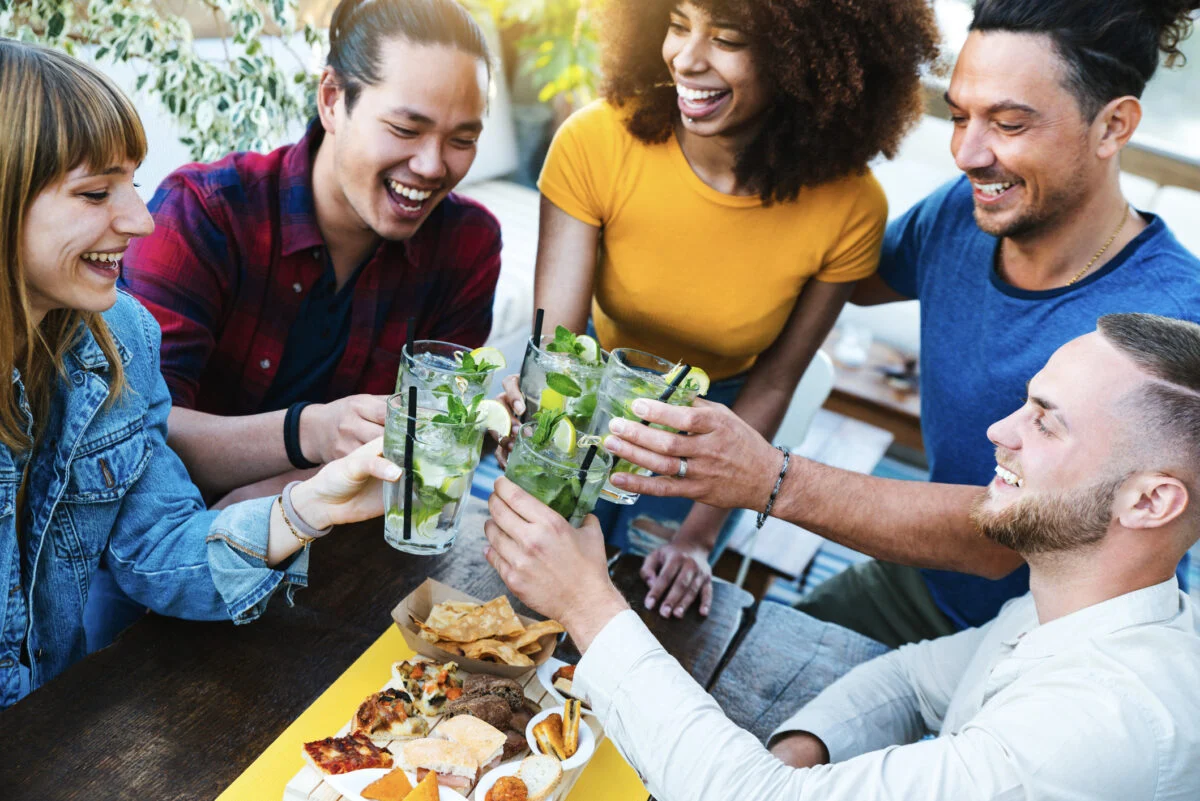
Young people are not giving up conviviality, but they are rewriting it: they choose what to drink more carefully, they alternate alcoholic and non-alcoholic cocktails and they transform their living room into a small cocktail bar. They are guided by the desire to maintain control, the search for authenticity and a new idea of well-being
Drinking less doesn’t mean having less fun. This is perhaps the most significant change that the relationship between Generation Z and alcohol is experiencing. Young people continue to meet, organize parties and enjoy an aperitif, but they do so following different rules from those of previous generations: less excess, greater attention to quality and a growing freedom in switching from a traditional cocktail to a non-alcoholic drink without feeling out of place.
This transformation is captured by research carried out by OgilvyOZ for Schweppes on 2,001 people living in Italy, interviewed in May 2026. The sample was distributed throughout the country and segmented between Generation Z adults and Millennials, used as a comparison group. The quantitative results were also cross-referenced with sector analyzes and data.
The most evident data concerns the voluntary reduction of alcohol consumption: 54 percent of young people declare that they have consciously chosen to drink less. This is not necessarily total abstinence, but an often defined attitude sober curiosity: the willingness to question one’s relationship with alcohol, limit it or replace it on some occasions with non-alcoholic alternatives.
For 33 percent of Gen Z respondents, drinking less serves above all to maintain clarity and control. Among Millennials the same motivation stops at 21 percent. Self-control, therefore, is not experienced as a deprivation, but as a tool to enjoy the evening without paying the consequences the following day.
From drinking to socialize to drinking to choose
What changes is not only the quantity of alcohol consumed, but the very meaning of the drink. For many young people, the ideal evening is no longer defined by the number of glasses ordered, but by the overall experience: 37 percent attach great importance to the music, 28 percent to the atmosphere and 16 percent to the quality of the ingredients.
This affirms what the report defines fluid drinking: alcoholic and non-alcoholic drinks coexist on the same occasion, without a rigid contrast. You can start with a cocktail, continue with a mocktail and perhaps return to a light drink. The choice changes based on the moment, taste and energy level, no longer on group pressure.
Mocktails are also gradually abandoning the image of simple decorated fruit juices. The new non-alcoholic mixology includes botanicals, spices, bitter notes, citrus fruits and complex preparations, designed to offer an experience similar to that of a traditional cocktail. In short, the absence of alcohol must no longer coincide with a less interesting or sophisticated offer.
It is an important cultural transition. For a long time, those who didn’t drink were forced to justify themselves or settle for poorly thought-out alternatives. Today, however, especially among younger people, choosing a non-alcoholic drink can become a declaration of independence: I decide how much to drink and when to stop.
The home becomes the new center of sociality
The revolution also concerns the place where we meet. The bar and the club remain central, but the house takes on an increasingly important space. 56 percent of the young people interviewed say they prefer the domestic dimension, while 36 percent mainly choose outdoor socializing.
It is not necessarily a retreat from social life. On the contrary, the home becomes a space to be designed, personalized and shared. Young people take care of the lights, choose a playlist, prepare the food and experiment with the drinks. The living room is thus transformed into a small private room, in which guests are selected and the atmosphere can be controlled down to the smallest detail.
The phenomenon is defined home tending: a domestic version of bartending, also fueled by content published on social networks. 18 percent of those interviewed admit to being influenced by the aesthetic trends observed online, from the compositions of the glasses to the color combinations, up to the presentation of the table.
But behind the aesthetics there is also a deeper need. 35 percent of young people indicate authenticity as one of the reasons that push them to meet at home: less confrontation with strangers, less social pressure and greater possibility of building sincere and protected relationships. 41 percent instead link this choice to psychophysical well-being.
For Millennials, home often represents a well-established family habit. For Gen Z, however, it seems to take on an almost defensive value: it is the place in which to slow down, escape the daily rhythms and recover a more intimate form of closeness.
Less quantity, more quality
Greater moderation does not even coincide with an obsessive search for savings. 65 percent of under 30s say they prefer excellence to quantity, while 58 percent love to experiment with new products and flavors. The young consumer doesn’t just want to drink: he wants to know the ingredients, choose the right glass, take care of the preparation and create something that can also be shared visually.
However, the economic component remains significant. 28 percent say they limit alcohol because they prefer to spend differently. Instead of ordering many drinks, there is a tendency to choose one or two of higher quality, or to recreate the experience at home by purchasing selected ingredients.
It is in this context that drinks brands are expanding their premium and non-alcoholic offerings. Schweppes, for example, focuses on the Selection line and flavored tonics designed for both professional mixing and home preparations, such as the variants with basil and Sicilian lemon or with different qualities of lime.
Beyond the commercial proposals, the underlying signal appears clear: Gen Z is not canceling the aperitif ritual. He’s tailoring it to his own priorities. He wants to have fun, but without losing clarity; wants to be together, but in environments perceived as more authentic; he wants to drink, but without alcohol necessarily determining the success of an evening.