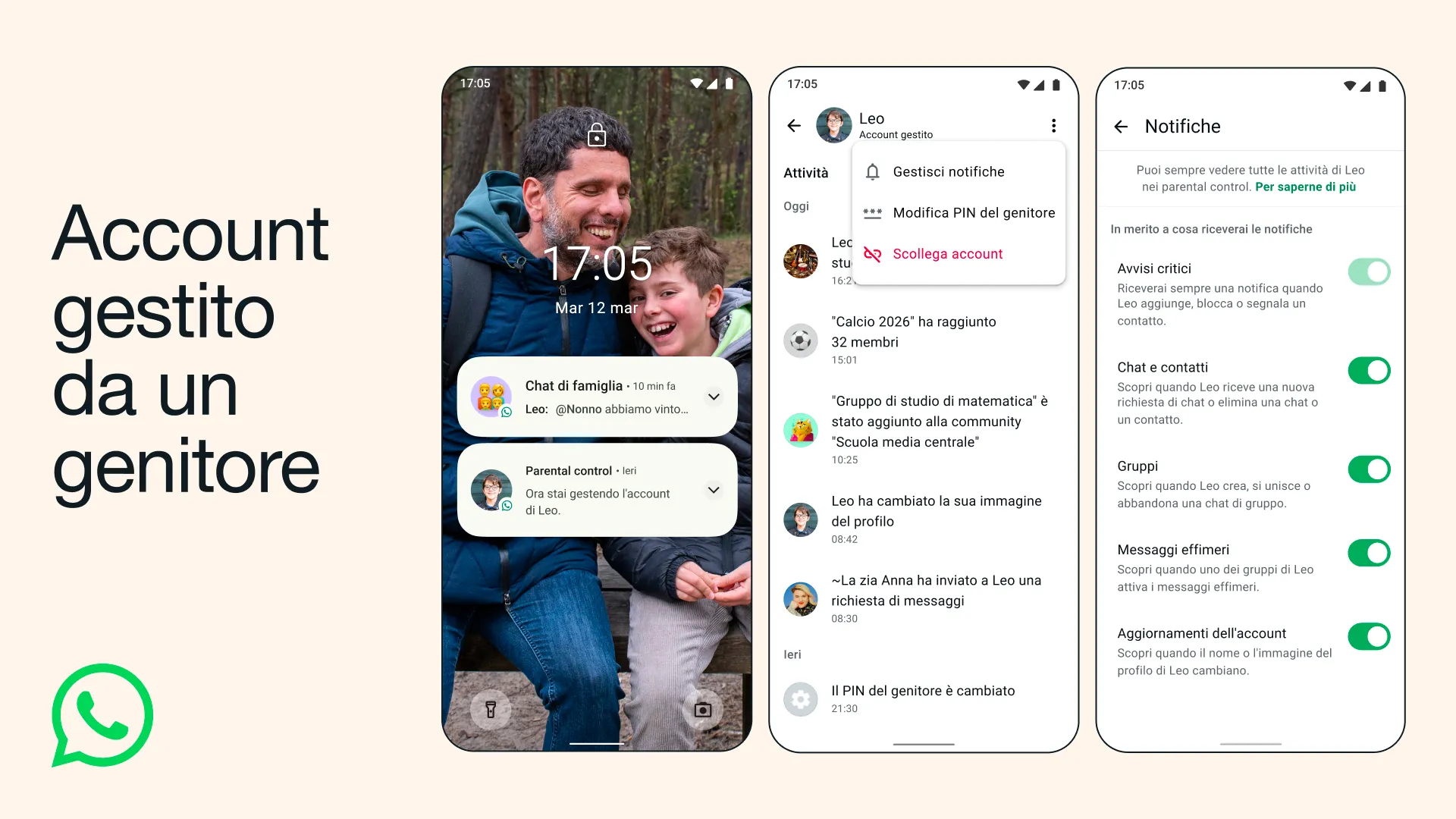
WhatsApp introduces parent-managed accounts for children under 13: controlled messages and calls, protected privacy and new parental control tools
For years it has been one of the most obvious contradictions of the digital age: younger and younger children with a smartphone in their pocket, but messaging platforms formally designed for older users. Now WhatsApp is trying to fill this gray area by introducing accounts managed by a parent, a new system designed for pre-adolescents under 13, which allows families to accompany their first steps in digital communication with more rigorous control tools.
The idea was born from an explicit request from the families. More and more parents are asking for a way to gradually introduce their children to messaging, without immediately exposing them to all the functions of a platform designed for adults. WhatsApp has therefore built an environment reduced to the essentials: messages and calls, nothing else.
A simpler and more controlled version of the platform, which aims to transform the first digital experience into a guided journey.
How parent-managed accounts work
Accounts for pre-teens must be created and managed directly by a parent or guardian and remain linked to their WhatsApp account. It is therefore not an autonomous profile, but a sort of controlled extension of the adult account.
After the initial setup, parents can determine who is allowed to contact the child, manage access to groups and control privacy settings. Message requests from unknown contacts also pass through the parent’s filter.
The experience for the boy remains deliberately limited: you can only send messages and make calls, without other functions that could amplify online exposure.
However, all conversations remain protected by end-to-end encryption, the same technology that WhatsApp uses for all users. In other words, the content of the messages remains private and cannot be read even by the platform itself.
Control goes through a parent PIN
One of the key elements of the system is the Parent PIN, a six-digit code that protects all parental control settings.
Only the parent can access the privacy settings and change them: this means that the minor cannot independently change the established rules. The PIN therefore becomes the real “switch” of digital supervision.
Through this system it is possible to personalize the child’s experience, adapting it to the needs of the family and the level of autonomy they want to grant.
How to set up an account for a minor
The setup requires two phones placed next to each other: the parent’s and the child’s.
The process starts from the child’s device, where the latest version of the app is installed. During registration it is necessary to enter the boy’s telephone number and his date of birth. At that point, a QR code is generated that the parent must scan with their smartphone to link the two accounts.
The adult then verifies that they are of age and creates the parent PIN which will be used to manage the control settings.
Once the process is completed, the child’s account is active and can be personalized with name and profile picture, while all security settings remain under the parent’s control.
A response to the new digital life of families
In recent years, WhatsApp has become much more than just a messaging app. It is the place where children’s days are organized, school activities are coordinated, updates are sent to relatives and family members are reassured with a quick message.
With the arrival of accounts managed by a parent, the platform tries to respond to a transformation that is now evident: digital communication has firmly entered the lives of younger people.
The challenge today is no longer to prevent access, but to build tools that allow parents to accompany it.
WhatsApp will begin rolling out this feature gradually over the next few months, gathering feedback from families to refine it. The declared objective is to offer the new generations a first digital communication space that is simple, private and above all controlled.