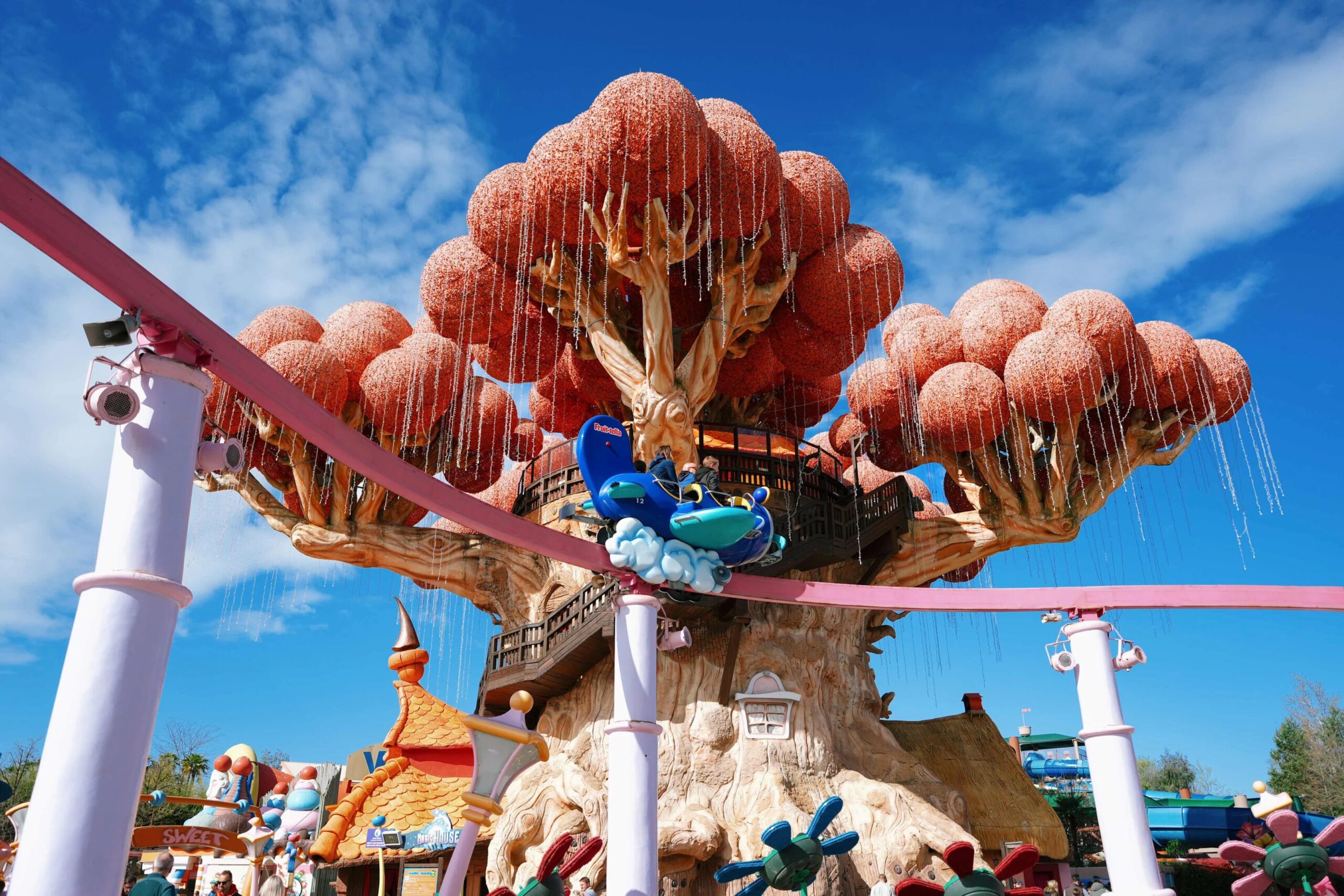
Gardaland, today, is much less innocent than it seems, and not because its most obvious nature has changed – that of families, school trips, roller coasters that continue to mark the time of entire generations – but because, beneath that apparently immutable surface, it has transformed into something much more complex: a place where the global languages of contemporary entertainment are intercepted, filtered and translated into physical experience, with a clarity that the 2026 season makes visible in an almost explicit way.
A few weeks after the opening, the signs are already there, but not so much in the numbers – which also speak of constant flows, of full hotels, of an immediate response – but in the quality of the demand, which is no longer simply looking for a day at the park, but something more complex, more constructed, closer to an idea of experience which in recent years has been radically redefined: one no longer travels to move around, but to temporarily inhabit an imaginary, to accumulate shareable moments, to give shape to a free time that is no longer pause, but content.
It is within this subtle but decisive passage that Gardaland chooses to position itself.
When fun becomes a construction
The change is not spectacular in the traditional sense of the term, that is, it does not come from a single attraction capable of redefining the identity of the park, but from a much deeper and more systemic transformation, which concerns the very way in which entertainment is designed: no longer as a sequence of isolated experiences, but as a continuous narrative construction, in which apparently marginal events, seasonality, formats and activities contribute to creating a coherent ecosystem.
Even initiatives that might seem accessory, such as those linked to the figure of Prezzemolo, actually reveal this paradigm shift, because they no longer limit themselves to entertaining, but seek to build relationships, to activate direct involvement, to transform the public – and in particular the little ones – into an active part of a creative process, which passes through drawing, meeting and guided participation.
It is a different, more sophisticated grammar, which prepares the ground for what comes next.
From digital to real, seamlessly
With Minecraft “Meet the Mobs”, Gardaland carries out an operation that must be seen well beyond the dimension of a temporary event, because it stages one of the most interesting steps in contemporary entertainment: the translation of digital into physical experience.
It is not a simple transposition, nor a replication of the game in the real world, but an extension, in which the imagery constructed within the screen is rearticulated in space, transforming the characters into presence, the dynamics into interaction, the virtual dimension into something tangible, traversable, shareable.
It is a reversal of perspective which, in recent years, has taken on a growing centrality: digital does not take the public away from reality, but feeds it, prepares it, makes it desirable, and the park becomes the place in which that universe finds its second life, more concrete, more immersive, more memorable.
And yet, this too is only an intermediate step.
K-pop as global cultural infrastructure
The real caesura, the one that most precisely defines the direction taken, is represented by the debut of the Gardaland K-pop Festival, which cannot be read – except in a reductive way – as a simple musical event, because what it brings with it is much broader and more structured.
K-pop, in fact, is not just a genre, nor a passing fad, but one of the most sophisticated and coherent cultural systems produced in the last twenty years, capable of bringing together industry, aesthetics, training, distribution and community on a global scale, building a model that does not limit itself to exporting content, but creates belonging, identity, active participation.
Inserting this system within Gardaland means, in fact, importing an entire cultural infrastructure, with its logic, its codes, its expectations, and trying to translate it into a context that until yesterday belonged to another tradition.
It is no coincidence that the festival was designed not as a sequence of performances, but as a layered experience, which includes fan meets, moments of direct interaction, dance masterclasses, participatory formats such as Play Random Dance, continuous DJ sets and an environment construction that aims to recreate — as much as possible — that immersive ecosystem that defines the K-pop experience.
The public, in this case, is not a spectator, but an integral part of the device. And this is where the most interesting point emerges.
Because the K-pop community is probably one of the most demanding and aware existing today: global, organised, capable of immediately recognizing what is authentic from what is simply decorative. It’s not enough to evoke an aesthetic, you have to respect its structure.
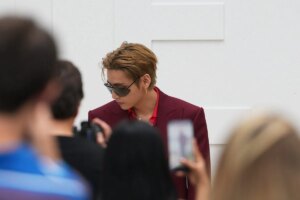
The presence of artists like ASTRO’s Rocky, KISU, LIGHTSUM and HYUNY (and many other names that will be announced shortly) is therefore not an accessory element, but a declaration of intent, because it signals the desire to insert themselves in a credible way into that scene, avoiding the very widespread temptation of reducing the phenomenon to an easily consumable surface.
In this sense, Gardaland does not limit itself to hosting K-pop, but attempts to dialogue with it. The result is that the geography of entertainment, as we have known it, ceases to make sense in traditional terms: a park on Lake Garda that becomes a meeting point between global gaming and Korean pop culture is no longer an exception, but the reflection of a system in which cultural distances have been drastically reduced, and in which audiences move following completely new logics.
Milan, Seoul, Garda: they are no longer separate poles, but nodes of the same network. And it is in this network that Gardaland tries to position itself, not as a simple destination, but as a platform capable of intercepting and translating complex cultural flows.
Free time as content
Behind this transformation we can glimpse an even deeper change, which concerns the very way in which free time is perceived and used: no longer a break, but the production of meaning, the construction of identity, an opportunity for participation.
Tourism, in this context, is becoming increasingly “event-driven”, i.e. driven by what happens at a specific moment, rather than by the destination itself, and this pushes structures like Gardaland to completely rethink their offer, organizing it as a sequence of events, peaks, moments capable of attracting, concentrating and activating the public.
It is a model that is closer to that of large international festivals than to that of traditional parks, and which requires a continuous ability to adapt.
A changing ecosystem
What also makes this transition possible is the transformation of the Resort into an increasingly complex ecosystem, which goes beyond the park in the strict sense and includes themed accommodation facilities, complementary experiences, diversified spaces that allow modular and personalized use.
This framework also includes a growing attention to the environmental dimension, which is no longer treated as an accessory element, but as an integral part of the experience, through concrete interventions on biodiversity, on green areas, on the overall quality of the space.
It is an attempt, not always simple, to keep together innovation and continuity, evolution and familiarity.
The point, in the end
So the question is not whether Gardaland is working – because it works, and the data confirms it – but what it is becoming.
And the answer, although still under construction, is quite clear: no longer just an amusement park, but a platform that intercepts global languages and translates them into physical experiences, a place where free time is transformed into content and entertainment into something much more complex, stratified, and in some ways even more ambitious.
A system that does not limit itself to following the present, but tries, with a certain clarity, to anticipate it.