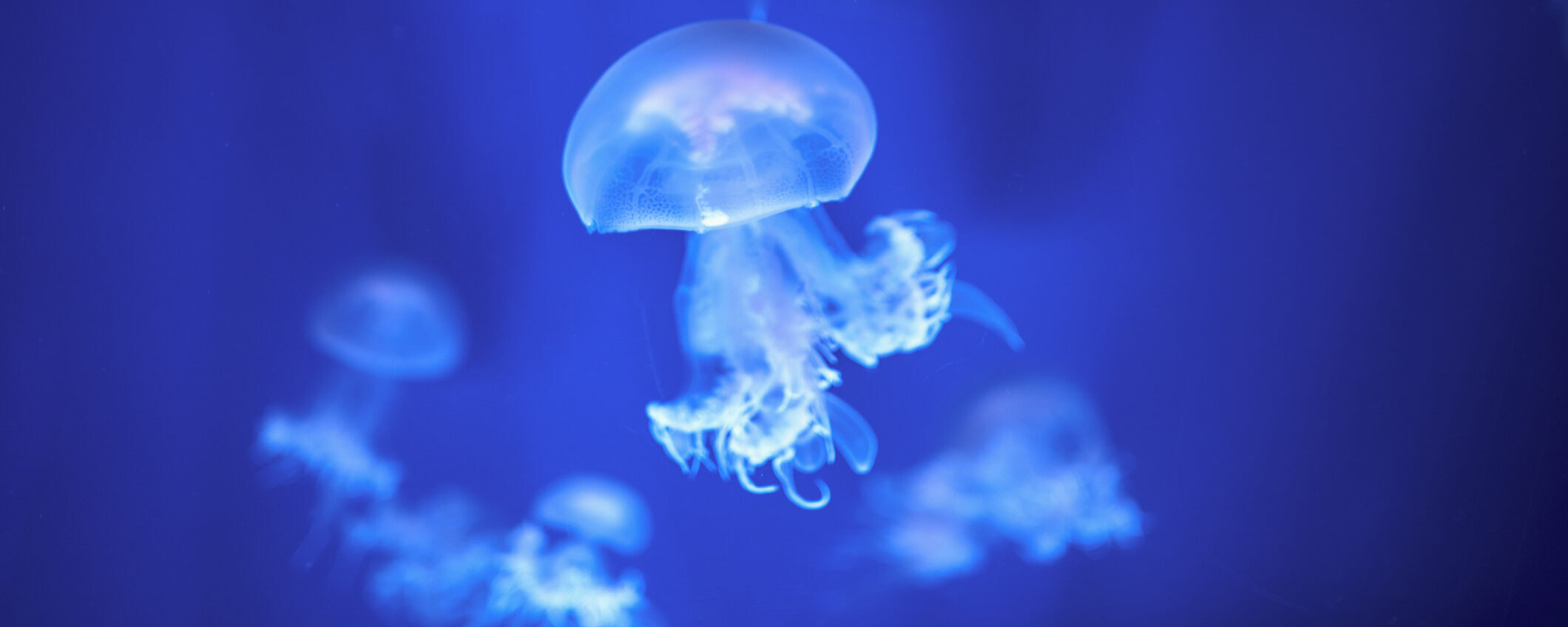
A technology developed by Spanish researchers uses electromagnetic fields to block jellyfish without nets or chemistry. Here’s how it works.
If you are reading this article under an umbrella, you know the scene: the sea in front of you, the sun high, the children ready to dive. Then comes the cry that ruins everything: “There are jellyfish!”. In an instant the stampede.
What if a buoy was enough to avoid all this? From Spain comes a technology that seems to come out of a science fiction film: an invisible electromagnetic shield capable of blocking jellyfish before they reach the swimmers. No net, no chemical products dispersed in the sea: just a floating device that creates a barrier of electromagnetic fields.
An invisible electromagnetic shield born in Spanish laboratories
The idea was born from the work of researchers at Universitat Politècnica de València and of theUniversity of Alicanteengaged in the development of this system for over five years. The experimental basis of the project is a conference paper presented at the conference Biotechnofrom the title Modification of the behavior of the jellyfish “Catostylus mosaicus” using electromagnetic fields. In that study, which lasted three years, the authors ofUniversitat Politècnica de València demonstrated in the laboratory that a medium frequency electromagnetic field could modify the behavior of the Australian jellyfish Catostylus mosaicusreducing their ability to move.
The principle is fascinating. The buoy, powered by solar energy and wave motion, supports a series of coils, connected to a structure immersed in the water, which in turn generate an electromagnetic field that interferes with the jellyfish’s neuromuscular system.
«These animals move by pulsing, contracting their bell to create a flow of water that allows them to move forward. By generating electromagnetic fields it is possible to reduce the number of these pulsations and even paralyze them, thus decreasing their ability to move and maintain their position”, he explains Jaime Lloretcoordinator of the research group of Universitat Politècnica de València.
How interference works on the jellyfish’s nerve network
The mechanism is curious because jellyfish do not have a brain. They are very ancient organisms, appearing in the oceans over 500 million years ago, and their movement depends on a widespread nervous network that coordinates the contractions of their characteristic gelatinous bell.
The electromagnetic field seems to disturb this very system: the pulsation slows down, the movement weakens and the animal loses the ability to move forward normally. The objective is not to kill them, but to create a sort of temporary “off limits”. The system is in fact completely harmless: once they leave the range of action of the device, the jellyfish they return to moving normally.
The idea, the researchers explain, is to intervene on the behavior of the animals and not on the surrounding environment, creating a discreet barrier that does not require permanent nets or structures in the sea. According to the designers, a single buoy could protect a stretch of coastline approximately 300 meters long and multiple connected devices could create a virtual barrier in front of the most exposed beaches.
The unknowns of the open ocean and the economic impact of jellyfish blooms
However, a great unknown remains: the jellyfish often they do not swim towards the shore, but are carried by the currents. If a huge mass of water pushes a swarm towards the coast, will the electromagnetic field really be able to stop it? And above all, will it be equally effective with different species and in variable marine conditions? Only tests in the open sea will be able to provide an answer.
The problem, moreover, does not only concern those who want to bathe without risking a painful sting. The massive proliferations of jellyfish, the so-called jellyfish bloomshave become an economic and environmental issue. Warming waters, excess nutrients in the sea and the reduction of some natural predators contribute to their spread in many areas of the planet, including the Mediterranean.
The swarms can create enormous problems even far from the beaches: they clog the water intakes of industrial plants used for cooling, they can cause difficulties for power plants, desalination plants and even nuclear power plants, which in some cases are forced to reduce or temporarily stop their activities.
Fish farms are also vulnerable: the jellyfish they can damage fish and cause significant economic losses. This is why a technology created with swimmers in mind could have a much broader future. If it passes the test of the sea and scientific confirmations arrive through independent publications, this curious electronic device could become a new tool to protect coasts, industries and infrastructures without resorting to invasive physical barriers.
After centuries of trying to avoid the jellyfish by swimming harder, applying unlikely creams or relying on luck, perhaps we could finally have a technological ally capable of giving us back the pleasure of a dive without too many worries.