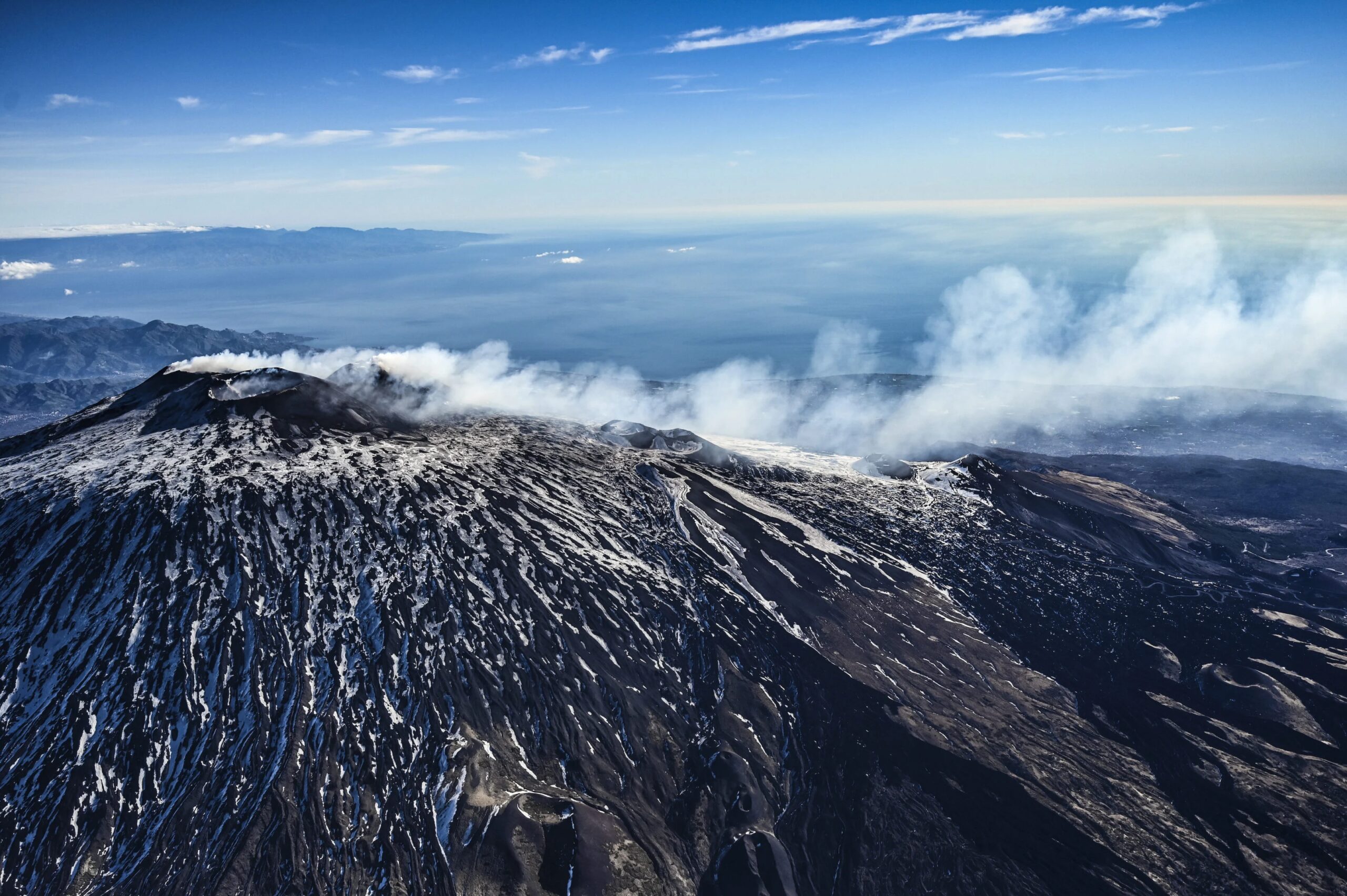
King Arthur would not have died in Camlann, nor would he have been led towards the foggy Avalon which for centuries literature, cinema and popular imagination have transformed into the last refuge of the ruler of the Round Table. According to one of the most surprising medieval deviations of Arthurian legend, the journey of the wounded king would have had a destination much further from Britain and decidedly more spectacular: Sicily, and precisely the bowels of Etnawhere Arthur would continue to live in an underground kingdom hidden from men, suspended between sleep, healing and waiting.
This is not a romantic reinterpretation born many centuries later, nor a legend recently invented to add another mystery to the Sicilian volcano. One of the fundamental testimonies appears in the Otia Imperialia Of Gervase of TilburyEnglish intellectual and jurist who lived between the 12th and 13th centuries, also passed through the Sicilian court of William II and author of a gigantic collection of history, geography, wonders, fantastic creatures and tales that circulated in the Europe of his time. It was he who recorded a tradition according to which the inhabitants of Sicily believed that Arthur lived on Etna.
And this is where the story becomes almost cinematic.
The horse disappears and takes her to Arthur’s kingdom
A groom in the service of the bishop of Catania loses the horse that had been entrusted to him and, in a desperate attempt to recover it, goes up the slopes of Etna, until he reaches an opening in the mountain. What initially seems like just a passage in the rock gradually transforms into a threshold between the real world and another space, because the servant walks along a narrow path and suddenly finds himself in front of a vast plain, beautiful and full of all kinds of delights, a place that should not be able to exist in the heart of a volcano.
In the center of that impossible land stands a palace built with wonderful artand it is inside the building that the groom meets the man no one could have expected to find in Sicily: King Arthur, lying on a royal bed and still marked by the wounds received in his last battle. The sovereign listens to the story of the missing horse, orders that the animal be returned and tells the visitor that he has been there for a very long time because the wounds sustained in the clash with Mordred periodically open up again.
It is therefore not a dead Arthur that is guarded by Etna, but a suspended kingremoved from the definitive end of his own history, exactly as happens in many versions of the British tradition according to which the sovereign has not really disappeared but is waiting for the moment when his people will need him again.
Only this time, Avalon has become a Sicilian volcano.
How Avalon ended up three thousand kilometers from Britain
In the best-known literary tradition, especially starting from Geoffrey of Monmouth, the wounded Arthur is taken to a mysterious otherworldly island where Morgana possesses healing powers. It is a space separated from the ordinary world, a land in which the rules of time and death seem to stop working and from which, at least theoretically, the sovereign could one day return.
The passage from an island in the Celtic world to Etna may seem enormous, but in the 12th century the cultural distance was much smaller than a geographical map suggests. In fact, Norman Europe built a network that connected northern France, England conquered in 1066 and the Italian South, where the Altavillas had created one of the most powerful, cosmopolitan and culturally sophisticated kingdoms in the Mediterranean.
And it is probably along these routes that the stories also traveled.
Treccani underlines how the myths of the Breton subject were known in Italy even before the full success of the great French chivalric romances and indicates precisely the continuous relationships between the Normans of Normandy, those of England and those established in Sicily as one of the ways through which those tales could have arrived in the Mediterranean. Furthermore, in the Sicilian environment, the location of Morgana’s kingdom on Etna has been attested since at least the end of the 12th century.
However, the myth is not simply transported from north to south like an object that remained identical during the journey: it changes shape to adapt to the new landscape.
A mysterious western island shrouded in fog could function perfectly in the British imagination; in Sicily there existed something even more powerful, an immense mountain that breathed, trembled, produced fire, opened caves and chasms and seemed to physically offer access to the depths of the earth. Etna already possessed an impressive mythological stratification, from the classical traditions linked to Hephaestus and Empedocles to the Christian interpretations which during the Middle Ages had transformed its craters into possible gates of Hell or places of expiation of souls. Inserting Arthur into that landscape meant giving him a Mediterranean Avalon already naturally predisposed to the supernatural.
The myth that traveled together with the Normans
Then there is a political dimension which makes this story even more interesting, because in the Middle Ages Arthur was not only the protagonist of fantastic tales: he was also a extremely powerful dynastic symbolcontested, reinterpreted and used to construct genealogies, prophecies and ideas of kingship.
For the Normans, who in the space of a few generations had created dominions from the English Channel to the Mediterranean, appropriating the great genealogies and great Western myths also meant placing their power within an older and more prestigious history. Scholars have shown how important genealogical memory, the use of previous traditions and the ability to absorb different cultures were in the construction of Norman authority in the South; in the specific case of the Arthurian matter it is prudent not to argue that the legend of Etna was deliberately invented by the Altavillas as propaganda, because the sources do not allow such a clear conclusion, but the political and cultural terrain in which it thrived was certainly that of a society that used myths, symbols and contaminations to define its place in the world.
And Gervasio of Tilbury makes the picture even more intriguing. The English author had frequented the court of William II of Sicily, but he Otia Imperialia they were later dedicated to the emperor Otto IV of Brunswicknephew of Henry II of England and protagonist of a very tough competition for the political control of Italy and Sicily. Some scholars have therefore read the Sicilian Arthur also in the light of this political environment, observing how an immortal British sovereign transformed into the hidden lord of the island could have much more complex meanings than a simple tale told around the fire.
And the Fata Morgana arrived on the Strait
Finally, there is a detail that seems to perfectly close the circle between Britain and Sicily: Morgana never really disappeared from the island landscape.
Its name has remained linked to one of the most famous optical phenomena of the Strait of Messina, that “Fata Morgana” which in particular atmospheric conditions deforms the horizon making coasts, buildings and boats appear suspended, multiplied or transformed into fantastic constructions. Popular tradition interpreted those images as towers, castles and palaces created by the Arthurian sorceress, to the point of attributing to her a fabulous crystal residence hidden among the waters of the Strait.
And it is precisely here that we must distinguish the medieval legend from its subsequent stratification: the palace in which Gervasio places Arthur inside Etna is described as marvelously built, but not as a crystal palace. Crystal belongs above all to the Sicilian imagination that developed around the Fata Morgana and the mirages of the Strait, even if over the centuries the two traditions inevitably ended up touching and confusing each other.
The result is perhaps even more fascinating than the simplified version of the myth: on the one hand Arthur sleeps in the fiery heart of Etna, on the other Morgana builds impossible castles on the water, while between Catania and Messina fragments of a legendary cycle born thousands of kilometers further north survive.
The Italian Avalon hidden under Etna
The legend did not remain confined to Gervasio. Subsequent medieval texts in fact continued to associate Arthur with Sicily: Caesarius of Heisterbach took up a similar story shortly afterwards, while works such as Floriant et Florete they managed to more explicitly transform Sicily and Mongibello into an Arthurian space, almost a second Mediterranean Avalon. Contemporary studies in fact speak of a true small medieval tradition in which the royal island simultaneously becomes a otherworldan otherworldly territory inserted into the concrete geography of the Mediterranean.
Perhaps this is the most extraordinary detail of the story. The Middle Ages did not need to choose between reality and legend with modern rigidity: a mountain could simultaneously be a volcano, the hotbed of ancient creatures, the entrance to Hell and the home of an immortal British king, while an atmospheric phenomenon over the Straits could become evidence that a fairy built castles above the sea.
Thus one of the founding myths of Northern Europe crossed the continent together with knights, merchants, ecclesiastics and courtiers, reached a Sicily ruled by a Norman dynasty and encountered one of the most powerful landscapes of the Mediterranean. Avalon stopped being just an island lost in the fog and became Etna: a mountain of fire within which King Arthur, at least according to the men of the Middle Ages, could still be alive.