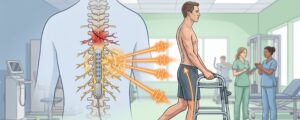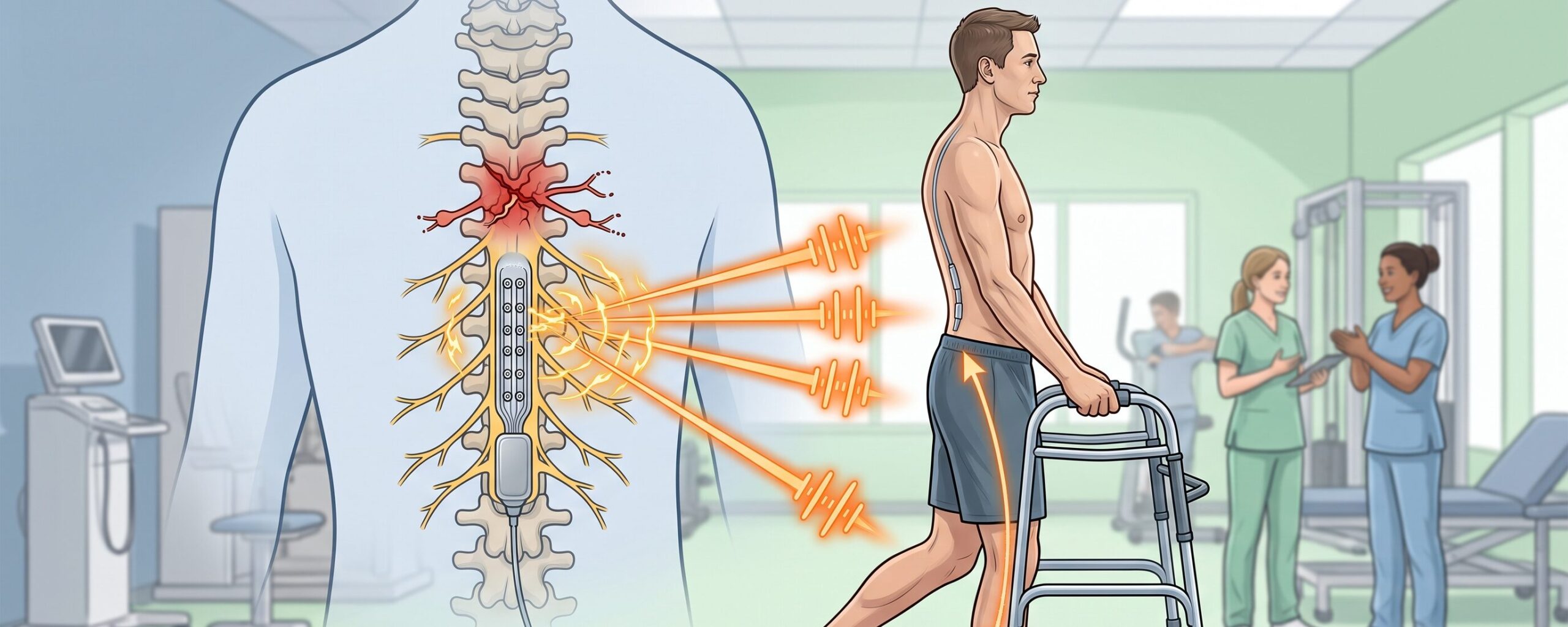
The study that demonstrates how the residual movement of the trunk can become a command for neurostimulation of the spinal cord is Italian. Four patients with complete spinal cord injury thus recovered the ability to stand and walk with a walker.
Four people with a complete thoracic spinal cord injury were able to get back on their feet and walk with a walker thanks to electrical neurostimulation of the spinal cord. The data comes from an Italian study published in the scientific journal Med by Cell Press and conducted by researchers at the MINE Lab, born from the collaboration between Vita-Salute San Raffaele University of Milan and Sant’Anna High School of Pisa and active at the IRCCS San Raffaele Hospital. The peculiarity of the research is in the way in which patients are able to control movement: not through a brain implant, not through external sensors and not even through a system that interprets brain signals, but by exploiting a small voluntary movement of the trunk. On average they are approximately enough nine degrees of torso extension to modify the effect of the stimulation and allow the leg to move from the position necessary to support the weight of the body to that which allows you to move forward with a step. It is an important technical, but also conceptual, difference. In fact, the four participants in the study did not recover the ability to voluntarily move their legs: at the time of the implant they were not able to voluntarily contract the muscles of their lower limbs and this ability did not reappear during the experiment. It is neurostimulation that produces leg movement; the trunk instead functions as a command that modulates the stimulation. After implantation of the stimulator and four months of intensive rehabilitation, all four were able to maintain an upright position and walk with a walker, without manual assistance and without body weight support systems. One participant walked 132 meters in 42 minutes of continuous walking; all four walked facing curves, slopes and uneven external surfaces. Three participants also achieved the ability to stand by supporting themselves with a single handleaving the other free for daily activities. The WISCI II scale, which measures walking ability, has passed from 0 to 9 in all participants.
How the trunk can control a paralyzed leg
Epidural electrical stimulation of the spinal cord it has long been one of the most studied ways to try to recover some motor functions after a spinal cord injury. The principle is relatively simple to describe, even if its application is anything but simple: through electrodes positioned in the epidural space, the nervous structures of the medulla involved in the circuits that regulate movement are stimulated. The novelty of this study is to have identified a way to allow the person himself to modulate the effect of the stimulation. The researchers observed that, when the stimulation is active, the legs can receive different responses: one extension responseuseful for supporting the weight of the body and maintaining an upright position, or a coordinated flexion response of the hip, knee and ankle, necessary to bring the leg forward and take the step. The transition from one to the other can be caused by a slight voluntary extension of the trunk, without changing the stimulator settings. The authors define this mechanism trunk-mediated controltrunk-mediated control. The hypothesis is that changing posture changes temporarily the anatomical relationships between the medulla, the nerve roots and the electrodesthus changing the way stimulation is received by nerve structures. The result is a system in which the body itself becomes part of the control interface. And this is precisely the point that distinguishes the approach from more sophisticated experiments based on brain-computer interfaces. In the latter cases, the goal is to read brain activity and transform it into a command intended for an external device or stimulator. Here, however, it is not necessary to decode the motor thought: a movement is used that the patient is still able to perform.
«The most clinically interesting aspect is that we are not talking about a recovery of the ability to voluntarily contract the leg muscles: that ability remained absent in all four participants. Instead, we have found a way to use a preserved voluntary function, the movement of the trunk, to control the effects of the stimulation and allow the person to actively participate in the construction of the step”
— Pietro Mortini, full professor of Neurosurgery at the Vita-Salute San Raffaele University and director of the Neurosurgery and Gamma Knife Radiosurgery Unit of the IRCCS San Raffaele Hospital
Because rehabilitation was decisive
The result did not come simply thanks to the implantation of a neurostimulator. Intensive rehabilitation was an essential part of the trial. The four participants had chronic traumatic spinal cord injury located between T4 and T7, classified AIS A or B and considered functionally complete from a motor point of view. After implantation of the stimulator, they followed a daily, progressive and individualized program. The training started from trunk control and activation of the lower limbs through neurostimulation, gradually arriving at standing, weight transfer and finally walking.
The limitations of the study and next steps
These are data that show a concrete functional recovery, but which must be read carefully. The study concerns only four people and represents a first demonstration of feasibility: it therefore does not allow us to establish that the same strategy can work in the same way in all people with a complete spinal cord injury. Nor does it mean that the paralysis has been “cured.” The underlying neurological condition remainsand leg movement continues to depend on electrical stimulation. Even just because the stimulator used is already commercially available does not mean that the trialled procedure is now routine therapy for anyone with a spinal cord injury. In fact, the treatment requires an implant, personalized programming and months of dedicated rehabilitation. However, the new result is part of a research program that has been ongoing for some years. In 2023 the group had experimented with the first implant in a person with an incomplete spinal cord injury; in 2025, results relating to two other patients were published, also with incomplete lesions and with some residual motor skills. The new trial instead addresses a more severe condition: four people with functionally complete lesions and no ability to voluntarily contract their leg muscles. This is the real novel element that allows us to read the result without easy enthusiasm, but also without underestimating its significance: for research on paralysis due to spinal cord injury, finding a way to restore voluntary control of gait, also through a technologically assisted mechanism, means adding a new piece to the possibility of recovering lost functions.