In November, in Seoul, everyone was saying the same thing: «autumn lasted one day, winter took the rest». And in fact the cold was the kind that comes suddenly, without warning, as only cities that know no respite can do.
Yet, along the streets, the bright yellow of the ginkgo leaves stubbornly resisted, as if to remind us that the seasons – just like K-pop – no longer obey the rules: they change when they want, they surprise when you least expect it.
WakeOne, the izna agency, is nestled a stone’s throw from Hongdae: the beating heart of Korean youth, a neighborhood that vibrates with music, streetwear, students and new trends. Yet, the building stands in a corner that seems to belong to another space: silent, concentrated, almost an artistic laboratory hidden in the heart of the city.
A secret passage between the creative chaos of Seoul and the place where K-pop is constructed with pinpoint precision.
Inside the agency, the climate changes immediately: soft lights, quick footsteps, that electric calm that can only be perceived in places where the future takes shape a second before showing itself to the world.
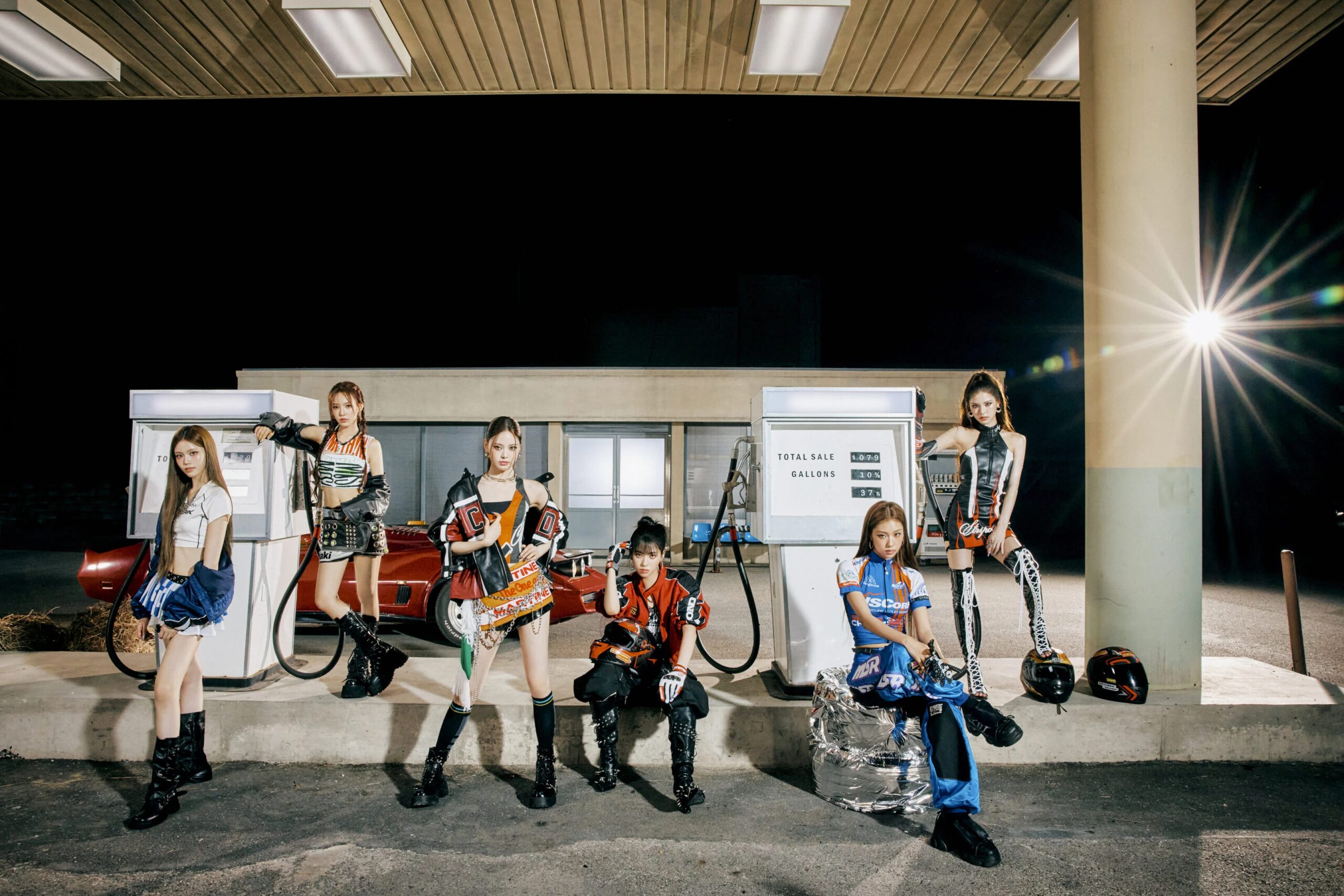
When the doors opened, they appeared: the izna.
No superstructures, no artifices. Simple, bright, with a bearing that mixes innocence and determination. Beautiful, yes, but in the way that people are who are not trying to convince you: they are simply looking you in the eyes.
Yet behind that disarming naturalness lies a strength already recognized by the industry: the Favorite Rising Artist award at the MAMA in Hong Kong, a consecration which, for a rookie group, is equivalent to a stamp on the registry of the future. You observe them, and you understand that there is no point in waiting a few years to see where they will go. They are already going there, and at the right speed.
And then there is the part that no press release tells: the presence. Live they have a type of energy that is immediately noticeable. It doesn’t overwhelm you: it conquers you one detail at a time. A look. An accent in their voice when they talk about work. A gesture as they remember the months of the survival show. And you realize that their growth is not a narrative plot constructed on the table: it is a muscle, forged day after day, test after test, choice after choice.
Their music lives from the same apparent paradox: a combination of freshness and ambition, of pop immediacy and aggressive definition. Their second mini-album, Not Just Prettymarked a clear leap in the way of telling stories. Not a rebranding, but a gesture of maturity. The sounds have become sharper, more tense, more confident. The title track “Mamma Mia” is a controlled explosion: edgy choreography, hypnotic rhythms, a declaration of identity. Race Caron the other hand, flows like a manifesto of freedom: it is IZNA that accelerates, that exceeds the limits, that says it does not want to stay in the lane.
What is striking is the coherence: nothing seems to have been put there by chance. Even the visual – bold, sharp, imperturbable – is not born out of imitation, but out of necessity. Haircuts, reversed styling, a stage presence that no longer belongs to the “debut” category: it belongs to that of clear intentions.
And as their answers flowed – precise, sincere, full of that awareness that you don’t expect from girls that half the world considers “rookies” – the interview began to change weight. It was no longer just a meeting: it was a photograph of a group that knows exactly what it wants to be.
Then, when we turned off the recording, the most spontaneous moment came. Someone mentioned “Mamma Mia” again, and so I found myself telling them what it really means for us Italians: not just the phrase, but the gesture, the irony, that surprise that slips away without being thought of. They listened. In front of me, six pairs of curious eyes, alive, waiting. The eyes of those who are not following K-pop: they are rewriting it, note after note, with a passion that needs no translation.
Panorama spoke to them in an exclusive interview.
To begin with: could you introduce yourself not only with your stage name, but with the story that each one brings into the IZNA universe?
NEVER:
In the group I often act as a mediator. When there are different opinions during training or in organizing our commitments, I try to maintain balance and make everything flow without tension.
BANG JEE MIN:
I am one of the oldest and I feel the responsibility to be reliable. The others can count on me, and I like being that kind of stable presence on the team.
KOKO:
My energy is bright and loving. I like to bring positivity and create an atmosphere where everyone can feel lighter.
RYU SA RANG:
I consider myself an all-rounder. I try to do everything right. I’m one of the youngest, but sometimes I feel surprisingly mature for my age.
CHOI JUNG EUN:
My world is choreography. I create, I propose ideas, I define the identity of the group when we are on stage.
JEONG SAE BI:
I’m the eldest unnie. In daily life I like to guide with small gestures, organize, take care of practical things. I try to bring harmony.
Your latest mini-album marks a clear change in ambition. What was the spark behind this project?
BANG JEE MIN:
We didn’t want to be seen as just “nice.” With this album we wanted to show a bigger and bolder part of ourselves, a true spectrum of what IZNA can be.
RYU SA RANG:
It’s our second mini-album and we felt it was time to take a bold step. The title track and b-sides show new nuances of our group.
Which track really captures IZNA’s heart?
NEVER:
Among the b-sides, “Race Car” represents us a lot. It has the energy of a fearless race and shows the way we want to move forward: without hesitation.
JEONG SAE BI:
“Mamma Mia” is a declaration: “I will be myself”. It’s a song that talks about trust, something that profoundly defines our group.
How did you build your visual concept? Which part really belongs to you?
KOKO:
The rap part of my choreography is freestyle. I worked with the performance director, but many of the ideas are my own. I wanted that part to be authentically “Koko”.
CHOI JUNG EUN:
We changed our look to show confidence and strength. Some of us cut our hair, others completely changed our styling. It was our decision to show a more powerful side of IZNA.
What was the biggest challenge in preparing the album?
CHOI JUNG EUN:
Every time we want to show a new side of ourselves. It’s challenging to prepare different concepts, but it’s also fun because it allows us to grow.
RYU SA RANG:
The contrast with the past was evident. Our previous song was very sweet and bright, while “Mamma Mia” is the opposite. We discussed a lot to find the courage to change radically.
What does trust mean for iznas right now?
BANG JEE MIN:
For me, confidence means staying true to yourself. When we train together and believe in each other, that trust becomes visible on stage.
RYU SA RANG:
We had long and different training courses, and the survival show showed everything: effort, strength, difficult moments and moments of growth. I believe that process helped shape our trust today.
When did you feel you had entered a new era?
NEVER:
I felt it as we worked together. The more we rely on each other, the more we grow. Our teamwork has improved a lot.
KOKO:
We’ve practically lived together since we debuted. Just one practice session is enough to be completely synchronized. It’s in those moments that I feel the shift.
How did your cultural diversity influence the album?
JEONG SAE BI:
Each of us has a different story and background. The Japanese members guide us when we are in Japan, we Koreans teach in Korea. The same happens in music too: each part of a song lives thanks to our differences, which come together to create our identity.
What stereotype did you want to break with this comeback?
BANG JEE MIN:
The idea that a girl group should above all be “nice”. With “Mamma Mia” we wanted to shift the attention from our image to our performance, to the passion we put into what we do.
One word to define yourself in this era?
NEVER: Lovely
BANG JEE MIN: New beginning
KOKO: Powerful
RYU SA RANG: Not giving up
CHOI JUNG EUN: Confidence
JEONG SAE BI: Lovely