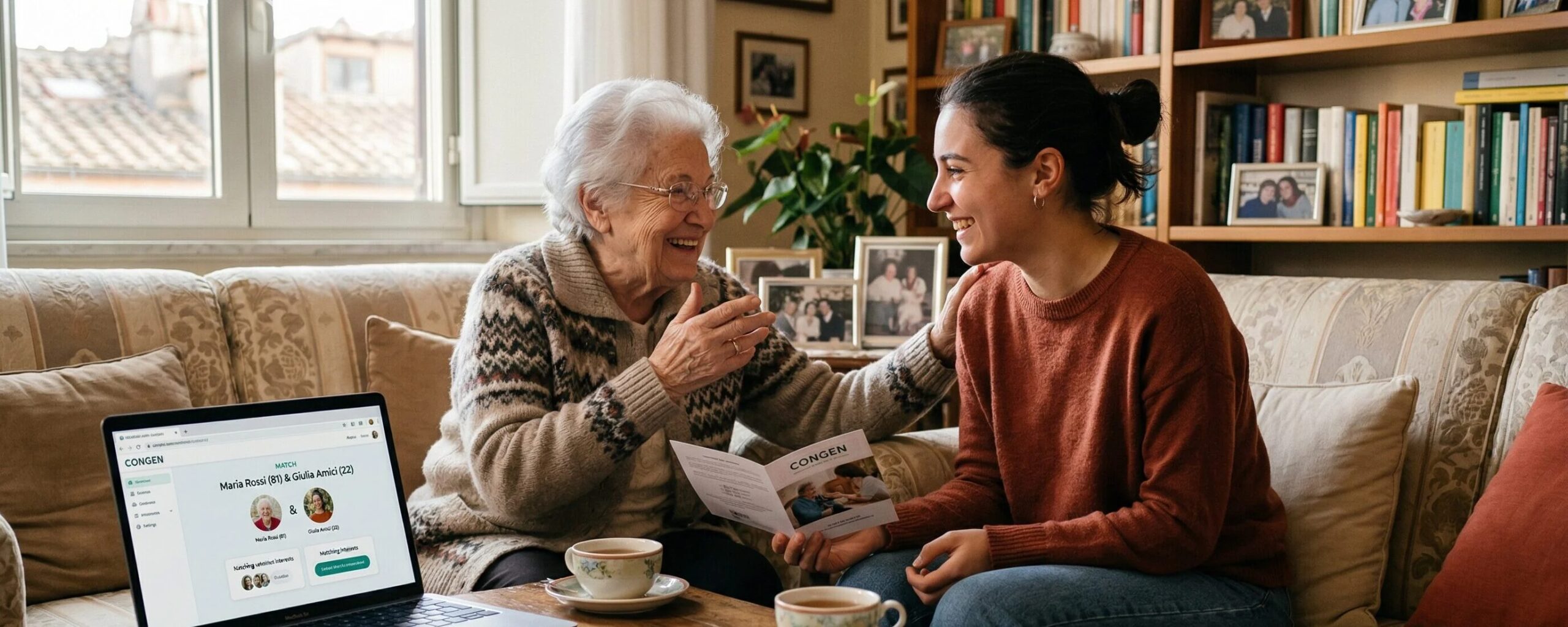
A startup brings together the elderly and very young people who help them with small tasks: a visit to the doctor, using the PC or simply a walk. They don’t replace a nurse but “they stand by”. And this is priceless
At first they respond with caution. They measure words. Then all it takes is a question about the past, about a job done forty years ago, about a trip, about a love. And something changes. The eyes light up. They light up as they talk.
Giulia Amici, 22 years old, student, sees it happen every time she keeps an elderly person company. She is one of the eighty “ConTe Kids” involved by CONGEN – Connecting Generations, a startup that connects self-sufficient or partially self-sufficient pensioners with young people between 18 and 35 years old. An algorithm, in practice, matches them on the basis of common interests, habits, passions and geographical proximity. To share time. Building relationships. «My grandmother is Austrian» says Giulia. «She became a widow almost ten years ago and is alone, because we live in Italy». It’s not an exception. It is the normality of thousands of families. «Often, when I call her in the afternoon, she tells me: you are the first person I talk to. Every time, my heart aches.”
It was precisely this personal experience that pushed Giulia to apply when the University of Tor Vergata offered an internship at CONGEN. “I thought: if I already do it with my grandmother, I would be happy to do it with other elderly people in her same condition.”
And there are many more people in that condition than we are willing to admit. According to Istat data, over 40% of over 65s live alone or without significant daily relationships. More than 5.5 million seniors spend their days alone. 25% are in chronic isolation. 33% do not receive regular cognitive stimulation. Official numbers, not impressions. And, if we read them carefully, they tell an uncomfortable truth: we are a long-lived but increasingly “monadic” country.
The truth is that we have delegated. To the family, to social services, to structures. And when the family is far away or overwhelmed by work, when services are insufficient, when the structures do what they can, the days of those who are alone pass in silence.
Giulia does not provide healthcare. It does not replace nurses or carers. He’s next door. “Once I accompanied a lady to the hospital,” he recalls. “I went to pick her up at an RSA, took her to the visit, and stayed next to her.” The lady didn’t remember exactly what documents she had to bring, nor what the doctors had told her. «I took notes and then reported everything to the structure. She would never have made it alone.” It’s not heroism. It is presence, which is too often missing.
And then there are the small gestures. Help print a document, transfer a photo from your phone to your computer, explain how to send an image on WhatsApp. For a twenty-year-old it’s a matter of seconds. For an eighty-year-old it can be a wall. «I turn on the computer, make two passes and we solve the problem in a few moments», says Giulia. But in those two passages there is something more than technical competence: there is the sensation of not being excluded from the world.
But what’s really striking is what happens when the conversation dissolves. «They need to talk», says Giulia. «At first they are a little shy. Then, when they see that you are interested in them, they tell you everything with enthusiasm. And you realize that you are the one learning.” A lesson that overturns the stereotype: it’s not just young people who give. They receive.
The founder of CONGEN, Carlotta Conversi, 24 years old, a doctoral student in Global Studies at the University of Urbino, insists on this generational exchange. “We don’t offer healthcare,” he clarifies. «We offer relationships. Many elderly people don’t need a nurse, but someone to share time with them.” For her too everything was born from a personal story. «My grandfather lived outside Rome. We worked and couldn’t go to him often. He asked us for company, someone to talk to or play cards with. There I realized that there was a huge void.”
A void that also weighs on families. «It is often the children who contact us», explains Conversi. «People between 40 and 55, the so-called sandwich generation, who must simultaneously deal with work, children and older parents. They are looking for a reliable, continuous and safe presence.” The two poles of the relationship become aware of CONGEN mainly through word of mouth and collaborations in the area. Psychologists, pharmacies, family doctors and local entities intercept real needs and report names and contacts to the startup. This is a model that grows thanks to trust. When a family sees that the relationship is working, they tend to recommend it to others. There is no need for relentless campaigns. Satisfaction advertises more than any slogan.
The recruitment of young people, however, mainly takes place through universities, through career services and dedicated events. «We tell experiences and bear testimonies», says the founder. “We explain what it means to enter the life of a much older person.” Only later are ads published on more traditional platforms.
And there is another detail: the “ConTe guys” are not volunteers, they receive 10 euros an hour, «but with the growth of our network the objective is to increase the hourly pay of our collaborators», specifies Conversi. A way to earn while building a relationship that has human and social value.
Technology also plays its part. A digital platform and a matching system facilitate matches. An artificial intelligence tool generates reports of the activities carried out and reports any sensitive information shared during meetings, sending alerts to family members.
The model has already been validated in the field with around 60 families between Rome and Pavia and over 80 young people. An experience that is now ready to spread nationwide. Of course, compared to the almost 14 million over 65s who live in our country it is a drop in the ocean. But it is a drop that shows that the solution is possible.
Since family welfare has collapsed, loneliness is a huge social problem. Accelerates cognitive and physical decline. Reduces quality of life. To the point of irremediably compromising one’s health. Without stimuli, without dialogue, without human contact, growing old becomes painful. Like it or not, we must recognize that a society that does not connect generations is a society that is weakening. We continue to complain about individualism, about time wasted on social media. Then we discover that a few hours dedicated to others would be enough to change someone’s day – and perhaps life. The treatment begins with one chair placed next to another. And from a young man willing to listen.