A new race to the Moon that is not just a conquest: humanity needs resources, technologies and answers, as well as a place from which Mars is closer
This time it is not just a question of technological supremacy, but of an unmissable opportunity. And it is not a question of arriving and returning alive, but of slowly and not without difficulty building a human outpost on our natural satellite. Because humanity needs a test bed for Mars, and the Moon is the best launch pad for testing technologies and housing systems; to test methods for generating energy as well as the equipment needed to survive without an atmosphere for long periods and not, as happened from 1969 to 1972, for a few hours.
And since it is unthinkable as well as expensive and risky to continually ship supplies to the Moon, we decided to face another challenge, using lunar resources to live there. The discovery of ice, particularly in the permanently shadowed craters of the lunar South Pole, is crucial. This ice, in addition to becoming water, can be transformed into oxygen for breathing and hydrogen for rocket propellant. There lunar dustcalled regolith, will be used for construction as well as for producing oxygen and fuel, and also for extracting aluminum, iron and silicon.
What are the lunar opportunities
After the end of the Apollo program, in 1972 (Apollo 17), lunar scientific geological research had stopped. And to think that the motto of that last mission was The Cutting Edge (spearhead/the frontier), which reflected the spirit of advanced exploration and emphasized taking technology and scientific research to the highest levels, pushing beyond known boundaries.
Today, with the availability of automatic machines and better technologies, exploring will easily lead to the discovery of opportunities, and may reveal some of the mysteries about the history of the solar system. It will then begin a true lunar economywith economic opportunities provided by mining and the use of lunar regolith to build buildings. All this will be possible if access to the Moon remains open and regulated, therefore having geopolitical leadership on the Moon too will become fundamental. That said, at the time of writing (31 March 11am), the large SpaceX SLS (Space Launch System) rocket and its Orion spacecraft are on the launch pad, and even the massive solar flare underway since yesterday, which caused radio blackouts in Australia, does not pose a threat to the launch.
A space shelter against solar storms
The countdown is continuing and the “liftoff”, the take-off, is scheduled for 00:24 Italian time on April 2nd, and we will be able to follow the mission online on the websites of NASA And SpaceX Artemis. But space weather can pose a serious risk to astronauts as well as satellites, so the Artemis 2 mission also plans to test a radiation shelter for its crew of four astronauts. Emily Nelson, Artemis 2 flight director, explains: “Basically, we have a section of the spacecraft where we would position ourselves, and the crew would remain in that area until the event was over.”
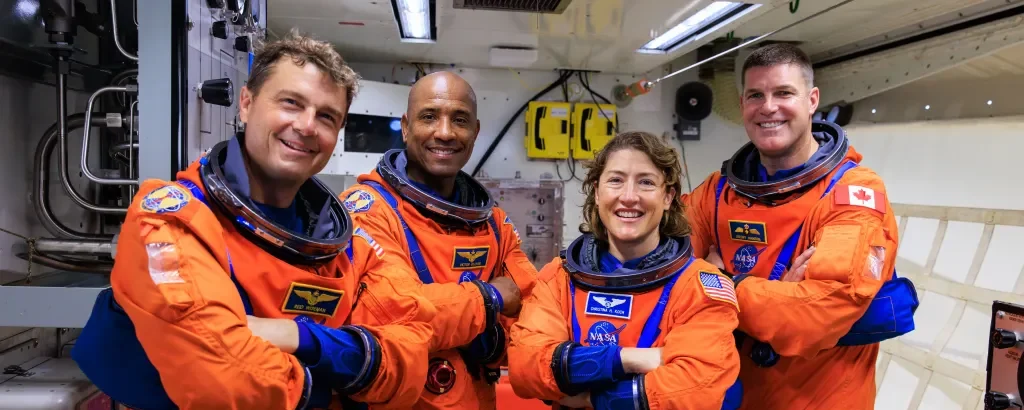
The mission will last 10 days to reach your destination, orbit the Moon and return. On board the veteran astronaut Reid Wiseman, the pilot Victor Glover, both from NASA, the mission specialists Christina Koch (Nasa) and Jeremy Hansen from the Canadian Space Agency. The Orion spacecraft is powered by the European Service Module (ESM), developed and built by Airbus on behalf of the European Space Agency (ESA), and this is not a detail at all, but rather fundamental for Europe (and Italy) to be part of the new race to the Moon, in addition to the more renowned space agencies, such as those of India, Russia, China and Korea.
The future of man on the Moon
After all, Artemis, Artemis, in Greek mythological origin is the twin sister of Apollo, who here sets herself an ambitious goal: to establish a stable and long-term human presence on the Moon, which remains a hostile environment: empty, without atmosphere, little gravity and no protection from meteorites, hit by cosmic radiation and with extreme temperatures. But still the only backyard of us earthlings in which experiment in fields such as medicine, robotics, energy and science.
The Apollo missions brought advances in computing and technology; the stay of astronauts on the International Space Station has led to innovations in medicine, recycling, water purification, food preservation and agriculture, the Moon will bring us other wonderful inventions, because up there every resource will count even more due to the distance from the starting point of supplies. Although 57 years after Apollo perhaps no one is composing new songs or launching fashions for this human return to the Moon, an expression that is used in the aerospace environment remains alive, and which represents the farewell and at the same time the wish for a successful journey which today is reborn internationally: Godspeed, Artemis 2!
Even an Italian will walk on the moon
An Italian astronaut will walk on the Moon. This is foreseen in the agreement signed today in Washington by the Minister of Business and Made in Italy Adolfo Urso, with responsibility for space, and by the chief administrator of NASA Jared Isaacman. The president of the Italian Space Agency, Teodoro Valente, wrote this in a post on X. “A long space cooperation, now even deeper between NASA and ASI, will lead to the creation of a base camp on the Moon and an Italian astronaut to walk on the lunar surface”. Thanks to the agreement, in fact, the Italian habitation module for the Moon called “Mph” becomes an integral part of the Artemis program.