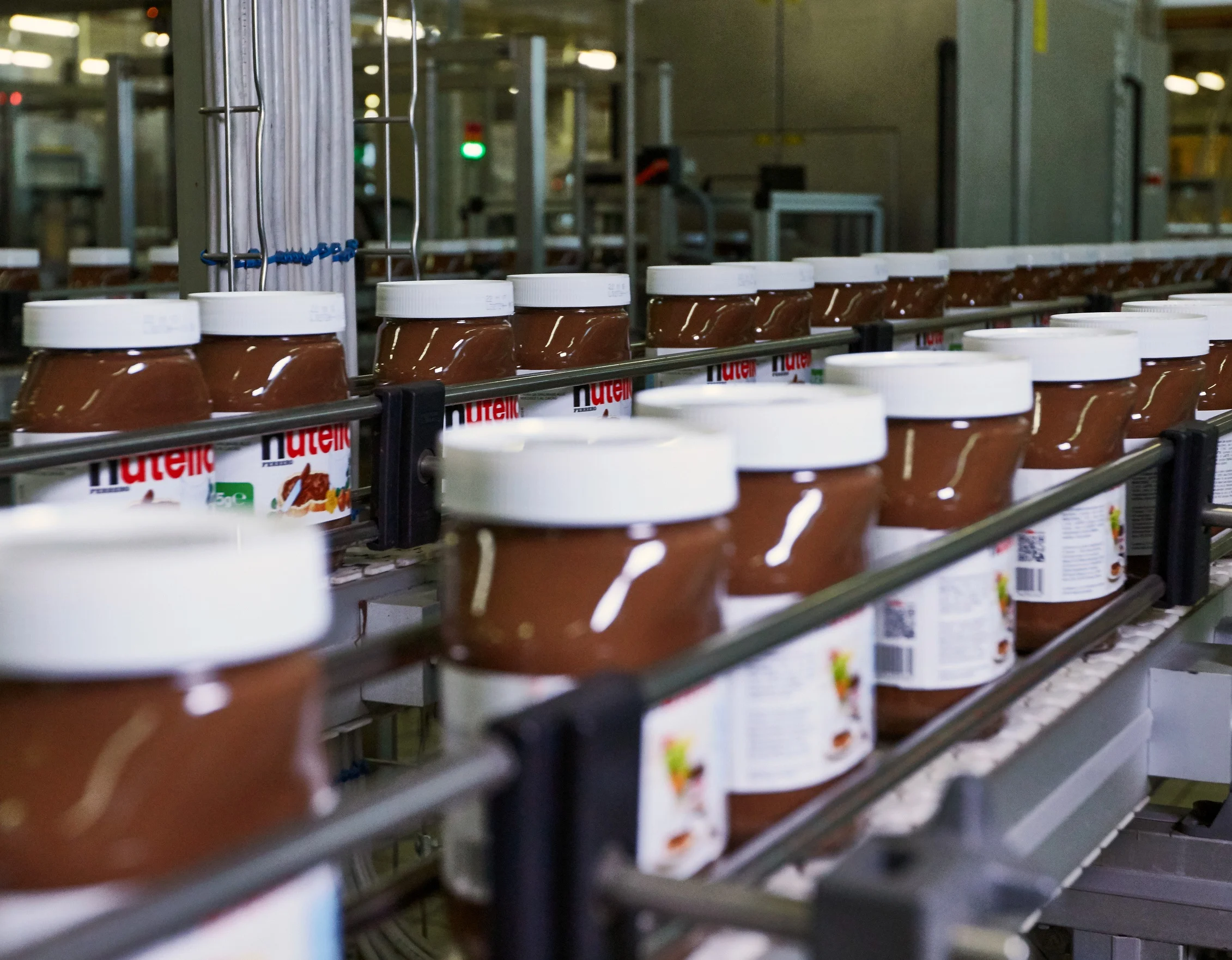
Italy celebrates the birthday of the most famous spreadable cream in the world. Born from a brilliant intuition of Michele Ferrero in a post-war period with a shortage of cocoa, Nutella was able to become a collective ritual, a phenomenon of global customs and national pride, to the point of floating in the absence of gravity among the stars
There is an invisible thread, yet very solid and with an unmistakable scent, which links the timid but industrious Italy of the economic boom to the astronauts of the Artemis II space mission. It is a thread that smells of home, of childhood, of domestic comfort and of unparalleled industrial excellence. Today, 20 April 2026, we celebrate the sixty-two years of Nutella, a milestone that marks the definitive consecration not only of a confectionery product, but of an authentic secular monument of the Italian collective imagination. In fact, it was a rainy April morning in 1964 when the first glass jar left the gates of the Ferrero factory in Alba. From that precise moment, the history of taste and eating habits around the world has changed its trajectory forever, inaugurating an entrepreneurial epic that has never ceased to amaze.
Alba’s intuition and the birth of a myth with a universal flavor
The genesis of this masterpiece of taste is rooted in necessity, masterfully transformed into virtue by Savoy pragmatism. In the difficult years that followed the Second World War, cocoa was a rare and very expensive raw material. The main ingredient of Nutella, the Langhe hazelnut, was the brilliant and economical answer to this shortage. It was Michele Ferrero who took over the recipe for “Supercrema” invented by his father Pietro, tenaciously improved the formula to make it velvety and unmistakable, and renamed it with a name destined to become a global vocabulary. The intuition was to combine the English word “Nut”, to immediately underline the international vocation of the product, with the suffix “ella”, with a soft, round, feminine and unmistakably Italian sound. A perfect linguistic baptism, supported by a visual identity that has remained proudly true to itself: the vigorous black to underline the solidity of the fundamental ingredient and the bright red to exude energy and positivity. To complete the work, the brilliant choice to market the cream in glass cups and glasses, anticipating by decades the modern marketing strategies linked to home reuse and collector loyalty.
From the Carosello to social networks: sixty years of Italian customs
The success of Nutella, however, cannot be measured only by leafing through company balance sheets; it is measured in priceless fragments of popular culture. The advertising debut of the Alba jar took place on the then sacrosanct stage of Carosello. It was 1967 and the brand sponsored, in magnificent black and white, the dramas taken from the book “Cuore” directed by maestro Sandro Bolchi, offering the sweetness necessary to tone down the somewhat bitter plots of the drama. From then on, the brand’s communication marked the eras of our country like a metronome. In the Seventies, while austerity and the oil crisis were biting the economy and the certainties of Italians, Nutella dispensed cathodic reassurances with the adventures of the timeless Jo Condor, regularly saved by the Friendly Giant. Then came the visionary and pioneering press campaigns, which portrayed children from all latitudes united by a slice of bread spread with cream, anticipating the great themes of inclusion and globalization long before they became television lounge topics. The decade of the nineties finally consecrated the definitive claim, that “What world would it be without Nutella?” which quickly became a philosophical interlayer for entire generations, up to the morning reassurances of the 2000s entrusted to the immense voice of Luciano Pavarotti and the most recent campaigns on emotional inclusion, demonstrating an ability to adapt that has led it to dominate digital contemporaneity with an immense audience of over thirty million fans on Facebook and millions of interactions on Instagram.
The numbers of a global giant and the sacred ritual of breakfast
Behind the poetry of childhood memories, however, beats the heart of an unstoppable industrial giant. The figures reveal absolute leadership: Nutella is today produced in eleven factories spread across the continents, processed by workers from as many as ninety-seven different nations and distributed in around one hundred and seventy countries. Annual production is close to five hundred thousand tons, an almost unimaginable volume. To give an idea of its titanic scope, if all the jars produced in twelve months were lined up, the entire circumference of the Earth would be covered twice, and their total weight would equal that of the Empire State Building. Yet, despite its pharaonic proportions, Nutella has kept intact its soul as a popular and transversal product, capable of uniting the tables of ordinary families and the leaders of international diplomacy. It was the breakfast offered to the powerful of the earth during the G8 in L’Aquila in 2009 and reappeared in elegant personalized editions for world leaders at the recent G7 in Puglia in 2024. This intrinsic link with the moment of awakening is supported by a nutritional narrative which, combined with bread, milk and fruit, has been able to position the product as an injection of optimism and functional energy to face the challenges of everyday life, so much so that it has been claimed as the only “doping” acceptable even by world champions such as Francesco Totti during the legendary Italian ride in 2006 in Germany.
From Nanni Moretti to the MAXXI in Rome: the impact on culture and art
The aggregating and thaumaturgical power of the Piedmontese cream has become a real phenomenon of study for sociologists and historians of customs. Since 2007, thanks to the spontaneous and passionate initiative of the American blogger Sara Rosso, every February 5th the planet stops to celebrate World Nutella Day, a day in which the web is flooded with recipes, memories and declarations of love. The highest state institutions have recognized its identity value: in 2014 the Italian Post Office dedicated a commemorative stamp to it for its fiftieth anniversary, while in 2021 the Ministry of Economy commissioned the Mint to mint a five-euro silver coin for the series dedicated to Italian excellence. Even the temples of high culture have opened their doors to her, as demonstrated by the impressive retrospective and immersive exhibition hosted in 2024 by the MAXXI in Rome. The references in art, cinema and literature are abundant and make up an endless anthology: from the unforgettable giant jar from which a neurotic Nanni Moretti compulsively draws in the film “Golden Dreams”, to the light-hearted verses of Giorgio Gaber and Ivan Graziani, up to the irreverent theater work “Nutella amara” by Corrado Guzzanti. Global celebrities such as Julia Roberts, Monica Bellucci, Shakira and champions such as Jannik Sinner and Gianmarco Tamberi have all confessed, sooner or later, their irremediable addiction to this cocoa and hazelnut flavored consolation.
The vocabulary of emotions: limited editions and the new frontiers of taste
However, this immense and deep-rooted emotional legacy has never stopped the Alba company’s inexhaustible drive for innovation. Over the years, Nutella has been able to masterfully play with its aesthetic appearance through very successful limited editions, transforming the famous jars into real tools of interpersonal communication. It allowed Italians to exchange good morning messages, it printed one hundred and thirty-five dialect expressions on the windows to celebrate the local linguistic richness, it generated millions of jars, one different from the other with the “Nutella Unica” campaign and it even collaborated with Treccani to rediscover the specific weight and beauty of the words of the Italian alphabet. A journey into the beauty of the peninsula which culminates in this April 2026 with the sublime “Nutella Buongiorno” collection, created in partnership with ENIT. An artistic project that sees ten wonderful Italian cities of art, from Turin to Palermo, portrayed by the brilliant illustrations of Antonio Colomboni, transforming every breakfast into an evocative journey through the architecture and atmospheres of our country. An evolution that did not stop at packaging, but courageously invaded supermarket shelves, expressing the original flavor in formats designed for modern times: from the resounding success of Nutella Biscuits to the fresh debut of Nutella Gelato, up to the very recent inclusive revolution of Plant-Based Nutella and on-the-go delicacies such as Nutella Donut and Crepe.
The final frontier: the jar floating in deep space
However, nothing conveys the measure of the greatness of this brand like the images that kept the world in suspense on April 6, 2026. Looking at that unmistakable jar floating, peaceful and sly, in the absence of gravity inside the Orion space capsule during the epic Artemis II mission, at the furthest point from Earth ever reached by humanity, one understands the true and profound essence of this Italian myth. It wasn’t just a matter of exporting a formidable confectionery product beyond the Earth’s atmosphere. It was a question of taking the human being, with all his earthly weaknesses, his ancestral need for comfort, his fragility and his intimate domestic joys, beyond every geographical, cultural and even gravitational boundary. An absolute triumph of ingenuity and Italian passion which, exactly sixty-two years after that distant and rainy Piedmontese morning, continues to explain to the whole world the unparalleled flavor of a promise of happiness, always kept.