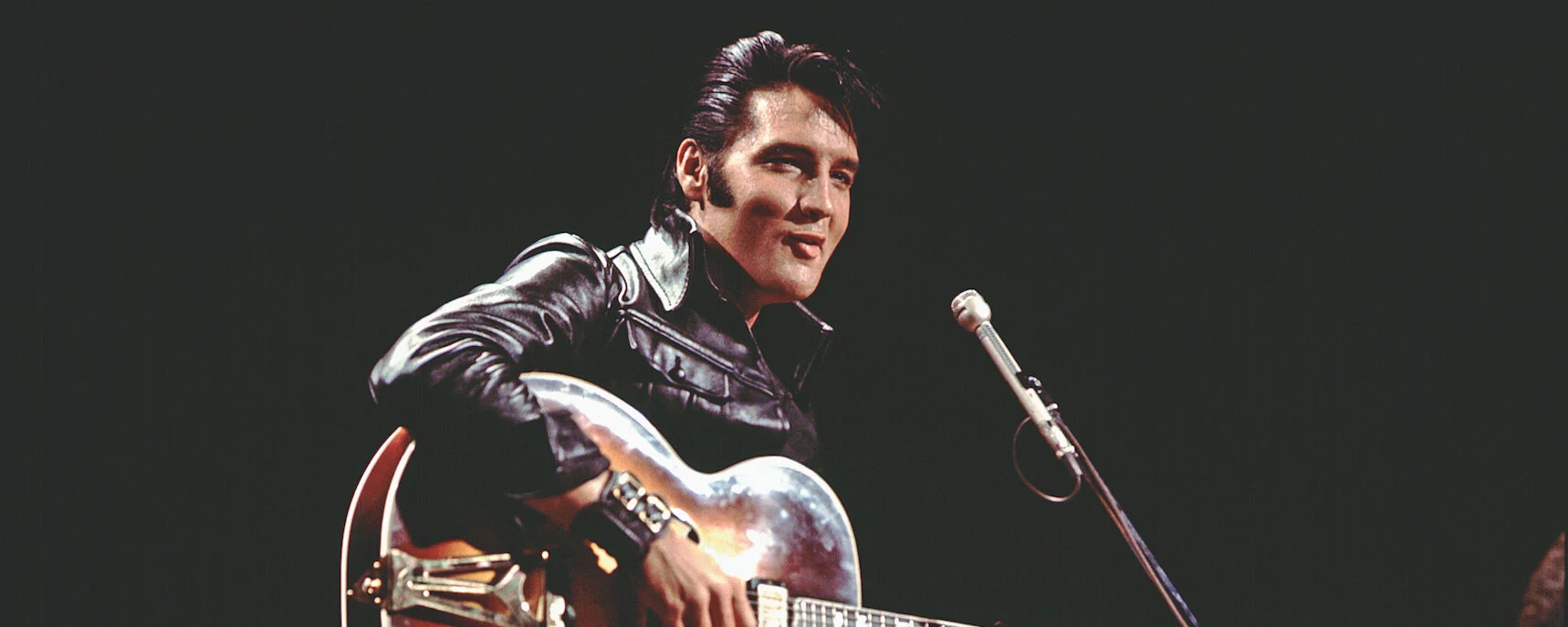
In 1977, the myth of Memphis lives between fragility and intense shows, suspended between man and icon. Baz Luhrmann’s new docufilm reconstructs the last moments of his life (on stage and off) and recounts his cultural legacy
In 1977 Elvis Presley was only 42 years old, but his body looked much older. The last 12 months of his life are a gray area, suspended between myth and decline, between the dimension of a global icon and that of a man prisoner of his own fame. It is the time when the “King of Rock” turns into a tired copy, forced to replicate himself, while the man, Elvis Aaron Presley, seems to vanish behind the entertainer.
Already in 1976 something definitively cracked. In October of that year the legend entered a recording studio for the last time in the Jungle Room, an improvised recording room in the Graceland residence, where he recorded songs such as Moody Blue and Way Down. The voice is still capable of deep vibrations, but the context tells something else: it is no longer the artist who shapes the art of rock, but rather a star who wearily records music to keep a consolidated business alive. That will be the last act as an artist and habitué of the recording studios.
The irrepressible Elvis, the one shown at the cinema in recent days by the Australian director Baz Luhrmann (already author of the biopic Elvis) in the concert-documentary EPiC: Elvis Presley in Concert, was something else entirely. Luhrmann’s docufilm is a spectacular restoration of 68 boxes of films, in 35 mm and 8 mm, discovered in the Warner Bros film archives inside the vault hidden in the Kansas salt mines where the images are kept to protect them from humidity. Concert footage and an entire unpublished interview in which Elvis talks about his life. The film is splendid and the soundtrack that accompanies it is intriguing (available on CD and digital and from 24 April on vinyl), perhaps the most authentic testimony of his performances in the early Seventies.
Only a few years later, however, the scenario appears completely different: punk bursts onto the record market with its iconoclastic fury, disco music becomes the dominant sound and the old school rock that exploded in the fifties and sixties sounds like the music of another geological era. Elvis, who at the beginning of his meteoric career had been the emblem of provocation and scandal, is now perceived as a living relic. Yet, he continues to perform tirelessly for the ever-decreasing audience that continues to adore him. His body, marked by extra pounds and an increasingly serious dependence on drugs (sedatives and opioid analgesics) becomes the battlefield between the desire to live up to the myth and the fragility of man. The images captured in that period during the shows show an artist visibly in trouble, but still capable of moments of almost epic intensity. Standing or sitting at the piano, “the pelvis” seems to sing against his own destiny: the voice is less brilliant, often cracked, but permeated by an emotional truth that makes technical imperfections irrelevant. More than the vocal cords, the heart speaks.
The last Elvis is the definitive staging of the motto “the show must go on” which becomes an inevitable destiny. There is something liturgical in the way he shows himself in front of his audience, as if the stage were the only place where identity remains coherent, even when private life crumbles into a thousand pieces. Having ended his relationship with Linda Thompson, which lasted for years, he becomes engaged to the twenty-year-old top model Ginger Alden, his latest partner and betrothed. She will find him lifeless, lying on the bathroom floor of his bedroom on August 16, 1977.
The last image of the King is that of a body that resists with a broken heart. And here the iconography is reversed: from transgression to liturgy, from spontaneous gesture to repeated act, from event to ritual. The legendary white tracksuit, the kitsch embroidery, the glittering stones, the huge belt around the waist become the mask of a character who understood before anyone else that the artist is an image even before a voice. And then, the more the body shows signs of failure, the more striking and sensational the image must be.
Elvis, born as a body of scandal, a pioneer of eroticism on TV thanks to the wiggling of his pelvis, a symbolic image of the energy of a white boy who for the first time sings with a black soul, scares and at the same time ignites the fantasies of Americans. Then, when life and its adversities have the upper hand, the artist becomes an all-round tragic figure. And when on June 26, 1977 he closed his last show with a heartbreaking version of Can’t help falling in love, the song lost all its romantic connotations and sounded like the final farewell. The end of the myth that anticipates the end of man by two months.