In the book “75 Years Of Atlantic Records” the history and images of the label that changed the history of music
There is the D factor behind birth of the most powerful and enduring record company in the world. D stands for dentist, an enlightened dentist enraptured by music who in the last months of 1947 decided to lend ten thousand dollars to Ahmet Ertegun, the son of the Turkish ambassador to the United States, an incurable music enthusiast and serial vinyl collector together with his brother Nesushi. They are joined by Herb Abramson, who had founded the tiny Jubilee Records in 1946. When in January 1948 a paragraph in Billboard magazine announced the birth of the label, Atlantic was a clay vase among the giants of the record industry of the time.
The grain of sand in the gear, a small visionary reality that has the ambition to invest in African-American music, jazz, blues, soul, genres still ghettoized at the end of the Forties. Like a new Robin Hood in the business corridors of Manhattan, Ertegun does not sign noose contracts and guarantees artists a profitable share of royalties. A Martian with boundless ambition: connecting the sound and vibe of African American music with white audiences. Ertegun wants it all: to deliberately ignore the separation between jazz and popular music, but also to create a somewhat snobbish and refined sound aesthetic. The goal is not to chase the market, but to shape it in one’s own image and likeness and transform a small independent label into the parent company of modern sound over the decades. He works on the quality of the artists Ertegun with his team, but above all on the quality of the sound. For this he hired the best of all, Thomas John Dowd, a young physicist involved in the Manhattan Project (the one that led to the atomic bomb), where he had made his own the concepts of applied electronics, frequency measurement and magnetic tape recording.
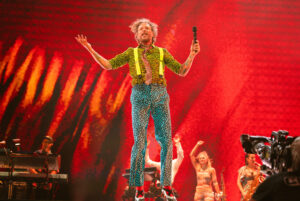
Photos from the book 75 Years Of Atlantic Records (Taschen). Credits: Chic (Anton Corbijn); Ac/Dc (Ross Halfin); Bruno Mars (Atlantic Records Archives); Phil Collins (Martyn Goddard)
It is the definitive revolution: in the 1940s, most American labels recorded directly on an acetate disc which meant recording everything live without any possibility of editing. Dowd introduced magnetic tape recording to Atlantic, a technology he had learned about in the military.
And everything changes forever: the idea of multitracking was born: from one day to the next it became possible to cut, paste and physically assemble the best parts of the recordings, overdub the instruments and insert additional voices and, last but not least, drastically reduce background noise. The tiny studio located in a ravine at 234 W 56th Street in Manhattan becomes a scientific laboratory among microphones hanging from the ceiling, hand-built mixers and surreal intuitions: Dowd uses the stairwell of the building as a natural echo chamber: he records the sound of the amplifiers placed on the upper floor, capturing it with a microphone positioned downstairs. From an engineer he soon transformed into an “invisible musician”: “I don’t record music, I play it with knobs” he liked to say. And the Atlantic sound becomes a trademark.
In this context, between genius, artistic intuitions and sonic magic Atlantic signs the present and future of music: Ruth Brown, Ray Charles, John Coltrane, Ornette Coleman, Charles Mingus, Aretha FranklinOtis Redding. «The most important thing is to be lucky enough to meet a genius who will make you rich in the music business» claimed Ertegun. A genius, not a “one hit wonder”. As explained in the definitive book on the label, 75 Years Of Atlantic Records (Taschen), a treasure trove of stories and images taken by the greatest music photographers of all time: «The difference between Atlantic and many other labels is that, even in the field of pop music, it has generally remained faithful to the ideal of cultivating lasting talent and almost no one-hit artist». The Bee Gees, Abba, I Rolling Stones, i Led Zeppelin Yes, GenesisCher, Crosby Stills and Nash, Ac-Dc, Chic, Phil Collins.
It survived the entire Atlantic, even the Far West of the beginning of the millennium when the bizarre and illegal practice of peer to peer had spread the idea that music could be easily listened to without paying anything to anyone. The key figure in navigating the storm of free music is Julie Greenwald, who joined the group in 2004 as president of Atlantic Records before becoming CEO of Atlantic Music Group. And the future breaks into the historic label: in the old millennium success was measured based on the one-off purchase of an album or a single, now it is the result of how many times that piece and that album have been streamed.”
The Atlantic roster includes the giants of rap, Ed Sheeran, ColdplayPaolo Nutini, Charli XCX, Bruno Mars, Cardi B and Janelle Monae. And Atlantic drags the entire discography out of the storm of the early 2000s, betting everything once again on artistic personalities capable of “living” in the ecosystem of multiple media: radio, TV, web, fashion and social networks. To close the circle of an incredible story, the incredible end in December 2006 of Ertegunextraordinarily poetic in its tragedy.
The final act of a man who dies for music in a place that had represented everything in his life: the Beacon Theater in New York. Ertegun moves in a dark area backstage shortly before a Rolling Stones show. He stumbles, hits his head on the floor, goes into a coma and dies a month later at 83. To pay homage to him, Led Zeppelin, who had been on hold since 1980, played twice in London in December 2007. The last time on stage together: 22 thousand tickets available and twenty million requests. Ertegun’s latest masterpiece.