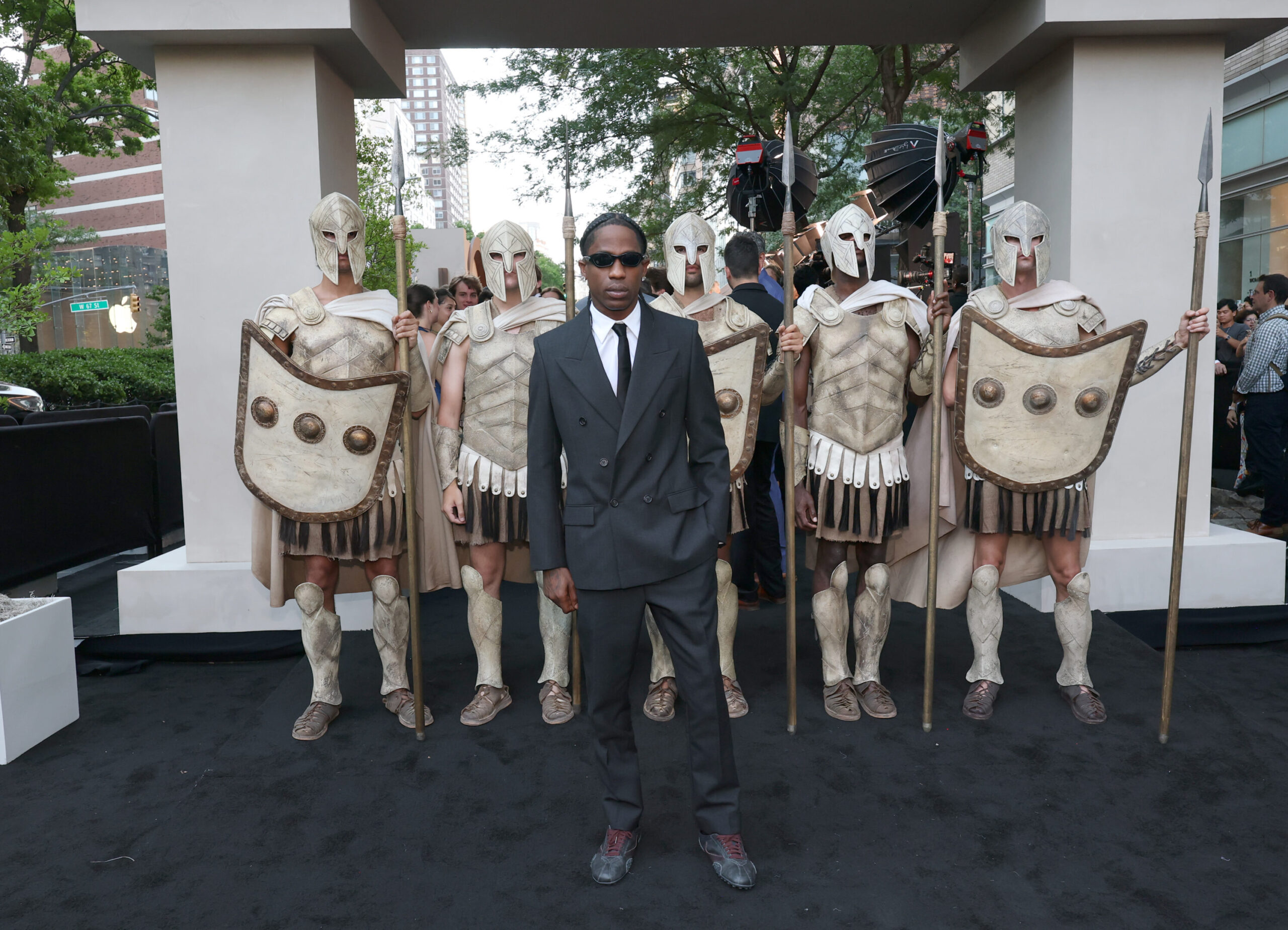
By entrusting the first canto of the Odyssey to Travis Scott, Christopher Nolan brings the poem back to its oral origins and brings the voice of the ancient bards closer to that of contemporary rappers.
Before it became a book, The Odyssey it was a voice. It traveled from one mouth to another, took shape in front of an audience and entrusted the rhythm with the task of keeping together names, exploits, shipwrecks and returns. Pronounced, modulated and probably sung by poets capable of transforming a shared memory into spectacle.
This origin gives rise to one of the most surprising choices made by Christopher Nolan for his adaptation of the Homeric epic. The film opens not with one of the most recognizable actors in its cast, but with Travis Scott, standing on a table while singing the song of Odysseus in front of a packed room. The rapper plays the role of the bard, the one who, in the ancient world, brought stories to life through his own voice.
A presence that at first glance might seem like a pop foray into a very distant universe, but which for Nolan responds to a precise reasoning. «I chose it because I wanted to recall the idea that this story was passed down as oral poetry, something similar to rap», explained the director. It is therefore not a question of modernizing Homer by applying a foreign language to him, but rather of restoring to the work its physical, rhythmic and performative nature.
Before the page there was the voice
Attributed to Homer and probably composed around the 8th century BC, The Odyssey was born at the end of a long oral tradition. The bards did not necessarily repeat a fixed text word for word, but recreated the story during the performance using formulas, epithets, narrative sequences and familiar images. Recurring expressions such as “Odysseus of many talents” or “the rose-fingered dawn” were not just poetic ornaments: they offered the singer recognizable rhythmic structures with which to compose and remember the song.
According to studies on Homeric poetry, the bard was simultaneously author, interpreter and archive. He didn’t just keep a story, but he set it in motion every time, adapting the pace and duration of the performance to the audience in front of him. Fidelity did not consist in the immutable repetition of words, but in the ability to preserve the core of the story through continuous variations.
The rapper as a contemporary singer
When Nolan asked Travis Scott to get on a table and recite the song of Odysseus in front of hundreds of extras and some of the film’s most famous performers, he entrusted him with exactly the test an ancient singer measured himself against: capturing the attention of an entire community without being able to count on anything other than rhythm, presence and words.
“I wanted someone who, by reciting lines, was credible in holding the attention of the room in a way that we could understand in today’s world,” Nolan said. Scott’s choice therefore depends less on the formal similarity between hexameter and rap than on their function. Both exist fully when spoken; both transform the story into a shared event; both ask the performer to control breathing, cadence, repetition and audience response.
The term MC itself, “Master of Ceremonies”, preserves this dimension. At the origins of hip hop, the MC was not only the one who wrote verses, but the one who animated the party, introduced the DJ, dialogued with the crowd and kept the community gathered around the music together.
Rap also shares with oral poetry the use of structures that aid memory and make a voice immediately recognizable: recurring formulas, stage names, self-representations, genealogies, variations on already known verses. Even “sampling” can be read as a technological form of oral transmission: a fragment from the past is recognized, broken down and inserted into a new narrative. Tradition, in both cases, is not protected by making it immobile, but by keeping it alive enough to be transformed.
Each era chooses the voice of its heroes
Finally, in the choice of Travis Scott there is an element profoundly consistent with Odysseus himself. The Homeric hero does not survive only thanks to strength, but because he knows how to tell his story. He changes his own identity, doses the information, wins over those who listen to him and transforms his own misadventures into a narrative of which he is both the protagonist and the author. Odysseus is a warrior, traveler and, above all, creator of his own legend.
Rap has also built much of its strength around self-representation: the story of origins, the affirmation of the name, the glorification of achievements and the creation of a character greater than the individual biography. The rapper, like the epic hero, continually inhabits the border between experience and myth. He doesn’t just tell what happened to him, but chooses the form through which he will be remembered.
By placing a rapper at the origin of the story, Nolan recalls that The Odyssey it does not initially belong to the page, but to the voice. Before becoming the literary monument studied in schools, it was a story capable of stopping a room, imposing silence and bringing missing men back to life. Exactly what still happens today when an artist takes the microphone and, through rhythm, transforms a personal story into a collective memory.