There are idols who arrive in Milan for a catwalk, an armored dinner, a night flight. And then there is Choi Minho, who has traversed the city with the same discipline with which he prepares a comeback: ten full days, lived without apparent haste but with a very precise internal rhythm, between runs at dawn in the parks that are still cold in February, when the avenues are suspended and the city has not yet become a stage, sessions in the gym, exhibitions, less obvious neighbourhoods, corners that do not end up in official stories. Of many Korean artists who have passed through here in recent years, he is perhaps the one who most chose to inhabit it, not simply pass through it.
It’s not a folkloric detail. It’s a posture.
To understand this posture you need to remember who Minho really is. A member of SHINee, one of the groups that helped define the architecture of contemporary K-pop by treating each comeback as a visual as well as musical manifesto, Minho is an artist who has gone through multiple seasons of the industry without becoming rigid. Athletic performer, actor capable of moving between mainstream and global platforms, soloist who has chosen expansion instead of replication, he is above all a system figure: he does not follow the lines, he anticipates them and traces them.
Minho arrives in Milan at a time that is not coincidental: on the one hand the horizon of Milan-Cortina 2026 – of which he is a promotional ambassador for the Korean Sport & Olympic Committee – on the other the Milan Fashion Week, with Soul Threads: Voices of Seoul, a project born from the partnership between the Seoul Metropolitan Government (SMG) and the National Chamber of Italian Fashion (CNMI), which brings five brands to the heart of the Milanese system to tell a new grammar of Korean fashion.
Soul Threads: When Seoul enters the system, not just the story
Soul Threads is not a window display operation, but a positioning gesture. It is the concrete manifestation of the bridge between SMG and CNMI: two creative capitals that do not exchange courtesies, but build a structural dialogue. Seoul does not come to Milan to be observed, but to enter the system and measure itself against it.
The protagonist brands of this edition – Amomento, Kimhēkim, BESFXXK, Jaden Cho and Daily Mirror – embody a generation that works on stratifications, deconstructed tailoring, tensions between heritage and street, identity fluidity that is not a slogan but a concrete construction. There is the sophisticated and silent minimalism of Amomento, the conceptual theatricality of Kimhēkim, the urban and experimental energy of BESFXXK, the almost architectural precision of Jaden Cho, the contemporary cleanliness of Daily Mirror. They are not brands built for export, but already mature identities that enter the Milanese market with an autonomous grammar.
The collaboration with the National Chamber of Italian Fashion and the presence within the Milan Fashion Week calendar signal a clear desire: not to ask for legitimation, but to build a dialogue between mature systems. Antonioli’s choice is, in this sense, central. Not a neutral container, but a space that over the years has functioned as a cultural radar, capable of intercepting and translating aesthetics born elsewhere into a Milanese key. Claudio Antonioli – an acute reader of subcultures and the tensions between luxury and experimentation – acts here almost as a silent master of ceremonies, director of an encounter that is not folklore, but cultural negotiation.
It’s not the first time that Minho crosses the grammar of fashion: in The Fabulous he told the inside story of Seoul’s creative system, including PR, stylists and brands. But there is no fiction here. There is a real dialogue between industries.
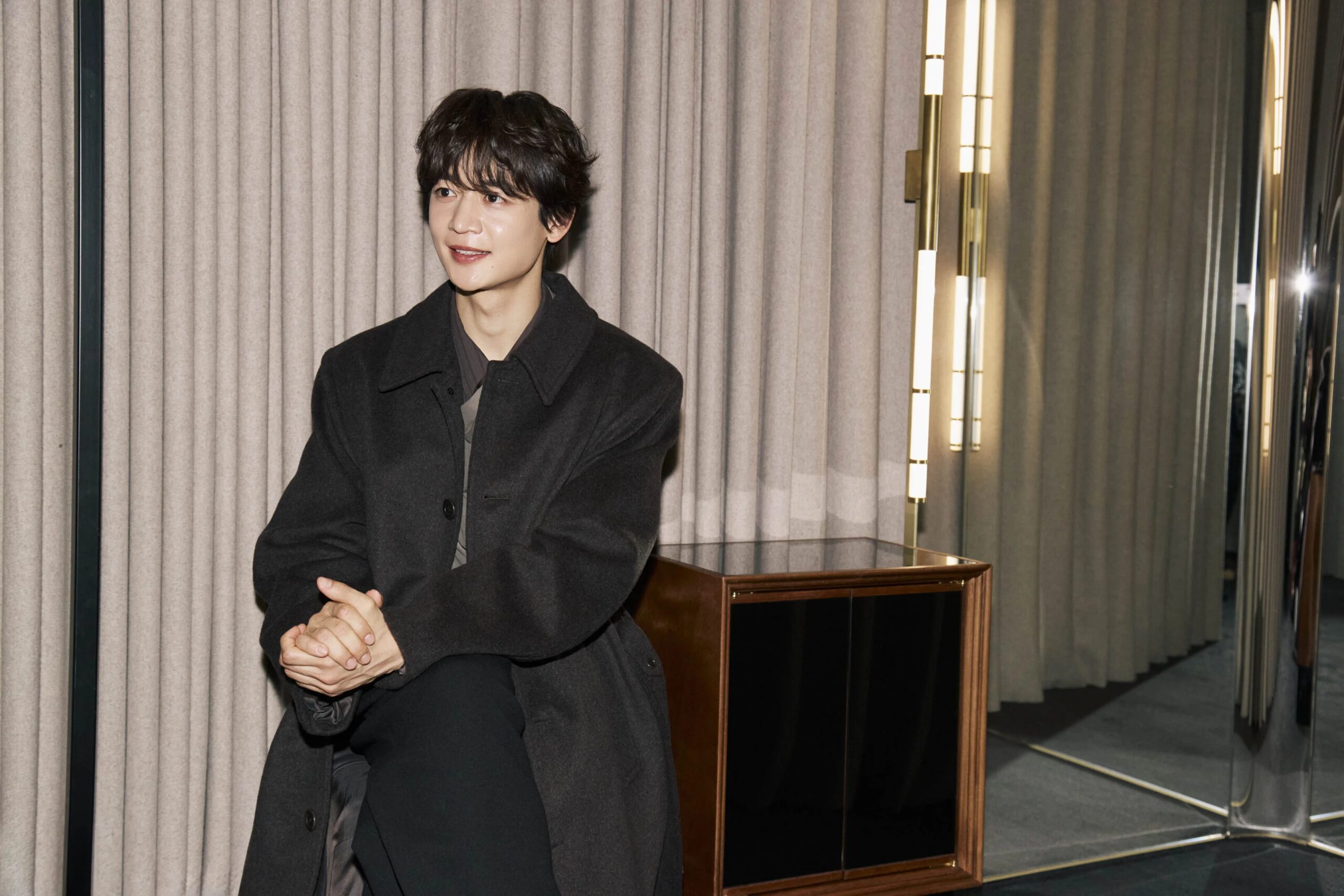
Our interview passes quickly, sitting with the classic Milanese romanticism of the Navigli behind us and immersed in design in one of Antonioli’s spectacular dressing rooms. Minho is as you see him: clean face, courteous smile, kind manners – princely as K-drama fans would say. In him there is no construction or scenic fiction. To our question, what it means to be at the meeting point between Milan, the historic city of fashion, and Seoul, the capital of one of the most dynamic creative energy in the world, the answer is measured but intense: «It is already a great honor to be here. And being able to feel the passion of top Korean designers live makes me feel even more involved, even more fired up.» His thought does not translate into a formula of circumstance, but into the awareness of a phase passage.
Idol, storyteller or creative bridge?
The question then gets to the heart of your positioning: beyond the label of brand ambassador, do you feel more like an artist, storyteller or creative bridge between systems?
The answer does not choose just one definition: «I think all these dimensions coexist. The stories of the various brands and my personal story intertwine, creating a stronger synergy. This is why it is an honor for me to be in this bridge position. I believe that every story can exist together with the others, and it is precisely this synergy that I love.” It is a passage that clarifies its function in the present: not just a face, but a narrative infrastructure.
SHINee and the line drawn in K-pop
With SHINee – a group that helped define the architecture of contemporary K-pop – Minho went through multiple aesthetic seasons without becoming rigid in a single formula. SHINee were among the first groups to treat each comeback as a visual manifesto, not just a musical one: coherent concepts, stylistic risk, identity built over time. It’s a lesson that Minho still carries with him.
When asked what role fashion has had in defining the group’s identity and how its style has changed since its beginnings, the reflection returns to the idea of experimentation: «During the activities with SHINee we tried to always offer the public something new. Even from a style point of view we have dared a lot, showing new trends and in some way guiding them. By wearing many different types of clothes I was able to test myself, and this greatly broadened my personal spectrum. Even today it helps me in the way I choose what to wear and in the way I perceive myself.» Not nostalgia, but method.
The soloist and the expansion of language
The individual path – inaugurated with the EP CHASE and consolidated with the first full-length CALL BACK – does not replicate the group aesthetic: it expands it. When asked what to expect from the next chapter, musically and stylistically, the answer is both inclusive and ambitious: «I hope you can expect everything. After embarking on a separate path from group activities, I am looking to try new things. I would like you to expect news in every respect. I will do my best to live up to expectations and come back with an amazing album.”
Music and image remain inseparable. In this sense, Milan becomes almost a metaphor: a city that has transformed fashion into industry and industry into a global language. Seoul, for its part, has made cultural speed a strategic asset. Minho is right in the middle.
Olympics and soft power
Meanwhile, Milan observes, as it prepares for the second phase of the Milan-Cortina 2026 Olympic Games with the start of the Paralympics. Minho’s presence at the closing of the Olympic Games alongside Team Korea adds another layer: pop culture meets sports diplomacy. It’s not just entertainment, but building soft power, as South Korea consciously uses its most recognizable figures as bridges between creative economies.
Ten days in Milan, between a dawn run and an evening event in Antonioli, between the silence of the avenues and the lights of Fashion Week, made one thing clear: he didn’t come to attend. He came to understand.
Just one word
The last question, deliberately essential, asks you to define yourself with a single word.
The answer comes without hesitation: «I would say “value”. “Value” is the word I would use to represent myself.»
In a time when the image runs faster than the substance, choosing “value” as a definition is not an elegant answer. It is a method statement. It is the demand for coherence in an industry that often rewards speed more than substance.
And at a time when K-pop is no longer just a music industry but a global cultural infrastructure, figures like Choi Minho are not narrative accessories: they are architecture. Milan, for ten days, was proof of this.