A night of tension in the eastern Mediterranean, in a stretch of sea far from the Israeli coast but now at the center of a new diplomatic front, saw the intervention of the Israeli Navy against the Global Sumud Flotilla, the convoy of boats that left with the declared objective of reaching Gaza to deliver humanitarian aid, and stopped off the coast of the island of Crete, in international waters.
According to reconstructions released by the organizers and partially confirmed by the Israeli authorities, the operation began during the night, when several military units intercepted the fleet – made up of dozens of boats – ordering a stop and proceeding to board a significant part of the vehicles, with the consequent transfer of the activists on board Israeli ships.
The intervention at sea and the activists’ accusations
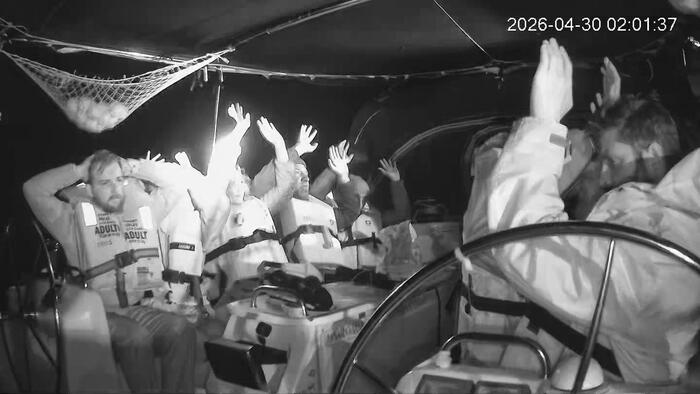
The testimonies released by the Flotilla speak of an action conducted with the use of weapons and signaling devices, with orders given to those present to move to the bow and remain in a controlled position, while some videos circulated in the following hours show excited moments of the intervention, with laser lights and radio communications.
Activists also claim that several boats would have been rendered unusable, with damage to navigation systems and engines, and that in some cases communications would have been interrupted, preventing any requests for help from being coordinated. A version which, at the moment, does not find complete independent confirmation but which contributes to fueling the tension around the incident.
Israel’s position and the reasons for the operation
On the Israeli side, the intervention is justified as a preventive action aimed at preventing the reaching of the Gaza Strip outside the official channels for the delivery of aid, already established and recognized by the authorities.
In some messages released on official channels, it is reiterated that any humanitarian cargo could have been transferred through authorized ports, inviting the boats to change route, while the authorities also referred to the presence of unspecified materials on board, without however providing independently verifiable details.
At the same time, Defense Minister Israel Katz spoke of possible links between the initiative and hostile organizations, announcing measures against fundraising campaigns linked to the mission.
The numbers of the operation and the situation of the activists
At the moment, the toll speaks of at least 21 boats intercepted out of a total of around 58 and around 175 activists stopped, coming from various countries, including Italian citizens, transferred to Israeli ships and headed towards the port of Ashdod.
Some of the vessels are no longer traceable in maritime monitoring systems, which has contributed to increasing uncertainty about the actual conditions of the fleet and the position of some crews.
The Italian reaction and the diplomatic case
The affair immediately took on a diplomatic dimension, with the Italian government taking action through the Farnesina to obtain clarifications from the Israeli and Greek authorities, while Palazzo Chigi expressed a clear position calling for respect for international law and the protection of the safety of the citizens involved.
Prime Minister Giorgia Meloni has called a meeting with the main relevant ministers, including the head of Foreign Affairs Antonio Tajani, to evaluate the developments and define the actions to be taken. In an official note, the government declared: «The Italian government condemns the seizure of the boats of the Global Sumud Flotilla, which occurred in international waters off the Greek coast and asks the Israeli government for the immediate release of all illegally stopped Italians, full respect for international law and guarantees on the physical safety of the people on board».
The international front: the Trump dossier between Iran and new tensions
On an international level, the Flotilla crisis is intertwined with a broader scenario, in which the Middle Eastern issue is once again being read in light of the moves of Donald Trump, who in the same hours relaunched on social media a message with an ambiguous tone – “The storm is coming” – accompanied by the phrase “Nothing can stop what is coming”, contributing to fueling an already highly tense climate.
According to what was reported by American sources, the US president is currently engaged in a series of strategic assessments linked above all to the Iranian dossier, with a briefing expected on possible scenarios of military intervention, which would include different but all high-impact hypotheses: from securing highly enriched uranium to targeted and limited operations, described as “short and powerful”, passing through the control of strategic areas such as the Strait of Hormuz, a crucial hub for global commercial navigation.
In this context, the Flotilla becomes, in the words of the Israeli authorities, part of a broader picture, with the Tel Aviv Foreign Ministry claiming that Hamas was behind the initiative, accused of wanting to “sabotage the transition to the second phase of Trump’s peace plan”, a reading that shifts the episode from the humanitarian to the geopolitical level, inserting it into a broader dynamic of confrontation.
At the same time, there was also intense diplomatic activity, with a long phone call between Trump and Vladimir Putin, during which the Russian president underlined the need to avoid escalation, defining the hypothesis of a ground operation as “unacceptable and dangerous”, while recognizing margins for a possible relaunch of negotiations.
To complete the picture, the alarm launched by the President of the European Commission Ursula von der Leyen, who highlighted the economic impact of a possible escalation in Iran, estimating a cost for Europe of around 500 million per day, a sign of how the ongoing crisis, although concentrated on a specific episode in the Mediterranean, is part of a much more fragile and interconnected network of balances.
International reactions and accusations of violation of law
Turkey’s reaction was harsh, defining the intervention as an illegitimate act in international waters, speaking openly of a violation of international law and asking for a position from the international community.
The organizers of the Flotilla, for their part, speak of an action against unarmed civilians and contest the legitimacy of the intervention so far from Israeli territorial waters, underlining how the operation took place hundreds of nautical miles from the final destination.
An episode that reignites tension in the Mediterranean
The episode takes place in a context already marked by tensions linked to the naval blockade of Gaza and the international initiatives which cyclically attempt to reach the Strip by sea, often giving rise to direct confrontations with the Israeli authorities.
The day continues to evolve, with continuous updates on the position of the boats, the conditions of the stopped activists and the possible diplomatic consequences of an intervention which, once again, shifts the confrontation from the political to the operational level, in the heart of the Mediterranean.