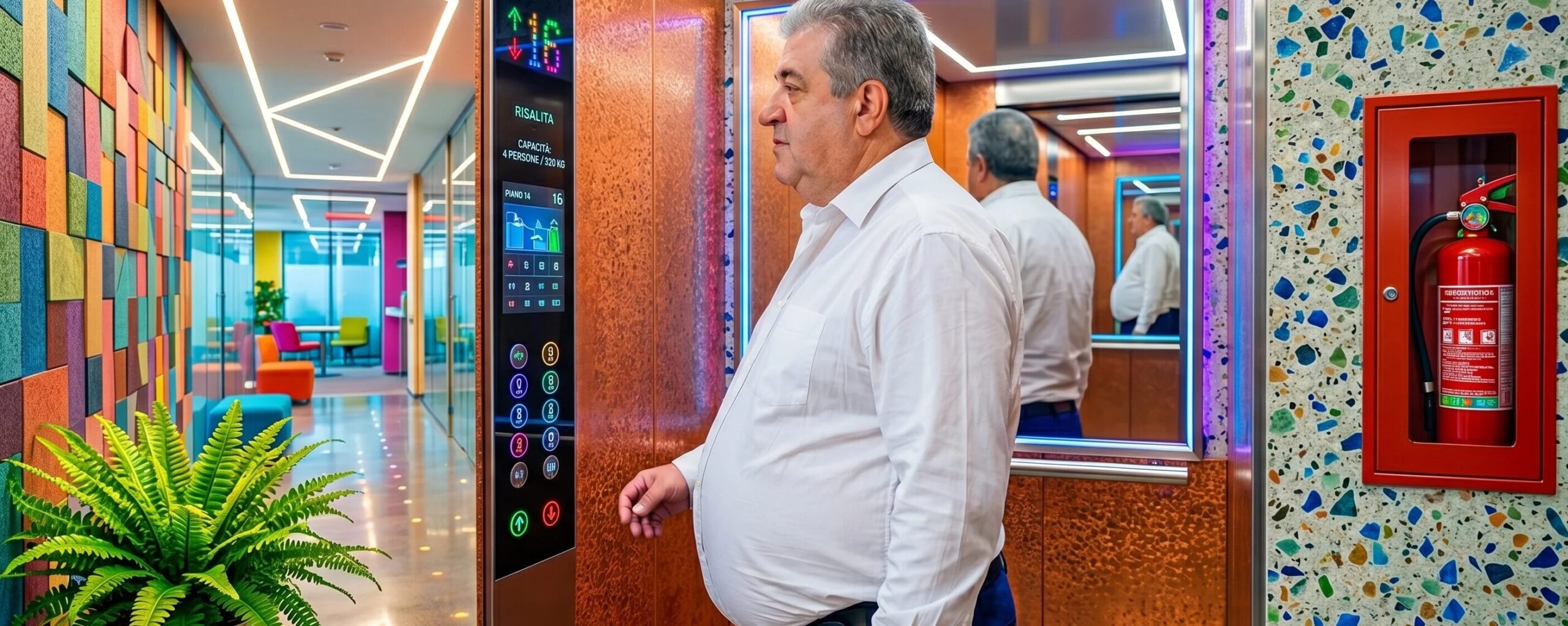
Over the last fifty years, the average weight of the population has grown throughout Europe, while many systems continue to be based on parameters that are now outdated. Experts are calling for an urgent review of design criteria and safety signs.
There is a side effect ofincrease in overweight and obesity which until now had remained almost invisible. It’s not just about cardiovascular risk, diabetes or healthcare costs. It also affects everyday life, urban spaces and even elevators. The theme was launched by a study presented at European Congress on Obesity (Eco), underway in Istanbulwhich invites us to rethink the standards with which many lifting systems used every day by millions of people are designed. The seemingly curious question is actually very concrete. For decades the sector has referred to an assumption considered stable: the average weight of a passenger. In Europe, industrial standards have historically assumed a value of around 75 kilograms per person. A given that in the seventies it might have been realisticbut which today no longer coincides with the average body composition of the European population.
The study coordinated by Fick Finer, president of the International Prader-Willi Syndrome Organization and former professor of Medicine at University College London, analyzed 112 elevators installed in various Western European countries between 1970 and 2024. The aim was to verify whether the design of the systems has followed the evolution of the population’s body weight over the last fifty years. The results show an interesting trend. Until the early 2000s, manufacturers seemed to have progressively adapted the theoretical capacity of elevators to the growth in average weight. In the nineties, for example, the expected load per single passenger had risen to around 80 kilos. After 2002, however, this trend essentially stopped. And this despite the fact that the average weight of the population has continued to increase. According to the authors, the problem is not just technical. It’s also about social perception and accessibility. If a sign indicates that an elevator can carry eight people, but in practice that space becomes insufficient or uncomfortable for very different bodies compared to the pastthe risk is creating discomfort, slowdowns and even potentially critical situations.
The old regulations and the puzzle of safety in modern buildings
The theme is intertwined with the world of technical standards on liftswhich in recent years have focused above all on safety, accessibility and emergency management. The European standards of the EN 81 series, also implemented in Italy, regulate aspects such as the transport of people, alarm systems, accessibility for people with disabilities and risk prevention. In particular, the legislation UNI EN 81-70 establishes minimum requirements to allow safe use and independence of elevators also for people with disabilities, while UNI EN 81-20 regulates the safety rules for the construction and installation of systems. The point highlighted by the research presented at Eco is that many technical criteria have been updated taking into account above all the surface area available in the cabin, rather than the actual evolution of the body weight and physical conformation of the population. In other words, modern elevators can respect the dimensions required by the standards, but continue to rely on outdated load assumptions. According to Finer, the transition from a model based on weight to one based mainly on floor space would not have really followed the anthropometric changes of recent decades. In fact, today there is very detailed data on the increase in the waist circumference and average body size of the population, elements that could require a broader revision of the design standards.
The problem concerns above all the existing building stock. In Italy, according to data reported by UNI, almost one million elevators are in operation and over 70% of the systems are more than twenty years old. A significant portion even exceeds thirty years of activity. This means that millions of people use elevators every day that were designed in an era when the average profile of users was very different from today. It is no coincidence that in recent years European standards have also insisted on the progressive adaptation of existing systems to standards most modern in terms of safety and accessibility. It should be clarified that the study does not claim that elevators have suddenly become unsafe. The authors themselves recognize the limits of the research, defined as descriptive and based on a relatively small sample. However, the work poses a question that could become increasingly central in the coming years: are the infrastructures designed in the twentieth century still adequate for the physical changes of the contemporary population?