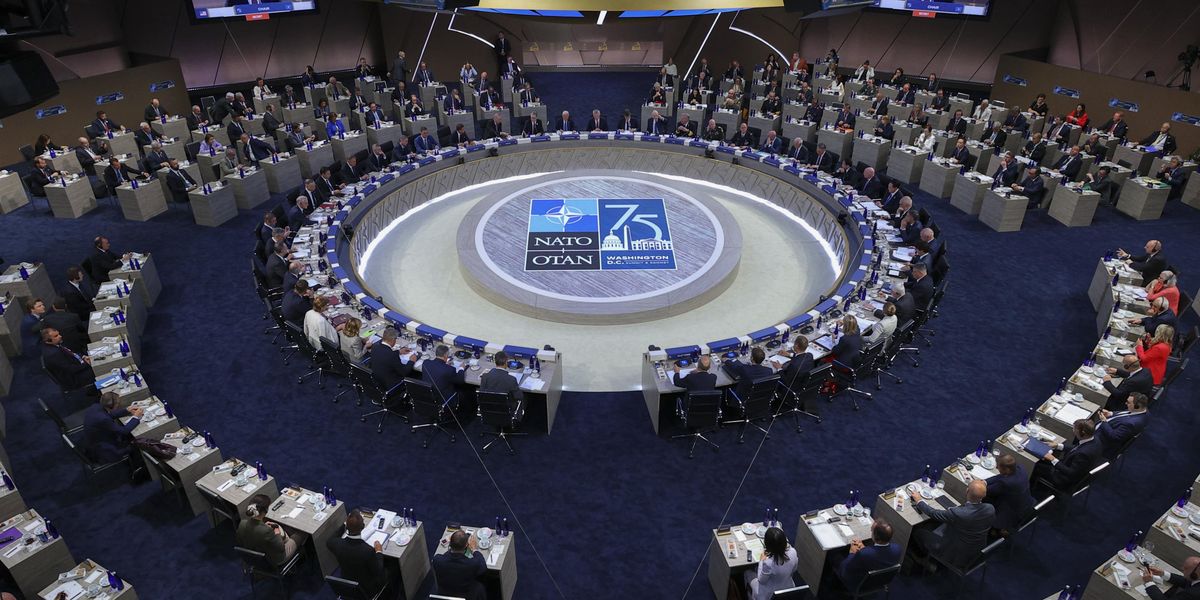
The Atlantic Alliance’s birthday, just celebrated in Washington DC, was its 75th. Three quarters of a century. Established in 1949 by the will of 12 founding countries – 2 Americans (USA and Canada) and all the other Europeans (including Italy) – today it has reached 32 members.
To celebrate this anniversary in a worthy manner, they decided to give themselves a gift, or rather a promise: to formalize Kiev’s accession as well, defining it as an “irreversible path” that will be completed once the war is over.
Even though NATO has only promised and is not tied to Ukraine in any way, except in words, Moscow has not taken the news well. NATO enlargement to include Ukraine, after the very recent entry of Finland (2023) and Sweden (2024), was the last piece missing from the current geopolitical plan of the Western powers, America in the lead.
Which? To stem the protagonism of both Russia and China, and their common and pressing expansion: that towards Africa, already in full swing; and that towards Europe, with multi-year attempts that have seen, on the one hand, Moscow first use good manners (propaganda) and then bad manners (invasion) and, on the other, Beijing use above all the weapon of commercial penetration (New Silk Road).
Both attempts, for now, have been rejected and the European Union has become united for the first time in economically and militarily containing any threat to its independence, with the complicity of the diktats of the United States, which as is known dictate the strategic, sanctioning and defense line for the entire West.
During the summit, several decisive statements were made on the official position of the Alliance: not only were China, Belarus, North Korea and Iran repeatedly criticized for supporting the Russian war effort, but Russia itself was lapidarily defined as “the most significant and direct threat to the security of the Allies”.
This is why NATO has just launched concrete, far-reaching measures to address the threat looming over the destinies of Ukraine and Eastern Europe: the establishment of NATO Security Assistance and Training for Ukraine and a new financial commitment, called the Pledge of Long Term Security Assistance for Ukraine. It is that word in particular, “long term,” that better than any programmatic document defines the Alliance’s plans for the future: defending Kiev, repelling Moscow.
Yes, push back. Because NATO is a defensive alliance, not an offensive one. For this reason too, the newly announced military umbrella that will protect Europe – supposedly the largest and most technologically advanced in the world – should not be understood as an act of war or a threat to the East. It should simply be seen in the context of the reality check that Europe as a whole has had since February 24, 2022: how many European countries do not have a missile defense system worthy of the name? Spoiler: Italy itself does not have one, and like others, it desperately needs one.
Russia knows that NATO is not a real or imminent threat to Russian territory. It is also aware that it is militarily inferior. And certainly the Kremlin does not want a direct confrontation any more than the members of the Alliance do. In the meantime, however, tensions between Russia and NATO increase every year. And so this 75th anniversary, which follows the largest Atlantic military exercise in history (Steadfast Defender 2024with over 90,000 soldiers involved), has become a necessary event for the fine-tuning of the Western war machine.
In this regard, one could cite the negotiations during the summit to bring the common spending of all the allies to 2% of the national GDP; one could cite the bureaucratic steps established for the new weapons supplies, for logistics, etc.; or again, the individual opinions expressed by the leaders of the Alliance. But perhaps there is something more interesting that emerged from the Washington DC summit. Two facts, in particular, arouse curiosity.
The first is that there was no mention whatsoever of the potentially more dangerous situations. Such as that of Mediterranean Africa and in particular of Libya, which fell into the uncomfortable position of a failed state precisely after the NATO operation. Unified Protector of 2011, which decapitated Gaddafi’s government, with the well-known consequences (among which a strong Russian penetration); and that of the Sahel, where the abandonment of the French and Americans corresponded to rampant terrorism and where, also in this case, the European soldiers were replaced by Russian militias.
The second fact to note is that the explosive situation in the Middle East between Israel, Palestine and Lebanon was not even discussed, except incidentally when – this, at least, is good news – it was decided to open a NATO Liaison Office in Jordan, an important ally of the United States in the region and a partner always considered reliable.
What has emerged between the lines is that both the Atlantic Alliance and Russia continue to pursue, each side with inflexible coherence and determination, the great geopolitical game that has always (forever?) seen them opposed and alternative to each other along a precise geographical line, which ideally draws their respective impassable borders. A blue line and a red line that are and remain the long-term strategic objective and represent something unavoidable and ineliminable, according to the military doctrine of both. A blue line for NATO, which goes from Danzig to Constanta (therefore, from Poland to Romania); a red line for Russia, which goes from Kaliningrad to Sevastopol (therefore, from the Russian exclave between Poland and Lithuania to the Crimean peninsula).
Guess which country is crossed by both lines? Yes, you guessed it. Ukraine.