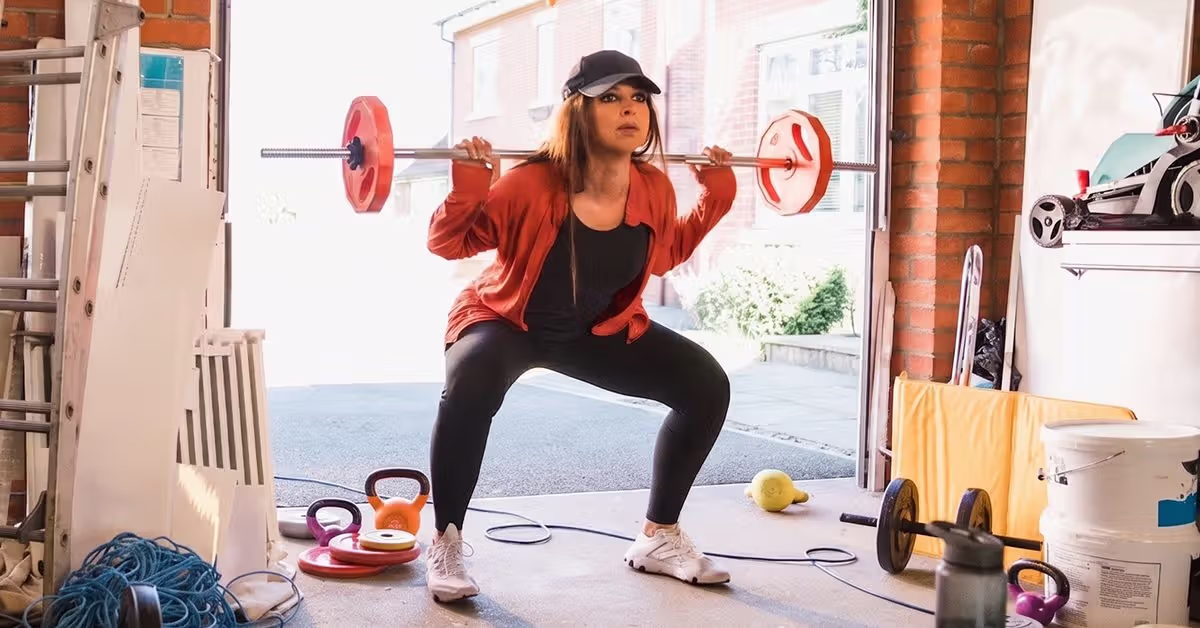
- Regular exercise is a well-known requirement for staying healthy, and as a person ages it continues to be an important way of prolonging the health span.
- The latest evidence shows that exercise can help prevent muscle loss as a person ages, and pinpoints the likely underlying mechanisms.
- Recent studies also show just which forms of exercise provide the most health benefits as we get on in age.
It may be common knowledge that maintaining a regular exercise routine is important to every aspect of human health.
In addition to this, an increasing amount of recent evidence shows just how important it is to keep up that exercise routine as we age to boost longevity and increase our health span — or the number of healthy years that a person lives.
Here is what some of the latest research covered on Medical News Today You have found about exercise and aging, and which forms of exercise bring the most health benefits later in life.
Exercise prevents muscle loss by boosting muscle-repair proteins
Research published in PNAS in November 2025 found not only that exercise could help maintain muscle mass with age, it also pinpointed the likely underlying mechanism using animal models.
Looking at fruit fly and mouse models, the study authors investigated the ways in which exercise could help activate genes that increase the production of proteins playing a role in muscle repair.
“As we get older, our muscle cells slowly lose their ability to clear away damaged proteins and repair themselves,” study author Hong-Wen Tang, PhD, Assistant Professor at Duke-NUS Medical School in Singapore, told MNT.
Through this study, Tang noted, he and his colleagues “discovered that a protein called DEAF1 becomes more active in aging muscle and drives another system, mTOR, into overdrive.”
“This makes muscle cells focus too much on growth and not enough on maintenance and repair, which gradually leads to muscle weakness,” he explained.
“Exercise turns on protective ‘longevity’ genes called FOXOwhich acts like a brake on DEAF1. When DEAF1 is switched down, muscle cells regain their ability to recycle damaged parts and stay healthy. In simple terms, exercise helps restore balance inside muscle cells and keeps muscles stronger for longer.”
–Hong-Wen Tang, PhD
Looking at which forms of exercise might best help maintain muscle strength in humans was beyond the scope of this study, but Tang hypothesized that both aerobics, or endurance, exercise and resistance, or strength, training may be good options.
HIIT may be best for preserving muscle, lowering body fat
A study published in Maturitas in December 2025 went on to suggest that high intensity interval training (HIIT) may be the best type of exercise both for preserving muscle mass and for reducing body fat as a person gets on in age.
For this study, researchers worked with 123 healthy older adults, with an average age of 72, and an average body mass index (BMI) of 26 kilograms per square meter (kg/m2).
They compared how different forms of exercise — HIIT, moderate-intensity training, and low-intensity training — affected body composition when engaged in three times a week for 6 months.
At the end of the 6-month period, the researchers found that only the participants who had engaged in HIIT were able to maintain their lean body mass while losing some body fat in the process.
In HIIT, people alternate short bursts of intense, vigorous activity and short periods of low-intensity activity, for recovery.
Study co-author Mia Schaumberg, PhD, explained in a press release that “high-intensity training in this study involved repeated short bursts, or intervals, of very hard exercise — where breathing is heavy and conversation is difficult — alternated with easier recovery periods.”
According to Schaumberg, “HIIT likely works better because it puts more stress on the muscles, giving the body a stronger signal to keep muscle tissue rather than lose it.”
To increase longevity, try a variety of sports
What about longevity — what kind of exercise is best for boosting lifespan? A study published in BMJ Medicine in January 2026 may have found the answer to that question.
In brief, engaging in a variety of forms of physical activity — such as running and cycling — on a regular basis could be the best way of ensuring you live a long and healthy life.
For this study, the researchers analyzed data from over 111,000 eligible participants to the Nurses’ Health Study and the Health Professionals Follow-Up Study.
The researchers found that participants who engaged in more exercise on a regular basis had a lower risk of death from any cause compared to participants who were more sedentary. Most forms of physical activity, other than swimming, were linked to a lower death risk.
But the participants who reaped the most benefits were those who took part in a variety of sports — those engaging in the broadest range of exercises had a 19% lower risk of death from all causes, and a 13 to 14% lower risk of death caused by heart disease, respiratory diseases, or cancer.
However, exercising for more hours per week was not linked to greater benefits. The message, thus, appears to be that it is more important to exercise regularly and to combine different kinds of sports, ideally.
“(A)lthough maintaining a high level of total physical activity is still most important, mixing up different types of activities that have complementary health benefits may be more helpful to prevent premature death,” study author Yang Hu, ScD, research scientist in the Department of Nutrition at the Harvard TH Chan School of Public Health in Massachusetts, told Medical News Today.
“Habitual engagement of almost all commonly practiced physical activities is beneficial to prevent premature death and achieve longevity. It’s important to maintain a high level of total physical activity, and on top of that, diversifying the types of activities may be more beneficial,” Hu emphasized.