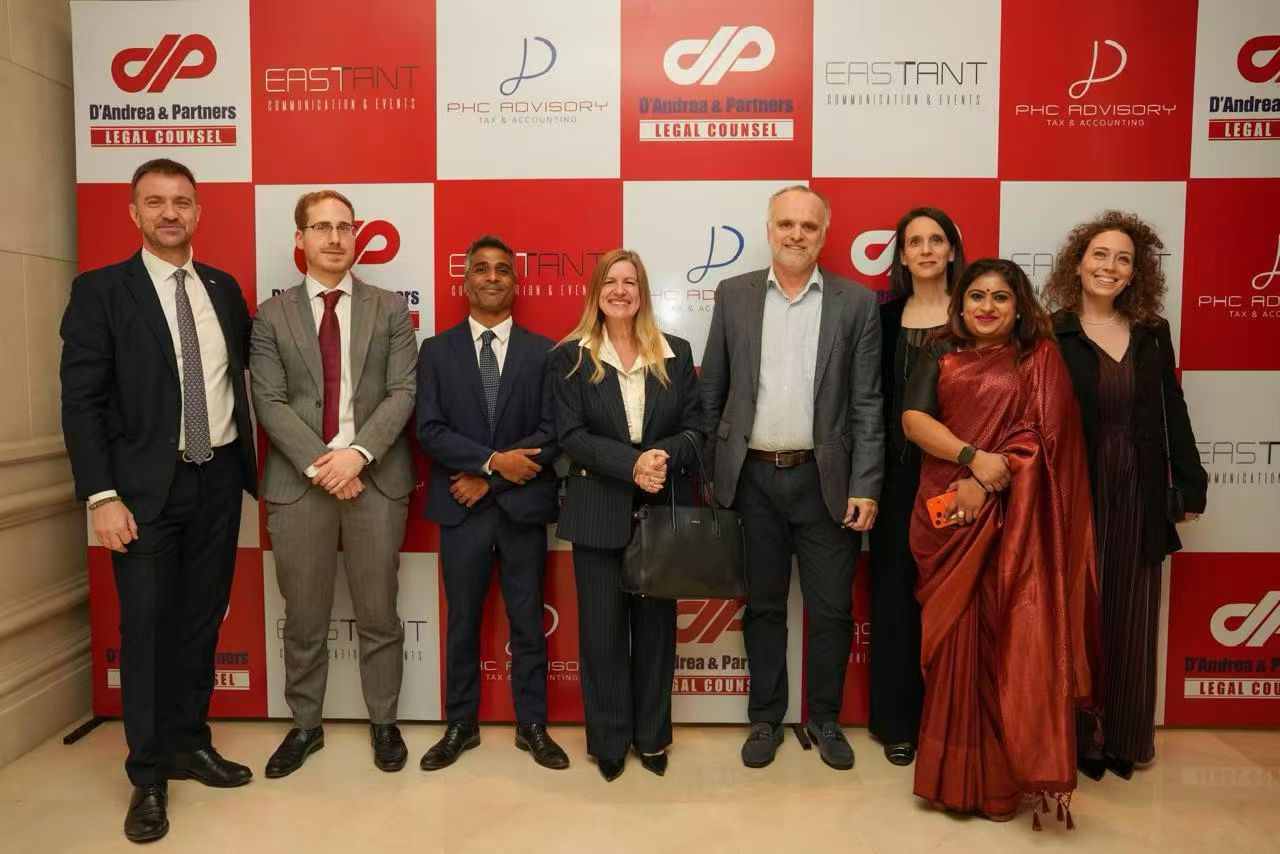
Ten years after the start of D’Andrea & Partners’ presence in India, we ask the lawyer. Carlo D’Andrea – Managing Partner of the firm and National Vice President of the European Union Chamber of Commerce in China – to reread this path. Not so much to tell a company story, but to use that experience as a key to understanding India’s transformation in the last decade.
“Ten years is long enough to understand whether a choice had a strategic logic or not,” observes D’Andrea. “When we decided to start our presence in India, in 2015, we did so in continuity with the path already undertaken in Asia, particularly in China. The objective was to build a platform capable of accompanying European companies in the main Asian markets, not in an episodic way but with a stable presence”.
The context, however, was very different from the current one. “These were the initial years of Prime Minister Narendra Modi’s first mandate. We began to talk about reforms, but many directions were still in the embryonic stage. In particular, it was precisely in those years that the program took shape Make in Indiaaimed at strengthening the country’s manufacturing capacity, attracting foreign investment and positioning India as a global manufacturing hub. India was perceived as a complex market, with a complex regulatory system and a level of international integration that was still limited compared to other Asian economies”.
At that moment, the choice was not at all obvious.
“I remember one of the first visits to a potential client: we traveled over five kilometers on foot, crossing an industrial area without marked roads. As a precaution, I shared my GPS position with my wife. It may seem like a curious anecdote, but it gives a good idea of what it meant to operate in India in that period: a context with great opportunities, but also with many operational unknowns”.
In the early years, he says, the work had an almost exploratory nature. “It was above all a question of accompanying companies in their first steps, helping them to understand the local context and structure a presence. But even then it was clear that, without a direct and continuous presence in the area, it would be difficult to build solid relationships”.
It is precisely this element – presence – that, according to D’Andrea, has made the difference over time. “One of the aspects that we considered fundamental was to guarantee operational continuity through professionals present permanently in India. Not a ‘fly-in fly-out’ approach, but a daily presence, capable of interacting with customers, counterparties and institutions in real time”.
In more recent years, this model has been further consolidated with the transfer of an Italian professional from the Shanghai office to the Mumbai office. This allows us to bridge the gap that often exists between the European approach and the local reality, offering businesses more concrete and immediate support”.
In D’Andrea’s story, the growth of the firm always remains in the background, as a reflection of the growth of the country. And the country, in the meantime, has changed profoundly.
“In the last ten years, India has made a clear leap. In less than two decades it has gone from being the eleventh economy in the world to now being among the top four in terms of nominal GDP, getting ever closer to third place. It is a trajectory that reflects not only the growth of the country, but also its growing weight in global balances”, explains D’Andrea, also recalling the statements of Prime Minister Modi in February 2026.
In 2023, India also surpassed China to become the most populous country in the world. “But demographic data alone is not enough to explain the phenomenon. It is the combination of market size, young workforce and production capacity that makes India particularly interesting today.”
However, D’Andrea invites us to avoid overly simplistic readings. “For years it was said that India was a service economy. In reality it is also a great agricultural power and has always had widespread manufacturing. What is changing today is the relative weight of these elements: industry is strengthening and India is increasingly inserted into global value chains.”
This process is part of an evolving international context.
“In recent years the relationship between Europe and India has significantly strengthened. Institutional visits, including on the occasion of the G7, and economic missions have contributed to building a more structured dialogue. India is increasingly perceived as a strategic partner”.
The path of the trade agreement between the European Union and India also fits into this framework. “At the beginning of 2026 it was announced as a historic and politically concluded agreement. It is a very relevant step, even if the formal implementation steps remain. If implemented, it could have a concrete impact on market access, investments and supply chain integration.”
At the same time, he observes, we are also witnessing a gradual rapprochement between India and China. “After years of tensions, flows and connections are being reactivated. This helps to redefine the regional balance and places India in an increasingly central position between Europe and Asia”.
In this scenario, the Italian presence has also acquired a new dimension. “Today there are over eight hundred Italian companies active in India. It is no longer a sporadic presence, but a structured industrial system”.
Alongside businesses, a real Italian System has also gradually consolidated in the country.
The Italian diplomatic network – with the Consulate General in Mumbai, the offices in Bangalore and Calcutta, under the coordination of the Italian Embassy in New Delhi led by Ambassador Antonio Bartoli – guarantees a stable and qualified institutional presence.
This is accompanied by the role of the Italian Trade Agency (ITA/ICE), with offices in New Delhi, Mumbai and Bangalore, directed by Dr. Antonietta Baccanari, which supports Italian companies in the processes of internationalization and commercial development.
On a financial and internationalization support level, public institutions such as SACE and SIMEST also operate, which support Italian companies in investment processes abroad through guarantee, financing and capital participation instruments.
Finally, comparison with European realities is also made possible through associations and chambers of commerce, which allow the sharing of experiences and best practices in an increasingly integrated context.
It is precisely this combination – businesses, institutions, financial system and associative networks – that today allows us to talk no longer simply about an Italian presence, but about a truly structured and coordinated system”.
As the market has evolved, the type of assistance required has also changed. “Today, companies no longer just look for support to enter the market, but for complex operations: joint ventures, industrial investments, intellectual property, compliance. It is a completely different level compared to ten years ago.”
This is also reflected in the organization on the territory. “The opening of the Mumbai office and the development of the presence in New Delhi are a natural consequence. Mumbai is the economic and financial center, New Delhi is the institutional and regulatory center. To operate in India today it is necessary to manage both dimensions”.
Looking back, the balance is linear. “Over the last sixteen years we have built an international path that starts from China and extends to India, supported by a growing presence in Vietnam and the United Arab Emirates, which contributes to outlining an increasingly complex presence along the main Asia-Middle East lines. These are different, but increasingly interconnected markets”.
And looking ahead, the perspective is equally clear. “India will continue to be one of the main engines of global growth. For years it was considered a difficult, partly closed economy. Today it remains complex, but is clearly in a phase of opening and integration.”
Hence also the vision for the future. “The next few years will be a phase of consolidation. We will continue to strengthen our presence in the area, also through increasingly structured direct supervision, accompanying companies in a context that becomes more sophisticated every year”.
And he concludes: “Ten years ago, India was a bet. Today it is a system.”