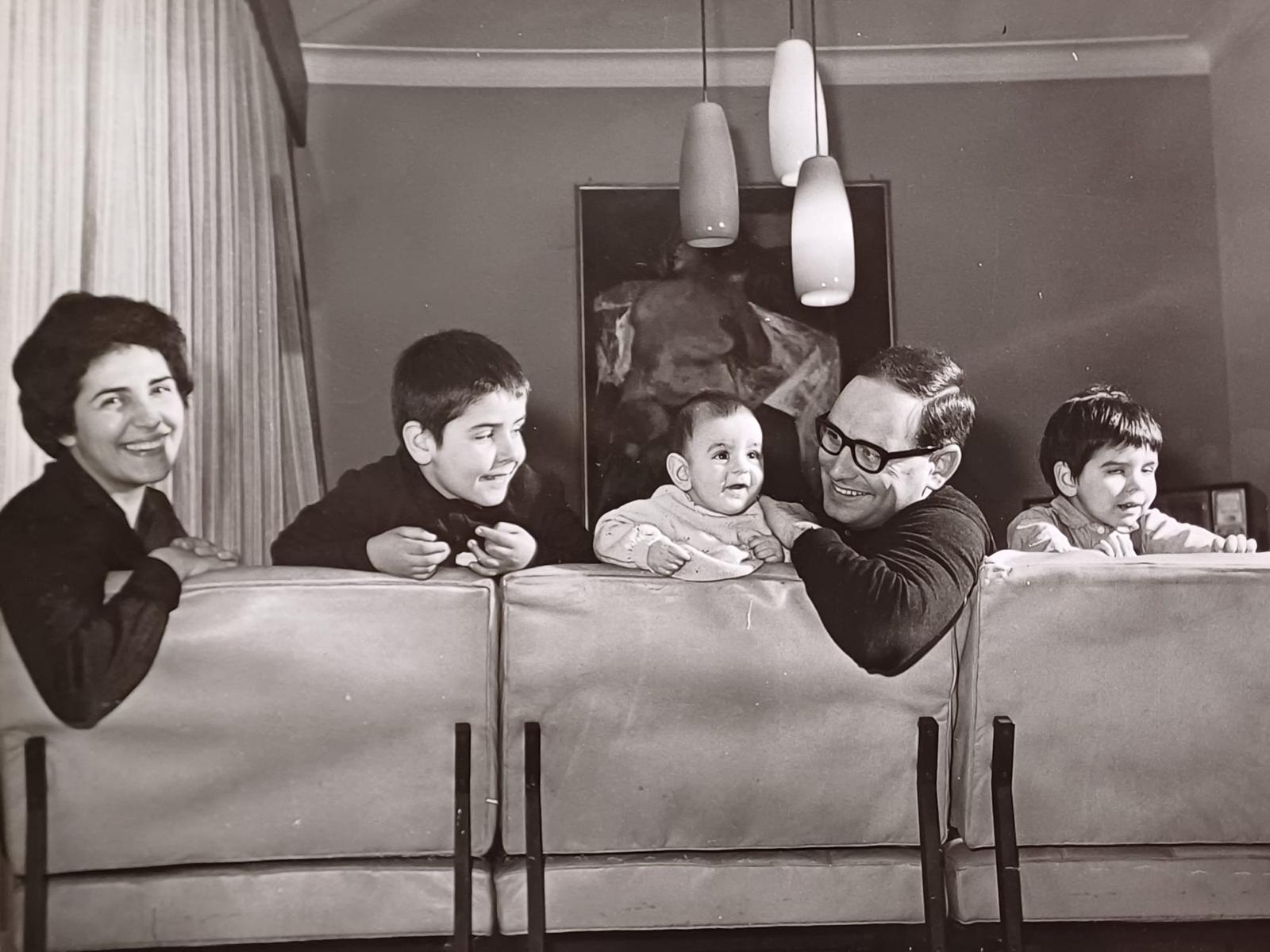
Some chords given with his left hand to approve the musical path of a teenager Andrea and the delivery of the rich bag with his own scores to seal the full trust placed in a now man Marco.
These memories are part of the memory of two brothers with a surname as important as their pride in bearing it. In the book “Ennio Morricone, the genius, the man, the father”published by Sperling & Kupfer in 2024, Marco Morricone, the eldest son, who inherited his father’s reserved and somewhat shy character, talks about life alongside the master, seasoning it with rarities of everyday life, revealing a man capable of creating masterpieces for the cinema without almost ever reading the scripts, sometimes starting from simple sounds such as ping-pong balls or free whistles in cornflake bags. A methodical and messy genius, analogical and terribly superstitious, who demonstrated a rough but sincere affection, with a penetrating ability to communicate through silences. The infinite love for his wife Maria, his compass, for whom he had been struck by love at first sight and to whom he dedicated the two Oscars. A severe champion who knew how to be very sweet.
Andrea Morricone, third child and today Maestro and conductor, however, tells his father’s life in music, through the symphonic project “He’s My Father – Morricone Morricone directs”in collaboration with his brother Marco and thePhilharmonic Orchestra of the Municipal Theater of Modena, organized by IMARTS – International Music And Arts.
Andrea is also of few words, what prevails in him is emotion as he talks about the purity of his father’s works, for which he almost struggles to find adjectives; the transport of the voice is enough to convey all the profound respect and absolute admiration.
Andrew, “He’s My Father – Morricone Morricone directs” is the first tribute that you two children create for your father Ennio
“This project was born around a table. My brother Marco, I and our respective wives were out for dinner. The idea of staging this particular format came up, synthesizing the musical part with the part narrated by Marco, with his readings, fragments of life taken from his book.
The musical part refers to the pieces composed by my father, I have chosen some of his most famous scores, entrusting them to listening as they were written, in their original version
More than a format, a real show
“A musical show with these counterpoints (using a musical term) of Marco who enters with his poetry, and the portraits of his father, accompanied by his instrument, the voice. Marco intervenes a few times, but with a timbre and contents that give the concert a truly peculiar, unique and fascinating quality. There will be a preview which will be held on 23 June in Modena; then on 25 June in Pompeii and 11 July in Villafranca. Dates to which others will soon be added.”
Ennio Morricone, not everyone knows, has also written great successes for pop music: Sapore di sale, Abbronzatissima (the Aa is his work), Il mondo, Piove (Ciao ciao babe), Se Telephone. And the latter was rearranged by her and will be played in the concert
“I rearranged “Se Telephone”, and I’m pleased to say it, but there is also a song that I dedicated to dad: “Theme for Ennio”. And above all there are Ennio Morricone’s masterpieces, which are insurmountable.
The performance is very delicate, we will have an extraordinary orchestra, made up of fifty-two musicians and another thirty people who form the choir. Almost one hundred people. The emotion and beauty that this music releases is embarrassing. The purity with which it is written. I think of the overture of “The Untouchables”, for example, or the breathtaking elegance of “Once Upon a Time in the West”.
Here, let’s talk about Sergio Leone. He and his father were classmates in elementary school. Two children who then found themselves, a few decades later, changing the history of world cinema
“Two teachers. In elementary school they weren’t great friends, they became friends later. It was my father who recognized him when Sergio Leone called him for his first collaboration in 1964. The last time they saw each other they played cops and robbers in the courtyard of the Institute “Dear“.
As my brother Marco writes in the book: “there was a lot of complicity between them. Sergio said that dad wasn’t his musician, he was his screenwriter. His music made the actors talk: with notes he was able to replace certain bad dialogues, enhancing a glance or a close-up, which was the specialty of the house. Theirs was a relationship of true friendship.”
Is there any soundtrack you are most attached to?
“They are all too beautiful, this is the answer I feel like giving. Even those chosen for the show. They were carefully evaluated one by one, to leave the audience speechless, astonished. If I really had to choose, however, I would say the Deborah theme from “Once Upon a Time in America”.
You are a composer just like your father, among other things a trumpet player like your grandfather. It has often happened that musicians, for various reasons, primarily probably to protect them, try to prevent their children from pursuing the same career as them. Did this happen to you too?
“Good question! At first he was absolutely hesitant – let’s say firmly against it! It happened that my mother took us, furtively, without saying anything to dad, to a guitar teacher. I was twelve years old and the teacher was part of his group of musicians. My mother recommended not to say anything to anyone. After a few days, the teacher was kicked out of the orchestra, and we were left, as they say, with the guitar in our hands and without ever having a teacher to learn to play it again.”
But in the end he gave up
“I played the piano and started composing very early, at eleven years old. One day he told me to play a melody. I played it shyly and he added his left hand to insert some chords. He realized that the melody I had composed worked: he didn’t say anything expressly, it wasn’t like him, but I understood that those gifted chords and that imperceptible nod of the head represented his tacit approval. A sort of good luck for the career I would have undertaken.
Later in life he was also drastic with me, especially after I acquired new techniques studied in America, which he often didn’t agree with. We found ourselves at opposite ends of the spectrum on several visions, but very close on many others.”
The comparison between two generations: you still worked together, as for “Nuovo Cinema Paradiso”
“I wrote the love theme, it is based on an autobiographical story, and I consider it the greatest privilege given to me by my father. I have a great memory, certainly a song that binds me very much to him. But there weren’t many opportunities to work together. I would always find myself working with someone invincible. And to help Andrea grow, I had to distance myself from Ennio.”
Caracalla, 2019. Her father conducts her last concert and then she goes on stage for the encore, with the symbolic passing of the baton, or the handing over of the baton, from father to son
“An extraordinary moment, combined both with the fact that he was reluctant to give up his baton, and with finding myself in front of an immense audience and an orchestra that I would soon conduct. I would have conducted a piece I had never performed before, the theme from Nuovo Cinema Paradiso. It was a truly emotional moment; I still remember it with great emotion. A performance that was successful, but which was only the beginning of many kilometers of road to travel to prove that I deserved that baton.”
Do you have children?
“Yes, I have three children and all three study music: they are all potential successors. It bodes well for continuing the tradition.”
The Morricone musical legacy seems to be safe.